

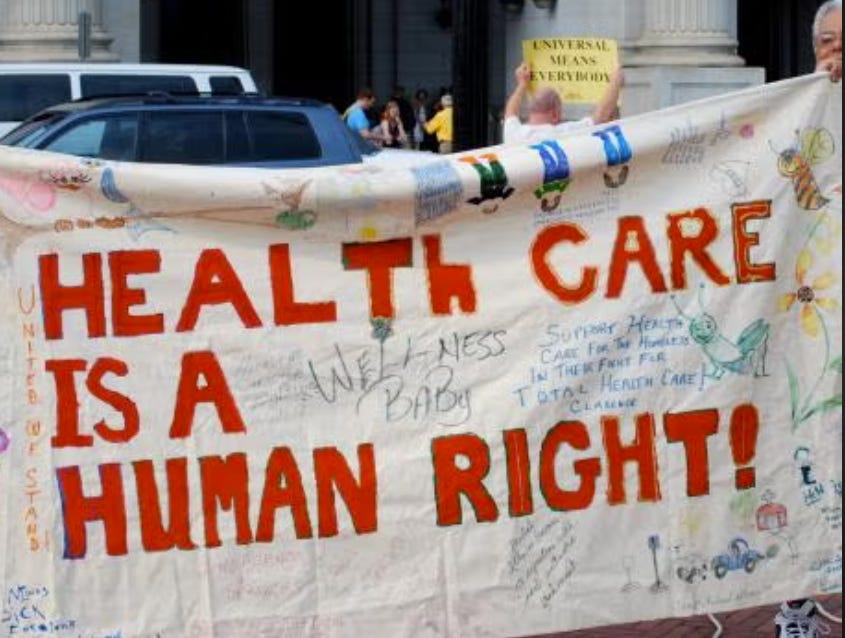
When HEALTHCARE BECOMES A WEAPON:
What Happens When the Government Controls Every Medical Decision in America?
By Barry O’Connell, Maryland Wire
There’s a question lurking underneath every Medicare‑for‑All debate, and it has nothing to do with premiums, deductibles, or whether your doctor takes your insurance. It’s a question about power — the kind of power that doesn’t care whether you’re a Democrat, a Republican, or somewhere in the exhausted middle.
It’s this:
What happens when the entire American healthcare system is controlled by whichever political coalition wins a single election?
We don’t talk about that part. We talk about cost. We talk about coverage. We talk about Canada. But we don’t talk about the fact that Medicare‑for‑All doesn’t just centralize payment — it centralizes leverage. And once you centralize leverage, you centralize the ability to coerce.
If you want to understand the stakes, imagine the federal government as the only payer in the largest healthcare market on Earth. Then imagine that the people running that government change every four years.
Now imagine what each side might do with that power.
This is where things get interesting — and dangerous.
THE RIGHT’S WISH LIST: WHAT CONSERVATIVE FACTIONS COULD RESTRICT UNDER SINGLE‑PAYER
You don’t need to guess. These are all areas where conservative lawmakers or advocacy groups have already pushed for bans, limits, or funding restrictions. Under a single‑payer system, those proposals wouldn’t just shape policy — they would shape the entire medical landscape.
1. Abortion
The most obvious flashpoint. If Medicare is the only payer and Medicare won’t pay, abortion access collapses nationwide. A funding ban becomes a functional ban.
2. Vaccines
This is where the RFK Jr. concern becomes real. If a future administration adopts anti‑vaccine positions, they don’t need to outlaw vaccines. They can simply refuse to cover them. No coverage means no market. No market means no research. The United States is too big a market to lose without consequences.
3. Birth Control
Some conservative groups argue certain contraceptives are “abortifacients.” Under single‑payer, that argument becomes a national policy lever.
4. Gender‑affirming care
Already restricted in many states. Under single‑payer, a national reimbursement ban ends access everywhere.
5. IVF and fertility treatments
A growing movement argues that unused embryos are “lives.” If Medicare won’t pay for IVF, IVF becomes a luxury for the wealthy.
6. End‑of‑life care
Some factions oppose certain forms of palliative sedation or withdrawal of life support. A reimbursement ban would reshape end‑of‑life medicine overnight.
This isn’t about whether these positions are right or wrong. It’s about the fact that a single‑payer system gives any administration the power to impose them nationally.
THE LEFT’S WISH LIST: WHAT PROGRESSIVE FACTIONS COULD RESTRICT OR MANDATE
If conservatives can weaponize a single‑payer system, so can progressives. Different issues, same power.
1. “Unscientific” or “disinformation‑based” medicine
Some progressive lawmakers have proposed restricting coverage for treatments they consider unscientific. Under single‑payer, that could include:
- Chiropractic
- Homeopathy
- Certain supplements
- “Alternative” cancer treatments
Some readers will cheer that. Others will see it as government deciding what counts as “real medicine.”
2. Mandatory vaccination for school, work, or travel
A single‑payer system could tie coverage to compliance.
No vaccine → no coverage.
No coverage → no care.
3. Gun‑related medical screening
Some Democrats want physicians to screen for gun ownership as a public‑health measure. Under single‑payer, that could become a condition of reimbursement.
4. Restrictions on crisis pregnancy centers
Some progressives argue these centers provide misleading information. A single‑payer system could cut off all funding, effectively shutting them down.
5. Limits on religious exemptions
A national payer could decide that certain religious objections to treatment are invalid for reimbursement purposes.
6. Climate‑based healthcare mandates
Some progressive groups argue hospitals should meet environmental standards to receive federal funds. Under single‑payer, that becomes a national requirement.
Again — this isn’t about whether these ideas are good or bad. It’s about the power to impose them.
THE REAL ISSUE: NOT WHO’S RIGHT, BUT WHO’S IN CHARGE
Every faction in American politics has a list of medical treatments they want to ban, restrict, or mandate.
Under the current system, no single faction can impose its entire list on the whole country.
Under Medicare‑for‑All, they could.
Not because Medicare‑for‑All is inherently dangerous, but because centralizing power always increases the stakes of political control.
Today, if one party wants to ban something, they can only ban it in the states they control.
Under single‑payer, they can ban it everywhere.
Today, if one party wants to mandate something, they can only mandate it in the states they control.
Under single‑payer, they can mandate it everywhere.
That’s the question Maryland readers need to wrestle with:
Do you trust the federal government — not just the government you like today, but the government you might hate tomorrow — to control every medical decision in the country?
Because once you hand over that power, you don’t get to take it back when the next election goes the other way.
Ask every G7 nation that has figured it out.