

Mechanics of Winning in Maryland
Why Signs, Mailers, and Media Still Shape the Battlefield More Than Any Platform Ever Will
There’s a running joke among Maryland operatives that campaigns are fought on three fronts:
the mailbox, the roadside, and the living room TV.
And depending on which county you’re standing in, one of those fronts matters a whole lot more than the others.
But behind the jokes is a real question that comes up in every cycle, in every barbershop, union hall, and Facebook group:
What actually moves votes in Maryland?
Not the platform. Not the ideology. Not the party label — we already know how that breaks.
I’m talking about the technique. The craft. The mechanics.
And the truth is, Maryland has its own political culture, its own media markets, and its own unwritten rules that shape how campaigns win.
I. The Sign Wars: Dominance, Not Persuasion
Political scientists will tell you that yard signs don’t persuade voters.
Maryland voters will tell you something different — especially in Prince George’s County, where signs aren’t just signs. They’re territorial markers, a show of force, a visual declaration that a campaign has volunteers, energy, and presence.
In PG, signs function like political plumage.
They don’t change minds, but they shape perception:
“This is the candidate with momentum.”
“This is the team that’s organized.”
“This is who everyone else is supporting.”
That perception matters in a county where slate politics, community networks, and turnout operations still drive outcomes.
But signs alone don’t win. They never have.
II. The Mailbox: Maryland’s True Battleground
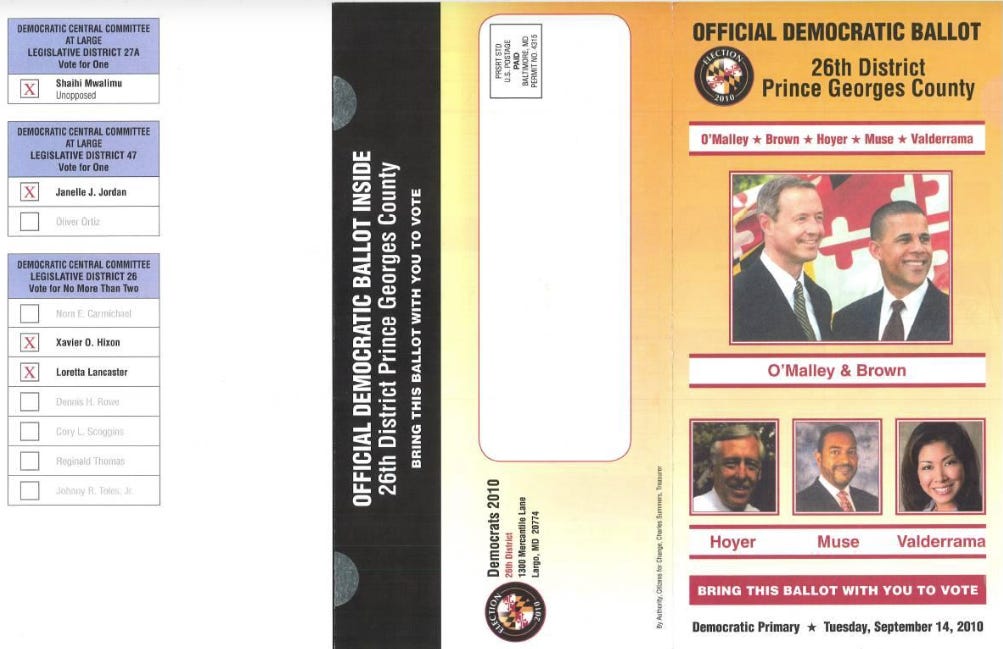
Maryland is a mail-heavy state, and the voters expect it.
Slate mailers, sample-ballot lookalikes, glossy persuasion pieces — they’re all part of the political language here.
And insiders track dominance by counting mailers.
This cycle, for example, Quincy Barabee has already sent out eight mailers, a number that caught the attention of people who watch the mechanics of these races.
That’s not an endorsement. It’s not a prediction.
It’s simply a fact about how campaigns demonstrate seriousness in Maryland:
mail equals muscle.
A candidate who’s mailing early and mailing often is signaling that they’re investing in persuasion, name recognition, and turnout — the three pillars of Maryland’s down-ballot success.
Mailers matter even more in:
- Prince George’s County
- Montgomery County
- Baltimore City and County
These are places where voters actually read their mail, where slates still shape choices, and where a well-designed piece can do more than a thousand signs ever will.
III. Television: Expensive, Brutal, and Still Effective
Maryland’s media markets are a nightmare for any campaign without deep pockets.
- DC market: expensive and spills into Virginia
- Baltimore market: cheaper but still broad
- Western Maryland: requires Hagerstown/Chambersburg
- Cecil/Harford: bleed into Philadelphia
But here’s the part political scientists agree on:
TV persuades more in down-ballot races than in top-of-ticket contests.
That means for Governor, AG, Comptroller, County Executive, State’s Attorney — TV still moves numbers.
The smartest campaigns buy surgical cable, not broadcast, to avoid wasting money on viewers who can’t vote for them.
IV. The Maryland Formula: Matching the Medium to the County
Every county has its own political culture.
The campaigns that win are the ones that respect that.
Prince George’s County
- Signs = dominance
- Mailers = persuasion
- Slates = legitimacy
- Field = turnout
Montgomery County
- Mailers + digital
- Highly educated electorate
- Signs matter less
Baltimore City & County
- Mailers + radio + field
- Radio is underrated and still powerful
Anne Arundel, Howard, Frederick
- Mixed media
- Mailers + digital + selective TV
Rural Maryland
- Signs matter more
- Field operations are essential
- Mailers work but at lower ROI
V. The Smart-People Consensus
Across all the research, all the cycles, and all the counties, the wisdom converges:
1. Signs show strength.
2. Mail persuades.
3. TV moves numbers when it counts.
4. Microtargeting works only in simple forms.
5. Testing beats intuition.
6. The medium must match the county.
Campaigns that understand this win.
Campaigns that don’t get lost in the noise.
VI. A Note on Visibility and Neutrality
This cycle has been unusually sensitive.
When one campaign circulates an analysis — whether by email, text, or social media — it can create the impression that the writer is aligned with them.
That’s not the case here.
I have friends across multiple campaigns.
I respect their work.
I’m not tied to any of them.
My job is to explain the mechanics of Maryland politics, not to pick winners.
This article is part of that work.
I remember knowing that Jessamy was in trouble when Bernstein signs were showing up in numbers in areas where Jessamy had always been strong.