

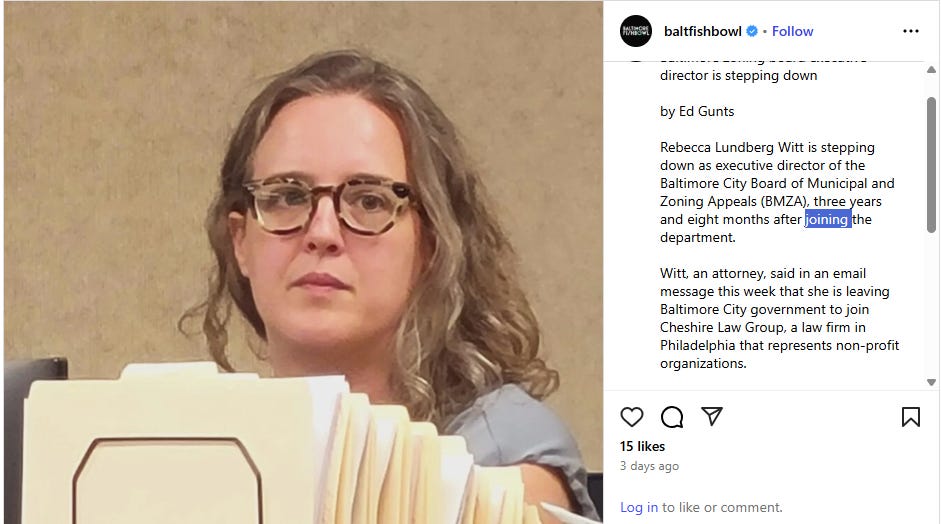
The recent resignation of Rebecca Witt, Executive Director of Baltimore’s Board of Municipal and Zoning Appeals (BMZA), has ignited a storm of controversy centered not just on zoning policy, but on the deeper tensions of equity, community identity, and political influence.
🔍 What Sparked the Conflict?
For decades, BMZA operated under a “consent docket” system—granting zoning variances en masse, often without individualized review. These variances allowed homeowners to build additions or modify properties, sidestepping the legal requirement that such changes be justified by the property’s “uniqueness.”
When Witt took charge, she ended this practice, insisting that each application be reviewed on its own merits. Her rationale: the old system was legally dubious and disproportionately benefited those with political access or legal representation.

🧑⚖️ Councilman Schleifer’s Objection
Councilman Schleifer, who represents the 5th District in Northwest Baltimor with its large Orthodox Jewish population, accused Witt of obstructing development and unfairly targeting his constituents. He claimed her enforcement of the “uniqueness” standard was discriminatory, even suggesting it had antisemitic implications.
At budget hearings, Baltimore City Councilman Isaac “Yitzy” Schleifer (D-5th) lambasted Witt, alleging her policies had cost the city “tens of millions of dollars” in development and disproportionately denied applications from his district. He threatened to zero out her budget and questioned whether her decisions were politically or culturally biased. It was a very divisive situation because many people saw Schleifer as a bully and compared what he was doing to situations in the Middle East. But that is not fair, he is certainly a better man then his Pikesville neighbor Izzy Patoka.
🏘️ What’s at Stake?
At the heart of the dispute is a question of zoning equity:
- Schleifer’s constituents often seek to expand homes to accommodate large families and religious practices.
- Witt’s policy applied the same legal standard citywide, which led to denials in districts where homes especially rowhouses aren’t easily classified as “unique.”
Some critics allege that Schleifer’s push for zoning flexibility is part of a broader effort to attract Orthodox Jewish families from New York and New Jersey. These families often invest in larger homes and contribute significantly to the tax base. From a fiscal standpoint, that’s a win. But from a governance perspective, the question becomes: Should zoning laws flex to accommodate cultural needs, or remain rigidly neutral?
⚖️ A Delicate Balance
This isn’t a story about liking or disliking any group. It’s about how cities navigate the tension between uniform law and community-specific needs. Witt’s approach emphasized legal consistency. Schleifer’s approach emphasizes constituent accommodation.
The Fallout:
Witt’s departure and the public scrutiny—raises broader questions:
- How should Baltimore balance equity with flexibility?
- What role should cultural identity play in zoning decisions?
- And who gets to decide what “uniqueness” really means?
Related Articles
Kiryan Joel
https://themarylandwire.substack.com/publish/post/170729019