

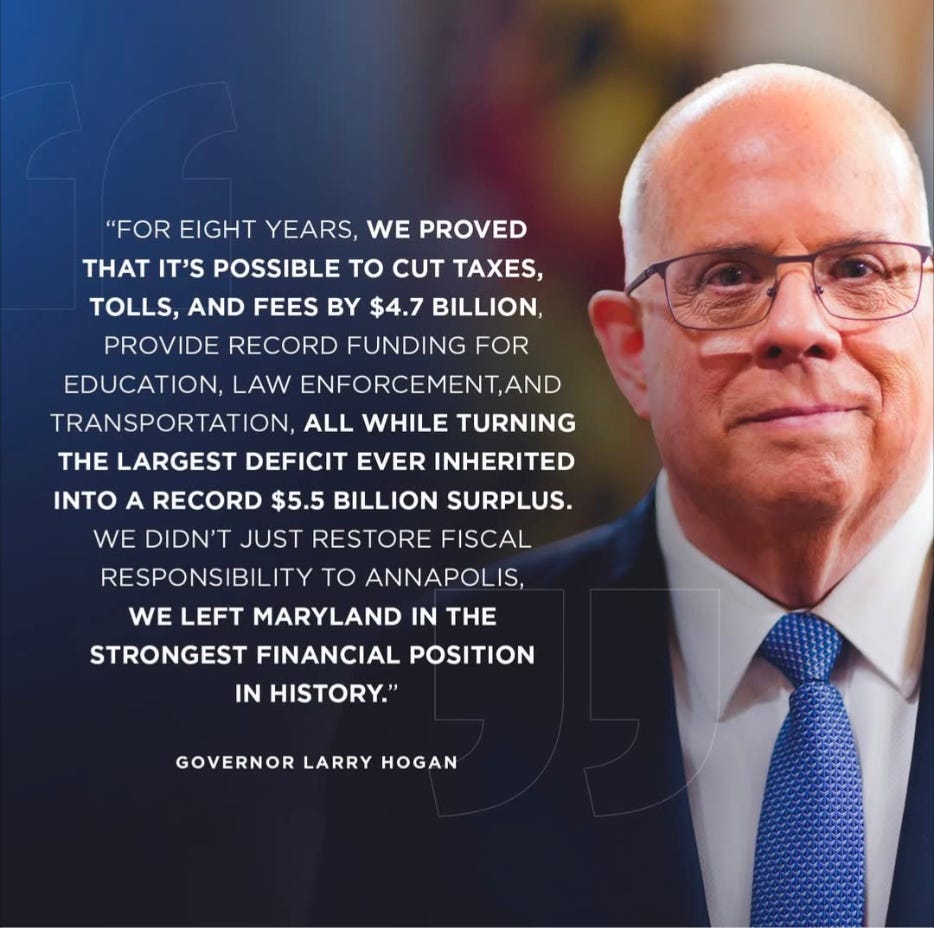
🧾 Claim: “We cut taxes, tolls, and fees by $4.7 billion…”
- Reality Check: While Hogan did reduce tolls and some fees, many of the tax cuts disproportionately benefited corporations and wealthier Marylanders. These cuts also reduced long-term revenue and contributed to underfunding critical services like education, public health, and transit.
- Impact: The Maryland Center on Economic Policy and other analysts warned that these cuts created a “sugar-high” effect—short-term savings that masked deeper structural deficits. (A sugar-high similar to eating two dozen donats for breaffast.)
🧾 Claim: “Record funding for education, law enforcement, and transportation…”
- Reality Check: Hogan vetoed the Blueprint for Maryland’s Future, a landmark education reform plan, calling it fiscally irresponsible. The legislature overrode his veto, but he never provided a sustainable funding mechanism.
- Transportation: He canceled the Red Line in Baltimore, forfeiting $900 million in federal funding and redirecting $736 million to road projects in predominantly white, suburban areas. This decision was widely condemned as racially discriminatory and economically regressive.
🧾 Claim: “Turned the largest deficit ever inherited into a record $5.5 billion surplus…”
- Reality Check: Much of that surplus was fueled by federal COVID relief funds, not structural fiscal reform. Hogan’s administration used one-time federal aid to plug budget holes, which created ongoing obligations without sustainable revenue.
- Governor Moore’s team inherited this “fortunate financial position,” but also a $3 billion structural deficit due to Hogan’s spending choices and economic stagnation.
🧾 Claim: “Strongest financial position in history…”
- Reality Check: Maryland’s economy grew only 1.6% between 2016 and early 2023, compared to 13.9% nationally. Hogan’s policies failed to stimulate meaningful growth, and Maryland lagged behind peer states in job creation and GDP expansion.

Sometimes one donut is not enough
🧾 Additional Context: Real Estate & Ethics
- Hogan’s real estate firm, HOGAN, benefited from state infrastructure projects. Nearly 40% of affordable housing awards went to developers listed as clients of his firm.
- He canceled the Red Line, then funded highway expansions near properties tied to his business interests.
- Ethics experts have called this a serious conflict of interest, and watchdogs have demanded investigations.
🧾 Political Motivation?
- Hogan’s statement was released amid speculation that he may run against Governor Moore in 2026.
- Polls show Moore currently leads Hogan by double digits, but Hogan’s messaging seems aimed at rebranding his legacy and deflecting blame for the fiscal crisis Moore is now managing.
🔍 SOURCES FOR CLAIMS
1. Maryland Center on Economic Policy’s critiques of Hogan’s tax cuts suggest they disproportionately benefited higher earners while weakening long-term revenue. See their April 2021 policy report on fiscal equity.
2. Hogan’s veto of the Blueprint for Maryland’s Future is documented in The Baltimore Sun, March 2020. The legislature overrode his veto to preserve landmark education reform.
3. Hogan’s cancellation of Baltimore’s Red Line and diversion of funds to highway projects is detailed in the NAACP Legal Defense Fund's 2016 civil rights complaint and The Washington Post, July 2015.
4. The $5.5 billion surplus cited by Hogan was bolstered primarily by federal COVID-19 aid and one-time revenues. Analysts from the Maryland Budget and Tax Policy Institute confirmed this in their fiscal briefings to the legislature in late 2022.
5. Maryland’s structural deficit after Hogan’s tenure was estimated at $3 billion by the Department of Legislative Services in its 2023 session budget overview. Governor Moore acknowledged this in public remarks from January 2023.
6. Comparative GDP data can be found via the U.S. Bureau of Economic Analysis. Maryland’s economy grew 1.6% between 2016 and 2023, compared to 13.9% nationwide—BEA Regional Reports (Q1 2023).
7. Real estate connections involving Hogan’s firm, HOGAN Companies, are outlined in The Intercept, October 2022. The article includes a breakdown of affordable housing awards and the proximity of state-funded projects to properties linked to the firm.
8. Polling data on Hogan vs. Moore is available from Goucher College Poll (Fall 2024), showing Moore ahead by 12 points among likely voters.