

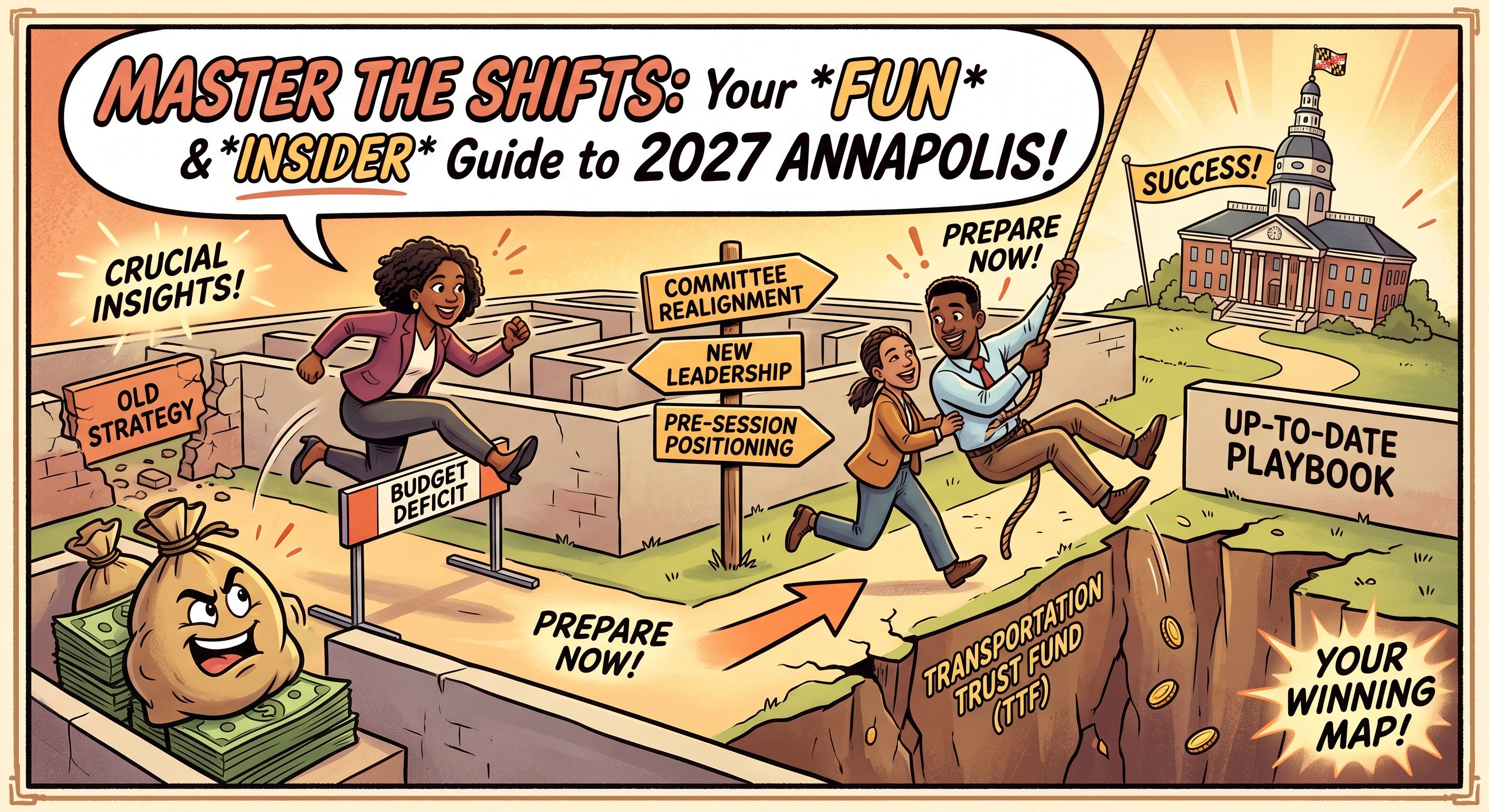
Most 2027 Maryland legislative strategies are already out of date—and pre-file season hasn’t even hit full swing.
If your government relations team is relying on the same 90-day playback from last session, you’re missing three major structural shifts happening across Annapolis right now.
With multi-billion-dollar structural deficits looming over the General Fund, severe capital constraints inside the Transportation Trust Fund (TTF), and sweeping committee realignments—including key retirements like Delegate Bonnie Cullison—the 2027 session will be won or lost before January.
Here are the 3 structural shifts every Maryland advocacy team needs to map out before November…
READ THE FULL STRATEGY BREAKDOWN]
1. The Fiscal Squeeze: From Legislative Mandates to Regulatory Defense
The era of broad, big-budget policy mandates is officially over in Annapolis. As fiscal analysts track structural budget shortfalls exceeding $1.5 billion annually, lawmakers will no longer have the appetite to fund expansive new legislative programs. Every bill carrying a General Fund price tag will face extreme friction from the Department of Legislative Services (DLS) and fiscal subcommittees.
The GR Impact: Traditional “pass a bill to fund a problem” strategies will stall out or get killed in committee. Moreover, capital projects reliant on the Transportation Trust Fund (TTF) face immense pressure as state leaders prioritize system preservation over expansion.
The Strategic Shift: High-performing advocacy teams are pivoting to administrative and regulatory channels. Instead of asking for new statutory mandates, focus on agency rulemaking, COMAR updates, and executive implementation of existing laws (e.g., climate compliance under the Climate Solutions Now Act, data privacy guidelines, or health agency scope-of-practice regulations). Achieving industry certainty through executive policy avoids the fiscal-note landmine entirely.
2. Pre-Session Coalition Building & The November Ballot Ripple Effect
Waiting until Opening Day to build legislative consensus is a fast track to getting held for “further study.” Critical statewide ballot measures on the November ballot—ranging from constitutional amendments to local referendums—are shifting stakeholder priorities early.
The GR Impact: Powerhouse trade associations, labor unions, and municipal coalitions (like MACo and MML) are locking in their legislative agendas and policy pacts months earlier than usual. If your team attempts to introduce complex or controversial language without pre-session consensus, opponents will easily freeze your bill in subcommittee.
The Strategic Shift: Late summer and early autumn must be used for proactive, pre-session stakeholder briefings. If your bill touches public-private partnerships, local tax authority, or county-level implementation, negotiate consensus language now. When legislators see a pre-filed bill backed by a pre-assembled coalition of county leaders and industry partners, the pathway through committee accelerates exponentially.
3. Committee Mechanics & The Post-Retirement Roster Realignment
Bill survival in Annapolis isn’t governed by party margins; it’s governed by committee room mechanics. As key committee rosters realign heading into the 2027 cycle—marked by notable departures like Delegate Bonnie Cullison and subsequent subcommittee realignments across the seven House standing committees—the gatekeepers are changing.
The GR Impact: A bill that easily cleared a subcommittee two years ago may face a completely different set of priorities, line-item scrutiny, or leadership philosophy in 2027. Cross-file dynamics between Senate Finance / Budget & Taxation and House Economic Matters / Ways & Means are shifting as intermediate-tenure lawmakers assume key subcommittee leadership roles.
The Strategic Shift: Re-map your committee intelligence. Do not rely on legacy relationships. Analyze which delegates and senators are taking on elevated roles in budget reconciliation and subcommittee drafting. Knowing who controls the voting workgroups—and what their specific district or policy drivers are—is the single most critical factor in moving a bill out of the hopper.
The Pre-Session Checklist for Advocacy Leaders
Audit Your Fiscal Notes: Can your priority legislation survive an austere budget environment without touching the General Fund?
Pivot to Executive & Regulatory Action: Can your policy objective be achieved through COMAR adjustments or agency guidance rather than statutory changes?
Map Subcommittee Leadership: Have you identified and briefed the newly elevated subcommittee chairs across key standing committees?