

🏛️ Wired Maryland
Monday Edition | Statehouse Intelligence & Leadership Profile
Monday, October 26, 2026
1. Federal Wins & VC Rebound Drive Howard County Cyber Surge
Data reveals that Howard County captured nearly 50% of Maryland’s total obligated federal cybersecurity award funding in fiscal year 2026. Coupled with a local venture capital turnaround that saw area startups land nearly $50 million across four major deals, the county’s software and defense density continues to insulate the region against broader federal employment contractions.
Read the full analysis on Technical.ly.
2. Major Shakeup in Maryland Terrapins Athletics
The University of Maryland has parted ways with head football coach Mike Locksley mid-season following a 2-5 start and a 13-game losing streak against power-conference opponents. Athletic Director Damon Evans announced the decision during the team’s open week, placing co-defensive coordinator Aazaar Abdul-Rahim in charge as interim head coach while the university launches its search for new leadership.
Read the breakdown on Sports Illustrated / CFB HQ.
3. State Releases Maryland Business AI Benchmark
Governor Wes Moore convened the Maryland Innovation Summit and released the Maryland Business AI Benchmark. While 91% of surveyed Maryland employers report using AI tools, 58% remain in early stages of basic adoption. In response, business leaders are asking the state for expanded small-business funding, technical training programs, and secure computing infrastructure.
Read the official announcement on the Office of Governor Wes Moore or download the full survey results from the Maryland Department of Commerce / Innovation.
4. State Policy Impact: Data Center Guardrails & AI Governance
Maryland state officials are finalizing regulatory frameworks to address digital infrastructure and consumer protection. The state’s ongoing data center initiatives continue to weigh grid capacity against tech expansion, while a new statewide AI framework introduces privacy, workplace monitoring, and algorithmic bias compliance guidelines.
Read details on the state AI regulatory rollout via The CommLaw Group.
5. Riverlane Establishes U.S. HQ in Discovery District
Quantum error-correction leader Riverlane officially established its U.S. headquarters at the Discovery District in College Park, Maryland. The move builds on the state’s Capital of Quantum initiative, which has already helped attract over $500 million in public, federal, and private investments toward establishing Maryland as a global quantum computing epicenter.
Read the press release via Business Wire / Riverlane.
💡 Have an intelligence tip, contract filing, or statehouse move to report?
Direct email to
barry@themarylandwire.comor reach Barry directly via text or phone at 570-447-4395 (text preferred for fastest response; voice calls returned as available).
Maryland’s tech, innovation, and policy landscape for Monday, October 26, 2026:
1. Quantum & Tech Ecosystem Growth
Riverlane U.S. HQ Expansion: Building on Maryland’s growing status as a quantum hub (anchored by the State’s Quantum Outreach initiative, which has catalyzed over $500 million in public-private investment), quantum error-correction leader Riverlane recently established its official U.S. headquarters at the Discovery District.
2. Infrastructure & Energy Policy
Data Center Task Force Focus: Governor Wes Moore’s recently signed executive order establishing a dedicated data center advisory task force remains a primary focal point for state tech and energy stakeholders. The group is tasked with balancing Maryland’s surging demand for digital infrastructure, job creation, and high-tech economic growth against grid capacity and environmental stewardship.
3. Life Sciences & Innovation
Maryland Tech Council Updates: The MTC continues to drive momentum across the region’s life sciences and tech corridors, focusing on positioning Maryland as a top-tier national innovation economy heading into the final stretch of 2026.
Via The Maryland Wire: When DBM signals caution, procurement shifts to task orders
Barry’s latest Maryland Wire piece, published October 25, is a procurement watch item for anyone with agency work in the pipeline: when the Department of Budget and Management signals fiscal caution through tighter revenue re-estimates, state agencies pivot away from launching brand-new multi-million-dollar capital solicitations and instead double down on master agreement task orders, Indefinite Delivery/Indefinite Quantity (IDIQ) extensions, and Job Order Contracting (JOC) task orders. For lobbyists and contractors, the read is practical rather than theoretical — the question for the first quarter is less what new money is coming than how existing vehicles get used while revenue forecasts tighten.
Source: The Maryland Wire
Early voting’s Sunday crowd: division and Question 3 on voters’ minds in Perry Hall
More than 16,000 Marylanders had voted early by 1 p.m. Sunday, October 25, according to State Administrator of Elections Jared DeMarinis, as voters at Perry Hall’s Honeygo Community Center talked about political division and the redistricting ballot question. Manuel Mastromanolis, voting in Perry Hall, said he was troubled by growing division and by the role of political contributions and poor communication in the system, while Michael Casserly said district boundaries should not be drawn to advantage one political party over another. In-person early voting runs through Thursday, October 29, 7 a.m. to 8 p.m. daily, ahead of Election Day on Tuesday, November 3 — and mail-in ballot requests by mail or fax must be received by Tuesday, October 27.
Source: Baltimore Focal
Alsobrooks calls Prince George’s grant reports ‘deeply disturbing’ as auditor vote arrives
Senator Angela Alsobrooks, the former Prince George’s County executive, said Friday on WAMU’s Politics Hour that reports about the Prince George’s County Council’s grant funding are ‘deeply disturbing,’ adding: ‘We deserve answers. And I think that, if what has been reported is true, people ought to be held accountable.’ Alsobrooks echoed calls for an investigation into funding for Community on the Frontline — run by Janna Parker, a close friend of Council Chair Krystal Oriadha — and its Beverly Hills fiscal sponsor, the Edward Charles Foundation, after County Executive Aisha Braveboy announced the return of $7.635 million and sought the rest of roughly $12.8 million awarded from 2024 through 2026. Council members Jolene Ivey and Sydney Harrison have called for independent audits of Community on the Frontline and of Joan’s House, tied to Council Member Edward Burroughs. Watch today: the council is expected to appoint Marcel Emerson as its new auditor, putting him at the helm of the Office of Audits and Investigations in the middle of its own grants review.
Source: Baltimore Banner
Baltimore County Council votes itself a 73.6% raise — Republicans Mangione and Marks dissent
Baltimore County Council members elected in November will earn $119,750 a year, up from $69,000 — a 73.6% increase — under a pay plan approved last week as the council grows from seven members to nine and moves to full-time compensation. Council Chair Mike Ertel’s measure passed 4-2, with Democrats Julian Jones, Izzy Patoka and Pat Young joining Ertel in favor; Republicans Nino Mangione and David Marks voted no, and Republican Todd Crandell was absent. Mangione argued the expanded council means fewer constituents per member and pointed to public safety and infrastructure needs, while Patoka cited the workload of quick constituent replies by email, text and social media. The chair’s pay rises from $77,000 to $129,750, and a companion measure lifts the county executive’s salary from $192,000 to $240,000 for the term beginning in December 2026; the county auditor put the added annual cost at $458,750.
Source: Baltimore Focal
Montgomery County’s Kate Stewart wins unanimous vote on scam-protection law
The Montgomery County Council unanimously passed the Financial Exploitation Protection Act this week, aimed at scammers targeting older and vulnerable residents. Sponsor Kate Stewart said ‘financial scams are on the rise, and older residents are afraid to pick up a call or open an email to avoid being a victim,’ after a statewide investigation in February found Marylanders had lost more than $6 million to call-center schemes using bank and wire transfers, cryptocurrency exchanges or gold bars. The law bars using deception, intimidation or undue influence to obtain money, property or services from someone at least 68 years old or a vulnerable adult, and empowers the county Office of Consumer Protection, led by Director Eric Friedman, to run a voluntary mediation program to help victims recover losses. SEEC, which supports adults with disabilities, backed the bill; its CEO, Karen Lee, said people with intellectual and developmental disabilities are more likely to fall victim to financial abuse.
Source: Baltimore Banner
Moore closes $23 million for 77 more veterans’ homes at Perry Point
Governor Wes Moore announced October 23 that the Maryland Department of Housing and Community Development has closed financing for the second phase of HELP Perry Point Veterans Village in Perryville, administering more than $23 million to add 77 permanent supportive homes for at-risk and formerly homeless veterans and their families on the campus of the Perry Point VA Medical Center — functionally doubling the village’s capacity. The funding, administered through the department’s Community Development Administration, combines federal Low Income Housing Tax Credit equity, HOME Investment Partnerships American Rescue Plan money and bond financing, with additional funds for energy efficiency in a community supported primarily by solar power. ‘To honor their sacrifice and their service, Maryland’s veterans deserve the highest level of care and support, and that includes a roof over their head,’ Moore said.
Source: Maryland Department of Housing and Community Development
Moore’s lawyers move against a ‘Vote Yes for Wes’ PAC ad that urges a no on Question 3
An attorney for Governor Wes Moore, David Mitrani of Sandler Reiff, sent a cease-and-desist letter to Truth for Maryland PAC over an ad and website urging a ‘yes’ vote for Moore while telling voters to vote against Question 3, the redistricting ballot question Moore supports. The letter says the PAC was not authorized to use Moore’s name, likeness, photos, logos or campaign designs, argues the ad is meant to make voters think Moore opposes the measure, and says it appears to violate Maryland’s new election misinformation law; Moore’s lawyers said they referred the matter to state election officials and demanded a takedown by Thursday, October 22. PAC chair Andrew Brightwell called the letter a ‘weaponization of the legal system’ and said the group would continue its campaign; no later outcome had been reported as of the October 26 week-in-review roundup, so watch for a complaint, a PAC response or a court filing this week.
Source: Maryland Bay News (summarizing the Baltimore Banner)
UMD Athletics agrees to First Amendment training after police confronted student journalists
The University of Maryland Athletics Department has agreed to receive First Amendment training from the Foundation for Individual Rights and Expression after two student journalists were confronted by campus police while reporting on head football coach Michael Locksley’s departure. Nolan Rogalski and Jude Wilkenfeld, editors with the student-run Testudo Times, said they were standing outside Jones-Hill House trying to interview players when a staff member photographed them, police arrived on a ‘suspicious activity’ report, took their student ID numbers and encouraged them to leave; campus police and Athletics said no report was taken and cited heightened safety concerns around the football program. Foundation program manager and counsel Marie McMullan said its Student Press Freedom Initiative team is ‘eager to work with UMD Athletics to ensure all staffers understand the rights of student journalists and the First Amendment principles at play on public university and college campuses.’
Source: Baltimore Banner
Chronic absenteeism falls to 22.8% — but school board candidates say barriers remain
Maryland’s chronic absenteeism rate fell to 22.8% in 2025-26, down from its 30.9% pandemic peak in 2021-22, State Superintendent Carey M. Wright said — yet school board candidates across the state say transportation, housing instability and other hardships still keep students out of class. Kent County candidate Zeke Falcon said missed school means lost instruction and weaker connections with teachers and peers, Baltimore City candidate Kwame Jamal Kenyatta-Bey called attendance ‘a gateway to every other educational outcome,’ and Montgomery County candidate Brenda Diaz called it one of the county’s ‘quiet academic crises.’ The burden is uneven: county figures for 2024-25 put Baltimore City highest at 46.4% and Frederick County lowest at 16.7%, and the state still sits above its pre-pandemic level — a number that matters beyond the classroom, since Blueprint funding releases turn in part on progress toward the 15% target.
Source: Capital News Service
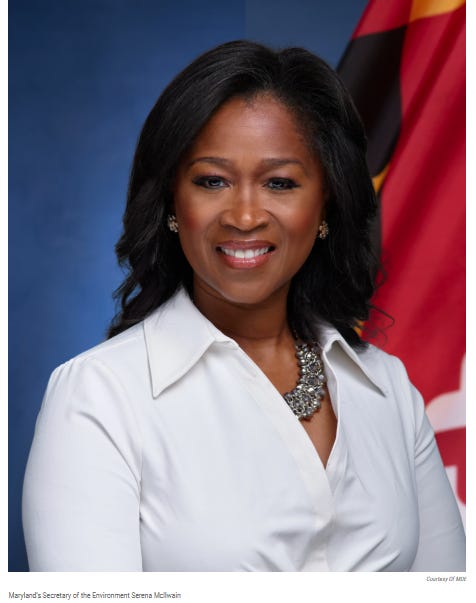
Serena McIlwain serves as the 11th Secretary of the Maryland Department of the Environment (MDE), appointed by Governor Wes Moore and confirmed in March 2023.
Early Life & Education
Born in Alexandria, Virginia, McIlwain holds a solid educational foundation focused on business, administration, and public policy:
Bachelor of Arts in Business Administration: Strayer University
Master of Science in Administration & International Studies: Central Michigan University
Master of Public Administration: George Mason University (Schar School of Policy and Government)
Career Overview
McIlwain began her career in public service at age 19 with the National Institutes of Health. Over the past three decades, she has held high-level executive leadership roles across federal and state agencies:
Federal Experience: Served as Director at the Architect of the Capitol, Chief Human Capital Officer and Deputy Assistant Secretary at the U.S. Department of Energy, and Chief Performance Improvement Officer at the U.S. Environmental Protection Agency (EPA).
State Operations: Served as Undersecretary and Chief Operating Officer for the California Environmental Protection Agency (CalEPA).
Academic Involvement: Teaches sustainability strategy at American University’s Kogod School of Business.
Distinction in Maryland
McIlwain is distinguished as the first Black cabinet member to serve as Secretary of the Environment in Maryland’s history, as well as the third woman confirmed to the position. She chairs the Governor’s Subcabinet on Climate and leads state efforts to address environmental justice, streamline regulatory permitting, protect the Chesapeake Bay, and enforce the state’s climate action mandates.