

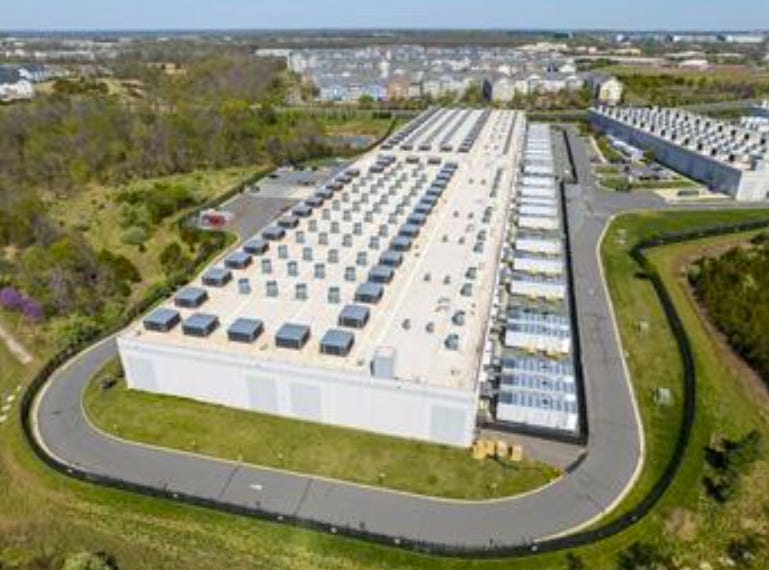
A question about Data Centers and Frederick County
Barry, do you care to comment how Frederick County became Ground Zero, and the remarkable purses those county officials gained for their red carpet? I’d like your permission to copy and paste this widely in our local information outlets.
I don’t mind questions and you are welcome to share my articles with attribution. Barry O’Connell
1. Why Frederick County became “ground zero” for data centers
Frederick sits at the intersection of three critical pieces of infrastructure that make data centers cheap, fast, and low‑risk to build.
A. Power transmission corridors — the big one
Frederick County is crossed by multiple high‑capacity transmission lines that move electricity from Pennsylvania south toward Northern Virginia. These include lines tied into the PJM grid that historically carried power from the Three Mile Island region and other Pennsylvania generation assets.
Data centers need:
- enormous, stable power
- redundancy
- proximity to transmission, not just distribution
Frederick has that in spades.
Montgomery County does not.
Howard County does not.
Prince George’s has some, but not at Frederick’s scale.
B. Fiber trunk lines and long‑haul routes
Frederick sits on top of major east‑coast fiber backbones — the same long‑haul routes that feed Northern Virginia’s data center ecosystem.
This means:
- low latency
- cheap interconnection
- no need to trench new long‑haul fiber
That alone saves developers millions.
C. Geography + zoning + land availability
Frederick has:
- large parcels
- industrially zoned land
- fewer environmental constraints than Montgomery or Howard
- a political culture historically friendlier to industrial development
When you combine power + fiber + land, you get a bullseye.
This is why Frederick was always going to be a target — even before Quantum Loophole showed up.
2. Why the money started flowing
You can say this plainly without accusing anyone of wrongdoing:
A. Data center developers spend aggressively everywhere
This is not unique to Frederick.
Northern Virginia, Ohio, Georgia, Texas — same pattern.
Developers spend on:
- lobbyists
- consultants
- land‑use attorneys
- community groups
- campaign contributions (legal, disclosed)
- “economic development partnerships”
It’s a high‑stakes industry.
A single campus can be a $1–$5 billion investment.
So yes — the money flows.
B. Frederick’s political structure made it easier
Frederick County has:
- a small number of key decision‑makers
- a county executive model
- a planning commission with outsized influence
- a history of development‑friendly politics
This creates a situation where a handful of officials can greenlight enormous projects.
Developers love that.
C. The “red carpet” effect
Once one major player (Quantum Loophole) got traction, others followed.
That’s how these ecosystems form.
And yes — the purses, donations, consulting contracts, and political attention tend to follow the investment. That’s not an accusation; it’s simply how the industry operates nationwide.
Barry - The main reason for the initial site getting rezoned is that the county had an old Alcoa site that was not paying taxes. Jan Gardener jumped in with both feet and only thought of the tax money that would roll in. Ok, it was early days. What followed was a majority county council seduced by greedy land speculators and builders. Frederick is NOT in a great electric power position. We are in a drought. The Potomac River may not have the capcity to give the additional data centers what they require. Greed and Ignorance made Frederick Ground Zero.
And don’t forget! The corridor has no land and disinvested in 18 counties. Forever. What do we have? Land.
Here’s the plan:
Western, eastern shore, southern Maryland form a power block. Create a public-private regional economic development governance model that sits adjacent to the Commerce Department—not under Commerce.
With the state now at nearly 100% broadband build out, the “rural” poverty narrative is a 20th century construct that no longer fits modern economic realities. .
It’s distributed economies, baby.