

Why Maryland Republicans Lose Statewide — Even When They Win Locally
A Maryland Wire Long‑Form Analysis
By Barry O’Connell
Maryland Republicans ask the same question every election cycle:
Why can’t the GOP win statewide?
It’s not a rhetorical question. It’s not a partisan one. And it’s not a mystery that requires guesswork. Maryland’s political history offers a clear, consistent pattern — one that repeats itself across presidential elections, gubernatorial primaries, and legislative maps.
The short version is simple:
Maryland will elect Republicans. It just won’t elect every kind of Republican.
The long version — the one that explains why — requires looking at what the state has actually done, not what anyone wishes it would do.
I. Maryland Has Elected Republicans More Often Than the Registration Numbers Predict
Start with the basic math.
Maryland is a state where Democrats hold a large registration advantage. Yet since 2002, Republicans have won the governor’s office three times:
- Bob Ehrlich (2002)
- Larry Hogan (2014, 2018)
Three GOP gubernatorial terms in the first quarter of the 21st century is not a sign of a state that “never supports Republicans.” It’s the opposite. It shows that Maryland voters will cross party lines when the candidate fits the state’s temperament.
This is not theory. It’s certified election history.
II. Maryland Has Rejected Trump‑Aligned Candidates Every Time They Appeared on the Ballot
The same voters who supported Ehrlich and Hogan also delivered decisive statewide losses to Donald Trump in every presidential election where he appeared on the ballot.
This is not a value judgment. It is a matter of public record.
The pattern continued in 2022, when Dan Cox, running on a Trump‑aligned platform, lost the governor’s race to Wes Moore by 32 points. Cox’s message aligned with national MAGA politics; Maryland voters did not buy what he was selling.
Again — not an opinion. A certified result.
III. The 2022 Republican Primary: A Case Study in the Party’s Internal Conflict
If you want to understand why Maryland Republicans struggle statewide, the 2022 GOP primary is the clearest example.
Dan Cox defeated Kelly Schulz, a two‑time cabinet secretary under Governor Hogan and a candidate widely viewed by Republican strategists as capable of competing in a general election. Schulz represented the Hogan lane — moderate, managerial, non‑culture‑war, and historically viable in Maryland.
But the primary electorate rejected her.
Inside the party, Schulz and Republicans like her are often labeled “RINOs” — Republicans in Name Only — by the MAGA faction. The message is unmistakable:
> If you are not aligned with national culture‑war politics, you are not “Republican enough” to win a primary.
That internal definition of “Republican enough” may win primaries.
It does not win general elections in Maryland.
This is not commentary. It is the observable outcome of the 2022 cycle.
IV. The Legislative Map: Where Republicans Win, and Why
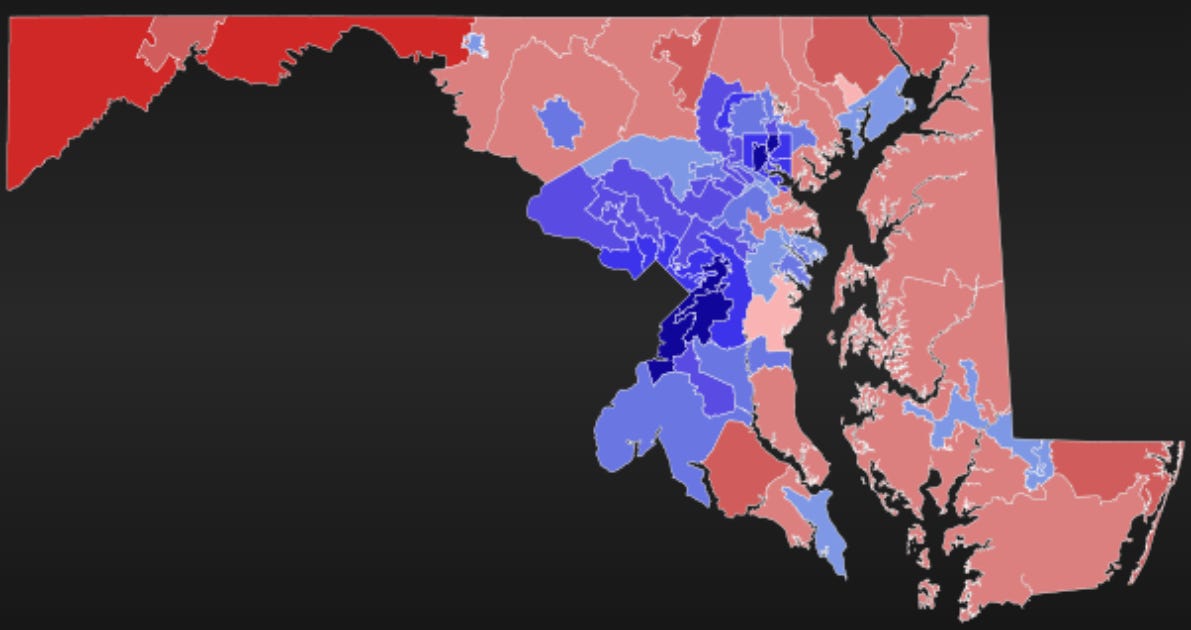
If you overlay Maryland’s legislative map with presidential results, the correlation is nearly perfect.
Where Trump won, Republicans hold legislative seats:
- Western Maryland (Garrett, Allegany, Washington)
- Most of the Eastern Shore (Cecil through Somerset)
These areas consistently elect Republican delegates and senators. They are culturally aligned with the national GOP, and the party performs well there.
Where Biden or Harris won, Democrats hold legislative seats:
- Montgomery
- Prince George’s
- Baltimore City
- Howard
- Charles
- Anne Arundel (increasingly)
- Baltimore County (majority)
These counties contain the population centers. They decide statewide elections.
The exception that proves the rule: Wicomico County
Wicomico is the only Eastern Shore county with Democratic legislative representation, concentrated around Salisbury. Demographic shifts suggest that representation may expand.
But outside that pocket, the Shore is solidly Republican — and solidly aligned with the same presidential voting patterns.
The conclusion is straightforward:
> Maryland’s legislative map reflects its presidential map.
> Republicans dominate where Republicans live.
> Democrats dominate where Democrats live.
> Statewide elections are decided by population density, not geography.
V. The Candidate Who “Could Win” — But Can’t Win the Primary
Republican strategists often point to Senator Steve Hershey of the Upper Shore as an example of a candidate who could be competitive statewide. His district spans parts of Cecil County and the mid‑Shore — areas where Republicans perform strongly.
Strategists argue that Hershey could appeal to moderates and independents in a general election. But they also note the structural problem:
> To win a Maryland Republican primary, a candidate must often move so far to the MAGA right that they become non‑viable in a general election.
This is not a personal critique of any candidate. It is a description of the strategic dilemma Republican operatives themselves identify.
The primary electorate demands one kind of Republican.
The general electorate rewards another.
That gap is where statewide GOP campaigns go to die.
VI. The Cannibalism Problem: When a Party Eats Its Own
Across multiple cycles, the Maryland GOP has shown a pattern:
- Moderates are attacked as insufficiently Republican.
- Candidates aligned with Hogan are dismissed as “RINOs.”
- The party’s internal factions fight harder against each other than against Democrats.
Republican strategists describe this dynamic as inflexibility and cannibalism — a party that “eats its own” before the general election even begins.
The result is predictable:
- Candidates who could win statewide cannot win primaries.
- Candidates who win primaries cannot win statewide.
This is not ideological commentary. It is the structural reality reflected in election outcomes.
VII. The Answer to the Question: Why Don’t Republicans Win Statewide?
Maryland does not reject Republicans.
Maryland rejects a specific kind of Republican — the kind that wins Republican primaries.
The state has shown repeatedly that it will elect Republicans who:
- avoid national culture‑war politics,
- appeal to suburban moderates,
- present as competent managers,
- and distance themselves from polarizing national figures.
It has also shown that it will not elect Republicans who:
- run on Trump‑aligned platforms,
- attack moderates within their own party,
- or define Republican identity through ideological purity tests.
This is not a matter of opinion.
It is the story told by every statewide election since 2002.
VIII. The Final Takeaway
If Maryland Republicans want to win statewide again, the path is not theoretical. It is not mysterious. It is not hidden.
It is the path that has already worked — three times.
But to walk that path, the party must first resolve the conflict between the candidates who can win primaries and the candidates who can win general elections.
Until that happens, the pattern will continue.
Marylander from Howard County. I like Maryland. I pay high taxes to live here. As long as republicans run on cutting taxes to the bone and eliminating services to those who need them, I will not vote for them. The Republican party is no longer just fiscally conservative. The brand is forever damaged. Any viable candidate must denounce the things for which the Republican party stands.