

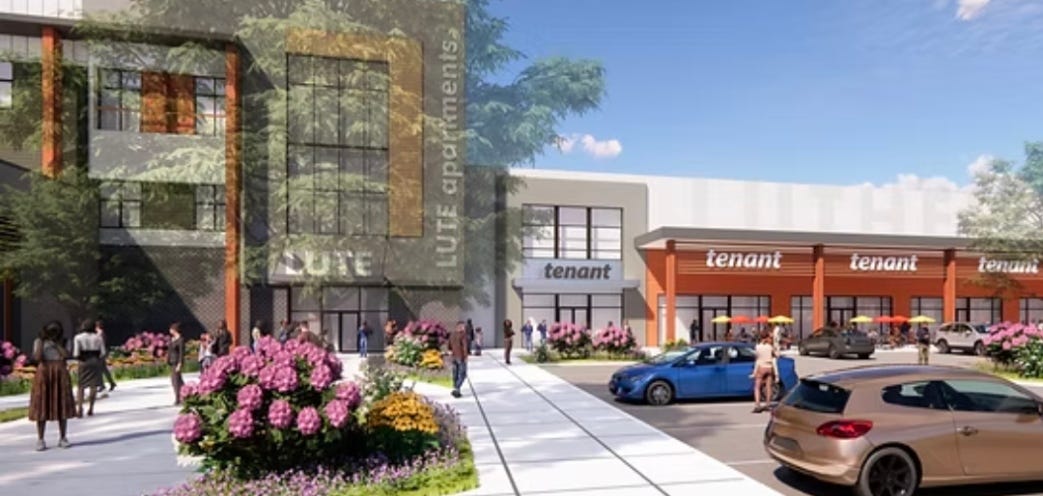
The Cost of Suburban Nostalgia: Why Baltimore County Needs Lutherville Station
By Barry O'Connell
The Maryland Wire — September 15, 2026
When Baltimore County Executive Kathy Klausmeier submitted a resolution last week designating the long-stalled Lutherville Station project as a Transit-Oriented Development (TOD), she didn't just reignite a six-year local zoning debate—she exposed the central economic paradox facing Maryland’s suburbs.
Everyone agrees that Maryland faces a severe housing shortage. Business leaders decry the lack of workforce housing, state officials highlight soaring rents, and young families find themselves priced out of the communities where they grew up.
Yet the moment a concrete proposal arrives to build 325 residential units on top of an underutilized Light Rail station, the consensus vanishes—replaced by a vocal constituency determined to keep their neighborhoods frozen in time.
The trade-off, however, is rarely stated clearly to the public: When local opposition blocks smart-growth infill, every taxpayer in Baltimore County pays the price.
The High Cost of the Status Quo
The economics of modern county governance are straightforward. Demands on local government—from funding public schools and upgrading aging infrastructure to paying competitive salaries for police and fire personnel—rise every year.
To fund these services, a county has two primary options:
Expand the commercial and residential tax base through higher-density redevelopment in existing corridors.
Raise property tax rates across the board on current homeowners.
By transforming an underperforming retail center into a modern, transit-adjacent residential hub, the Lutherville Station project adds 325 taxable units directly onto existing infrastructure. It generates fresh property tax revenue and consumer spending for local storefronts without requiring the county to build new roads, extend utility lines, or expand outward into rural green space.
When local "NIMBY" activists demand that the County Council block 325 new households from moving in, they are effectively demanding a private subsidy for their ideal neighborhood layout. The implicit message to the rest of Baltimore County is simple: We want our neighborhood left exactly as it was decades ago, and everyone else should pay higher taxes to make up the revenue shortfall.
SUBURBAN REDEVELOPMENT TRADE-OFF
[ APPROVE TOD REDEVELOPMENT ] [ BLOCK PROJECT / PRESERVE SITE ]
• Adds 325 taxable residential units • Zero new tax base expansion
• Captures value of existing Light Rail • Shifts fiscal burden to property taxes
• Promotes walkable local commerce • Locks in underutilized retail center
Decoding the Opposition
At recent standing-room-only public hearings, opposition to the project has rarely centered on technical infrastructure planning. Instead, it has relied on emotional appeals rooted in fear and nostalgia.
Public testimony at recent meetings made the underlying anxieties plain. One resident warned that transit-adjacent apartments would act as an unwanted magnet, bringing "the kids... the fights... what's happening over in Towson." Another explicitly appealed to nostalgia, stating simply: "I want to feel safe. Frankly, I want to feel like I felt in 1985."
These arguments frame public transit and new residents not as economic assets, but as threats to suburban insulation. The fear that transit options will shuttle "outside elements" into affluent enclaves is an old trope in regional planning—one that frequently uses safety concerns as a shield against broader demographic and economic integration.
In reality, Lutherville Station sits directly on a state-funded Light Rail line. Refusing to build housing next to major transit assets defeats the entire purpose of public infrastructure investment.
A Pragmatic Coalition at County Hall
Despite the vocal pushback, the project is gaining crucial political traction.
County Councilman Nino Mangione, a pragmatic conservative representing District 3, has stepped forward alongside Executive Klausmeier to advance the resolution. Mangione recognizes that the TOD designation does not bypass safety or planning controls—it simply unlocks state support and sets the stage for a formal Planned Unit Development (PUD) process, where specific community benefits can be negotiated.
State leaders are watching closely. Department of Housing and Community Development (DHCD) Secretary Jake Day has repeatedly backed the site as a logical location for density, aligning with Governor Wes Moore’s broader mandate to expand housing supply near transit hubs statewide.
With Council members Julian Jones, Pat Young, and Izzy Patoka signaling support, the Council’s upcoming vote represents a defining test of leadership.
What’s Good for Baltimore County Is Good for Maryland
Baltimore County cannot afford to treat housing policy as a series of local vetoes. Protecting existing homeowners' preference for 1985-style isolation at the expense of 2026 economic reality is a strategy for stagnation.
Building 325 units at Lutherville Station will not destroy the surrounding community. It will bring new tax dollars to county coffers, support transit ridership, and give nurses, teachers, and young professionals a place to live in the county where they work.
If Maryland is serious about solving its housing crisis and building a resilient economy, it has to start at places like Lutherville Station.