

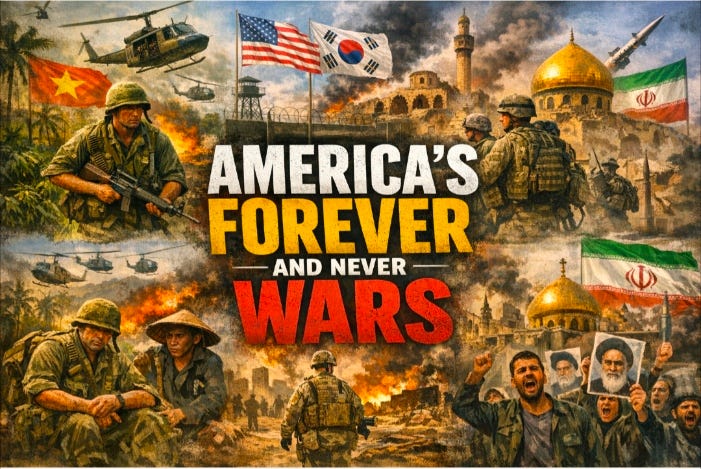
Why America Wins Some Wars and Loses Others:
A Framework of Legitimacy, Identity, and Civilizational Conflict
Executive Summary
Across the last century, the United States has demonstrated unmatched military capacity but inconsistent political outcomes. These inconsistencies follow a pattern. American victories correlate with wars in which U.S. forces fight alongside populations who perceive American intervention as restoring their rightful world. American failures correlate with wars in which U.S. forces fight against populations who perceive American intervention as invading their world.
This paper argues that the decisive variable is legitimacy — not in the procedural, democratic sense, but in the deeper anthropological sense: whether the population of the battlefield believes the United States is aligned with their identity, their social order, and their understanding of rightful authority.
Under this framework, Iran is not merely a difficult theater but an unwinnable one. The Islamic Republic is a civilizational‑religious system rooted in Twelver Shiʿism, structured for ideological regeneration, and designed to mobilize society against foreign intrusion. As Machiavelli warned of similar systems, such states cannot be conquered without destroying them entirely — a course the United States will not and cannot pursue.
I. The Legitimacy Principle: Why Populations Decide Wars
Military power determines battles.
Populations determine wars.
The United States tends to win when:
- local populations see American forces as restoring their world
- the enemy is widely viewed as the aggressor
- cultural and religious distance is low
- legitimacy flows naturally toward U.S. aims
The United States tends to lose when:
- local populations see American forces as occupiers
- the enemy is viewed as defending identity, faith, or homeland
- cultural and religious distance is high
- legitimacy flows naturally against U.S. aims
This is not a moral framework. It is a structural one.
II. The “Legitimacy Wars”: Why America Won World War I and II
In both world wars, the United States entered conflicts where:
- the aggressor was unambiguous
- allied populations overwhelmingly welcomed U.S. forces
- cultural and religious affinity was high
- American intervention aligned with local conceptions of rightful order
Ethnic and cultural ties — French, Italian, Polish, German‑American — created a legitimacy bridge. American soldiers were not seen as alien occupiers but as familiar liberators.
Outcome: rapid legitimacy transfer → rapid victory.
III. Korea: The Divided‑People Model
Korea represents a split‑legitimacy environment.
- South Koreans largely viewed the United States as a protector of their political identity.
- North Koreans viewed the United States as an existential threat to theirs.
The result was neither victory nor defeat but a frozen equilibrium.
Outcome: stalemate, not collapse.
IV. Vietnam: The Minority‑Regime Trap
In Vietnam, the United States backed a Catholic political elite ruling over a Buddhist majority. This produced a structural legitimacy deficit:
- the majority population did not see the U.S. as restoring their world
- the Viet Cong positioned themselves as the authentic national movement
- American power could not compensate for demographic illegitimacy
Machiavelli warned that a foreign prince who supports an unpopular minority must either destroy the majority or fail. The United States chose neither.
Outcome: inevitable loss.
V. Iraq and Afghanistan: The Civilizational Misread
In both conflicts, the United States confronted societies whose political legitimacy was rooted not in elections but in:
- tribal identity
- religious authority
- historical memory
- resistance to foreign domination
To many Afghans and Iraqis, the United States was not a country but a civilizational force — “Iglesistan,” as one Afghan elder put it. This placed America outside the moral universe of local legitimacy.
Outcome: prolonged conflict, eventual withdrawal, political failure.
VI. Iran: The Unconquerable Civilization‑State
Iran is not a conventional nation‑state. It is a civilization‑state whose political structure is fused with Twelver Shiʿism. The Supreme Leader is not a political figure in the Western sense; he is a religious authority whose legitimacy derives from a theological system, not a political one.
Structural features that make Iran unwinnable:
1. Legitimacy is religious, not political.
The Supreme Leader is replaceable through the Assembly of Experts. Killing him does not decapitate the system; it reinforces its narrative of martyrdom.
2. The population supports the religious framework.
Even Iranians who oppose the government often affirm the underlying religious legitimacy of the system.
3. The state regenerates leadership indefinitely.
This mirrors Machiavelli’s analysis of the Ottoman Empire — a centralized, religiously legitimated system that cannot be held by foreign powers.
4. The battlefield is a civilization, not a territory.
America can defeat Iran’s military.
It cannot defeat Twelver Shiʿism.
5. Any U.S. intervention becomes a civilizational invasion.
This guarantees mass mobilization against American aims.
Outcome: structural unwinnability.
VII. Machiavelli’s Warning and Its Modern Relevance
Machiavelli argued that states governed by a single religious‑political authority are the hardest to conquer because:
- their legitimacy is indivisible
- their leadership is easily regenerated
- their population is unified by belief, not bureaucracy
His conclusion was stark:
> Such states cannot be held unless they are destroyed entirely.
The United States will not pursue total destruction.
Therefore, by Machiavelli’s logic, Iran cannot be conquered.
VIII. Implications for U.S. Strategy
This framework suggests that policymakers must evaluate future conflicts not by military feasibility but by legitimacy feasibility:
- Does the local population see us as restoring their world?
- Is the enemy viewed as an aggressor or a defender of identity?
- Is the society culturally proximate or distant?
- Is the political system brittle or regenerative?
Iran fails every test.
Conclusion
The United States wins wars when it fights alongside populations whose identity aligns with American aims. It loses wars when it fights populations whose identity is threatened by American presence. Iran represents the most extreme version of the latter category: a civilizational‑religious state whose legitimacy is immune to foreign intervention and whose political structure is designed for perpetual regeneration.
Recognizing this pattern is not defeatism. It is the foundation of strategic realism — and the prerequisite for avoiding unwinnable wars.