

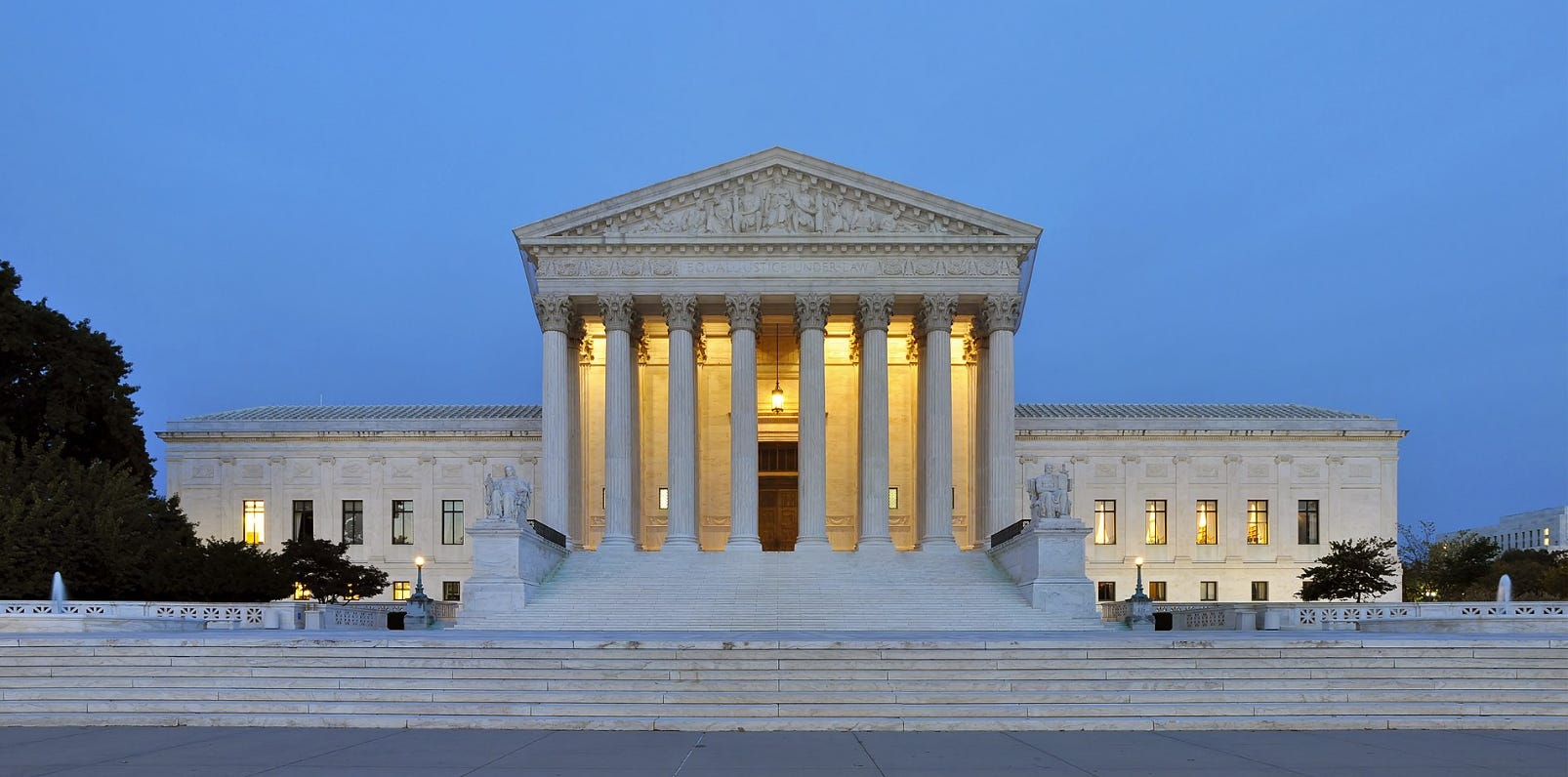
A Christian, a Constitution, and a Court: Wrestling With Real Life in the Age of Trump’s Justices
Maryland Wire Magazine Feature
I. The Fear That Never Quite Fit
When Donald Trump named three Supreme Court justices, the Democratic world around me reacted with a kind of existential dread.
The caricature was everywhere: beer‑drinking frat boys elevated for loyalty, not intellect; political foot soldiers in robes; men chosen to follow orders rather than interpret law.
I heard it so often that it became background noise.
But the more I listened to their questioning — especially in this term’s birthright‑citizenship case — the less that caricature fit the reality in front of me.
I’m not saying I agree with their jurisprudence.
I’m saying they’re not the cartoon villains people imagined.
They are conservative, yes.
But they are also jurists — and that distinction matters.
II. The Cases That Broke the “Rubber Stamp” Myth
Whatever people feared in 2017, the record since then tells a more complicated story.
There have been multiple cases where Trump-appointed justices ruled in ways that did not align with the president’s preferences or political interests.
Among them:
1. Trump v. Vance (2020)
The Court held that a sitting president is not immune from state criminal subpoenas.
Justice Gorsuch joined the majority.
This was not the ruling Trump wanted.
2. Department of Homeland Security v. Regents (2020)
The Court blocked the administration’s attempt to end DACA without proper procedure.
Justice Roberts wrote the opinion; Gorsuch and Kavanaugh did not join, but the ruling itself was a major setback for the administration.
3. Fulton v. Philadelphia (2021)
A religious‑liberty case where the Court ruled narrowly, avoiding the sweeping conservative victory many expected.
This frustrated the administration’s allies who wanted a broader ruling.
4. Moore v. Harper (2023)
The Court rejected the “independent state legislature” theory — a position strongly favored by Trump-aligned activists.
Gorsuch and Kavanaugh did not embrace the maximalist version of the theory.
5. Trump v. Anderson (2024)
The Court unanimously rejected Colorado’s attempt to remove Trump from the ballot — but the reasoning was institutional, not personal.
Even here, the justices signaled independence rather than allegiance.
These cases don’t make the Court moderate.
They make it conservative but not captive — a distinction that matters for anyone who cares about constitutional stability.
III. The Comment That Caught My Ear
During oral arguments on birthright citizenship, a lawyer suggested that the world has changed and the Court must adapt.
Chief Justice Roberts replied, almost casually:
> “Yes, but we have the same Constitution.”
To most people, it was a throwaway line.
To me, it was a signal — not of ideology, but of method.
It sounded like a reminder to the White House, to Congress, and to the country:
“We are not here to follow the moment. We are here to interpret a document.”
If that’s what he meant, it may be one of the most important statements of the year.
IV. Roe, Privacy, and a Christian Wrestling With Real Life
I’ve never been fully comfortable with the legal foundation of Roe v. Wade.
Not because I oppose a woman’s right to choose — I support that right — but because the constitutional reasoning always troubled me.
If the Court can find a right to privacy broad enough to protect abortion, then where is my right to privacy in my emails, my phone calls, my text messages?
Where is the constitutional protection for the digital life every American now lives?
That’s not a partisan question.
It’s a coherence question.
And then there’s the moral side — the part that comes from Scripture, not statutes.
As a Christian, I believe all sin is equal in the eyes of God.
That means abortion and gluttony sit on the same plane.
Try telling that to a church potluck crowd.
But it’s true.
And real life is never as simple as the slogans.
V. Lady Bird Johnson and the Ox in the Ditch
The best example I’ve ever found of moral complexity is the abortion Lady Bird Johnson underwent early in her marriage.
She fainted during pregnancy.
She was rushed to Sibley Memorial Hospital.
LBJ arrived from the Senate.
The doctor told him:
> “I can save your wife, or I might be able to save the child.”
“Might” — that word matters.
LBJ chose to save his wife.
From a Christian perspective, I cannot find the sin in that.
Letting two die when one might live is the greater sin.
Scripture itself gives us the Biblical principle: a man may pull his ox out of the ditch on the Sabbath.
Life and mercy override ritual.
If we can rescue big dumb farm animals on the Sabbath, surely we can save a mother’s life.
This is what real moral reasoning looks like.
Not slogans.
Not absolutes.
Not political talking points.
Real life.
VI. What I’m Watching for Now
I don’t need the Court to agree with me.
I need the Court to think.
I need:
- independence
- constitutional reasoning
- intellectual seriousness
- moral humility
- and a refusal to become an arm of the executive
That’s why this birthright‑citizenship case matters so much.
Not because of the outcome — though the outcome will shape millions of lives — but because of what it reveals about the Court’s spine.
If Roberts’s comment was what I think it was, then the Court is still a Court.
Not a rubber stamp.
Not a political weapon.
Not a presidential accessory.
A Court.
And in a year like this one, that’s no small thing.
1963 The Deaths of 3 Presidents Chap 1

The Petroleum Club Dallas Texas. Friday November 22, 1963, 12:37 PM