

The Quiet Chain Reaction That Could Reshape Maryland Politics in 2030
By Barry O’Connell
There is a tendency in Maryland politics to focus on the visible. Who is running. Who is rising. Who is falling.
But the most important political developments rarely begin in public. They begin as a chain reaction, set off by events that may not even happen in Maryland.
If current trends hold, that chain reaction may already be forming.
The National Stage and a Maryland Governor
If Democrats regain control of the House in the 2026 midterms, and potentially make gains in the Senate, the national political environment shifts dramatically. Oversight intensifies. The political temperature rises. The 2028 presidential race begins to take shape earlier and with greater urgency.
In that environment, certain figures begin to stand out.
Wes Moore is already emerging as one of the most prominent Democratic voices in the country. His profile continues to rise, particularly in communities where turnout and engagement are decisive in national elections.
If that trajectory continues, it is not difficult to imagine Moore being discussed as:
A presidential contender
A vice presidential selection
Or a candidate for a major cabinet or diplomatic role
None of those outcomes are guaranteed. But all of them are plausible.
And all of them lead to the same place.
The Constitutional Moment
If Moore leaves office before the end of his term, the Maryland Constitution is clear.
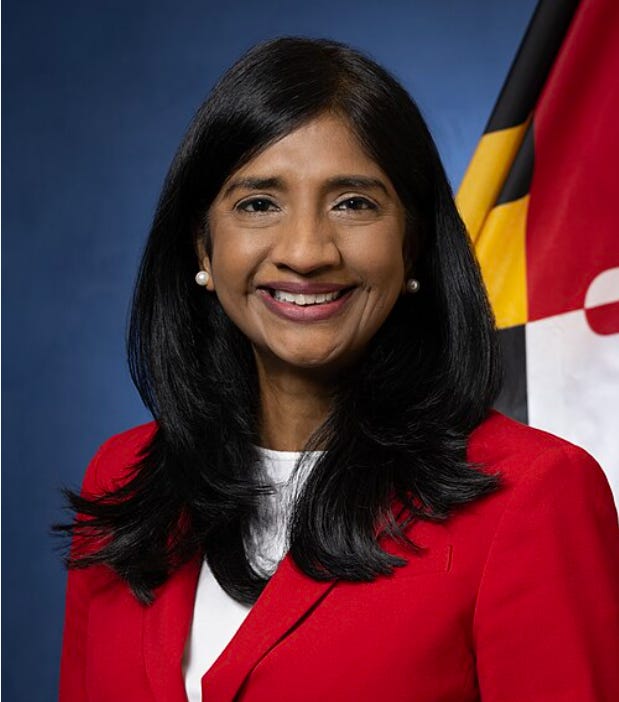
Aruna Miller would become Governor of Maryland.
At that moment, a second, quieter decision begins—one that may shape the 2030 election more than any campaign speech or endorsement.
Under Maryland law, a vacancy in the office of Lieutenant Governor is filled by nomination of the Governor and confirmation by a majority of the General Assembly in joint session.
This is not a formality. It is a political decision of the highest order.
The First Move of the 2030 Campaign
The selection of a Lieutenant Governor in this scenario is not simply about governing.
It is the opening move in the next election.
Governor Miller would need to select someone who meets three very real tests:
Willing to take the position and leave their current role
Able to secure confirmation from the General Assembly
Capable of strengthening a statewide ticket in 2030
That combination is rarer than it appears.
Who Is Actually Available?
There are many talented figures in Maryland politics. Far fewer are positioned to step into this role.
For example:
Anthony Brown has already served eight years as Lieutenant Governor and now holds an independent statewide constitutional office. It is difficult to envision him stepping aside to return to a role he has already fulfilled.
Glenn Ivey holds a seat in Congress, with a national platform and long-term potential. There is little incentive to trade that position for a subordinate role in state government.
These are serious figures. But they are not realistic fits for this moment.
The Case for a Legislative Statesman
That brings the conversation to a different kind of candidate.
Someone with deep relationships in Annapolis.
Someone who understands the legislative process.
Someone who can unify a major voting bloc while maintaining credibility across the state.
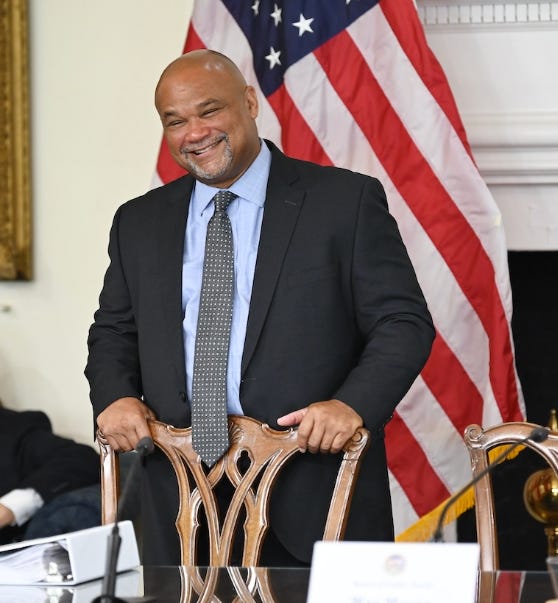
Dereck Davis fits that profile as well as anyone in Maryland today.
A former chair of the House Economic Matters Committee, with decades of experience in the General Assembly, Davis is widely respected across factions of the Democratic Party. His selection as State Treasurer by the legislature underscores that trust.
It is difficult to envision a scenario in which a Democratic General Assembly would reject him if nominated for Lieutenant Governor.
More importantly, his presence on the ticket would immediately strengthen it.
A senior Maryland Politico told me, “Whoever snags Davis is the immediate 2030 Frontrunner.”
The Geography of Power
Maryland elections are not won evenly across the map. They are built through coalitions.
Prince George’s County remains one of the most powerful political bases in the state. When unified, it can deliver margins that reshape statewide races.
Montgomery County provides the largest pool of Democratic voters, but often divides its support among multiple candidates.
Baltimore City and Baltimore County frequently serve as the balance point, determining which coalition ultimately prevails.
A Miller–Davis partnership would not guarantee victory. But it would align two of the most important elements in Maryland politics:
At this point the only way this scenario could go really bad would be if if Treasurer Davis has already agreed to run as Brooke Lierman’s running mate. But at this point there’s no indication that he has:
Executive leadership from Montgomery County
Deep political strength in Prince George’s County
That is a formidable starting point.
The Field That Awaits
Even with the advantages of incumbency, any Governor in 2030 would face serious competition.

Brooke Lierman is widely expected to consider a run for Governor. Fair or not, many observers believe her current role positions her for that next step, and that she would move quickly if the opportunity presents itself.

Secretary Jacob Day continues to be mentioned as one of the most promising rising figures in the state. His background as mayor of Salisbury, his military service, and his growing statewide profile make him a credible candidate whenever he chooses to run.
Johnny Olszewski Jr. presents another interesting possibility. A former county executive with executive experience and now a member of Congress, his decision may ultimately come down to whether he prefers a national or state-level role.
Others may emerge. They always do.
The Race Before the Race
For now, none of this is official. No one has declared. No tickets have formed.
But the outlines are there.
If Moore’s national profile continues to rise, if he leaves for a larger role, and if Miller ascends to the governorship, then the next chapter of Maryland politics will not begin in 2030.
It will begin the moment a new Lieutenant Governor is chosen.
Because in Maryland, the most important decisions are often the ones that happen quietly.
And by the time the campaign begins, the outcome is often already taking shape.
New Jersey has had some decent governors. Phil Murphy had done a decent job for the Garden State and others in the past two decades.
Maryland could take a few lessons from the Jersey economic development playbook: progressive and aggressive.
Maryland talks a big game but shoots itself in the foot by hanging on to legacy statutes, and closed loop insider practices.