

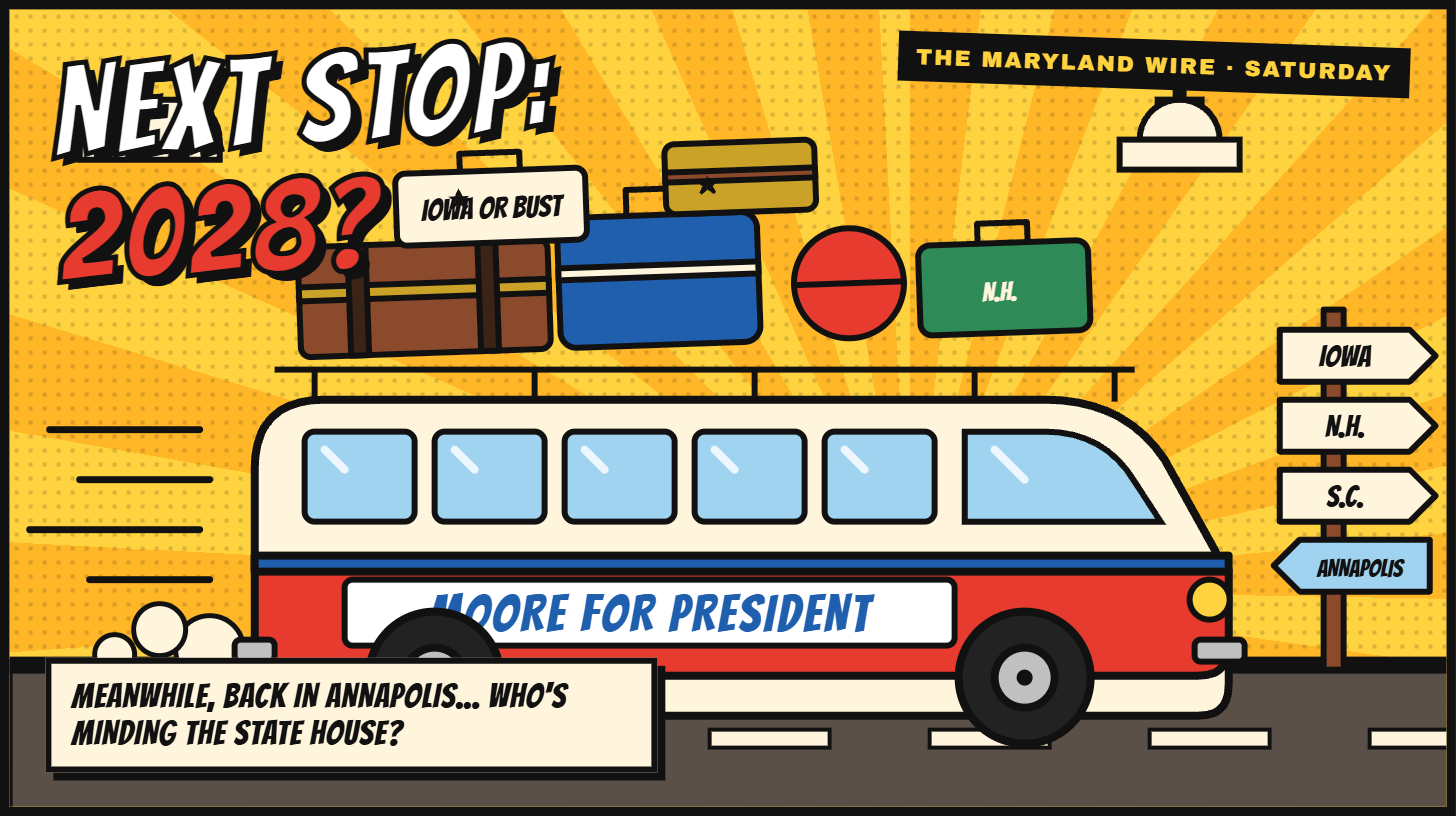
Who Runs Maryland When Moore Hits the Road
Nov 14, 2026 · @Jack
Moore won't promise a full second term. If he hits the road for 2028, the State House runs on a two-person team: Manny Welsh minding the machinery and Mollie Byron minding the politics.
Gov. Wes Moore spent election week doing things governors do when they are thinking about something bigger than their state.
He announced a new book, Repair: Healing a Divided Nation, due out March 9. Asked by Politico whether the next president should be a governor, he answered, "I think yes." And two days after winning reelection, he put a new chief of staff in charge of the second floor.
None of that means he is running. All of it means the people who lobby the executive branch should be asking a practical question: when the governor is in Iowa, New Hampshire or South Carolina, who is actually running Maryland?
From "Full Term" to "I Gave the Answer"
In September 2025, Moore told NBC's Kristen Welker on Meet the Press that he would serve a full term and was not running for president. It was about as clean a pledge as politics produces.
Thirteen months later, at the October 6 debate, The Banner's Pamela Wood pressed him for a yes or no. Moore said he had already given the answer, and that he was committed to Marylanders and running for reelection. Republican nominee Dan Cox pounced, saying the governor wouldn't look voters in the eye and rule out a run.
Moore has also said he belongs in the party's "national conversation." Spotlight on Maryland counted at least 10 times since 2023 that he has publicly brushed off presidential talk, even as his out-of-state travel and fundraising grew.
His defenders have a ready answer. Democratic strategist Len Foxwell told Spotlight the governor can walk and chew gum at the same time. The question for our readers isn't whether he can. It's who does the chewing back home.
Manny Welsh: The Operator in the Big Chair
On November 5, Moore moved Lester Davis out as chief of staff, sending him to run TEDCO as interim CEO in place of Troy LeMaile-Stovall, and named Emmanuel "Manny" Welsh to replace him. Welsh is Moore's third chief of staff, after Fagan Harris, now at the Abell Foundation, and Davis.
If you wanted to design a caretaker, you would draw something close to Welsh. For the past year he was the state's first chief administrative officer, managing the executive branch day to day. Before that he was deputy chief of staff over Commerce, General Services, cannabis and alcohol regulation. Before that, he was Moore's man at the Board of Public Works.
Moore himself, announcing the move, pointed to Welsh's encyclopedic grasp of the state bureaucracy. That is the skill set you want minding the store while the boss is on a book tour.
One caution for anyone tempted to call him a pure technocrat: Welsh spent 2015 to 2023 in Peter Franchot's Comptroller's office, the last three as chief of staff. Nobody survives that post without political instincts. Salisbury's Jake Day, back when Moore first hired him, called Welsh one of the most trusted and affable operators of Annapolis's systems. Operator is the right word.
Mollie Byron: The Political Hand
If Welsh keeps the trains running, someone has to keep the cabinet and the counties pulling in the same direction. That is where Mollie Byron comes in.
Byron has been Secretary of Appointments since April 2025, succeeding Tisha Edwards. Before that she spent two years as Moore's director of intergovernmental affairs, the job that puts you on the phone with every county executive and mayor in the state. Her résumé runs through Prince George's County government, where she ran CountyStat, government relations for The Nature Conservancy, and the O'Malley-Brown administration.
The line that matters most: she was Martin O'Malley's deputy national political director in his presidential run. She has called it an emotional rollercoaster. She is one of very few people on the second floor who has seen a presidential campaign from the inside.
And her current job is more political than the title suggests. The appointments office decides who sits on the boards and commissions that matter to regulated industries: hospital rate-setting, gaming, utilities, licensing. In a second term, with terms expiring across those panels, that is real leverage.
Outside the office, she sits on the board of Emerge Maryland, mentoring women who are thinking about running for office.
People who know the pair describe Welsh and Byron as unusually close collaborators in keeping the cabinet on course. If Moore goes national, they are the obvious caretaker team: the operator and the politician. Her campaign résumé is exactly what a presidential effort would want to borrow. But Byron's career has been built in Maryland, and those who know her expect her to stay in Annapolis rather than decamp to Des Moines.
The Bench Behind Them
A caretaker team is only as good as the people answering its phones. Here is who gets busier if the governor gets scarcer.
The legislative shop. Will Tilburg, the former Maryland Cannabis Administration director, became chief legislative officer this summer. During session, he is the person most of our readers actually deal with. His predecessor, Jeremy Baker, a former chief of staff to Speaker Adrienne Jones and senior adviser to the late Speaker Michael E. Busch, moved over to run the Maryland Lottery as acting director. The lobby shop also added Tony Bridges, formerly of MDOT.
The counties. Dylan Goldberg succeeded Byron as director of intergovernmental affairs. When a county executive can't get the governor, Goldberg is who they get.
The policy desks. Deputy chiefs of staff Chichi Nyagah-Nash, who covers environment, transportation, general services, IT and energy, and Michael Huber hold the agency portfolios that utilities, developers and contractors live in.
The message. Communications director David Turner speaks for the office, and Carter Elliott IV, who has worked Moore's campaigns, speaks for the campaign.
The constitutional backstop. Lt. Gov. Aruna Miller is the official answer to who governs when the governor is gone. Her office, led by chief of staff Geri Royale Byrd with communications director Brandon Stoneburg, is worth knowing now. Miller is also hosting the National Lieutenant Governors Association in Annapolis next June.
The tell to watch. In May, Moore moved Dylan Arant, who had reported to the chief of staff, out of the governor's office to run the reelection campaign after Ron Owens stepped away. That is the pattern to watch for: political people leaving the second floor for the campaign side. When it happens again, you'll know the national effort is real.
Across the Hall: Who Gains When the Governor Is Away
A governor with one eye on 2028 is a governor with less leverage over the legislature, and the presiding officers know it.
Senate President Bill Ferguson has already shown he will say no to Moore. He blocked mid-decade congressional redistricting, absorbed the backlash, and kept his caucus. House Speaker Joseline Peña-Melnyk, by contrast, passed Moore's map and sidestepped the feud. Expect both to fill whatever vacuum a traveling governor leaves.
The rest of the leadership bench matters too: Senate Majority Leader Nancy King, House Majority Leader David Moon, Speaker Pro Tem Luke Clippinger, and on the Republican side, Senate Minority Leader Steve Hershey and House Minority Leader Jason Buckel, per Ballotpedia's 2026 roster.
Then there is the Board of Public Works, where Welsh built his career. With the governor's seat at that table increasingly handled by staff, Comptroller Brooke Lierman and Treasurer Dereck Davis become even more important stops for anyone chasing a state contract.
Mark Your Calendar: Where the Collisions Come
The 90-day session runs from mid-January to mid-April; this year's ran January 14 to April 13. Lay Moore's national calendar over that and two collisions jump out.
March 9, 2027. Repair hits shelves in the final weeks of the 2027 session, when budget conference and the big bills are moving. A book launch means national TV and travel. Expect a governor who is partly on tour during the weeks that decide most of our readers' bills.
January to April 2028. The 2028 session is Moore's last full one, and it would overlap the opening months of the presidential nominating calendar. If he runs, his final session would be managed almost entirely by Welsh, Byron and Tilburg.
There is also unfinished business. Voters approved Question 3, which lets the legislature redraw the congressional map, and Moore framed that campaign as a fight with President Trump. A 2027 redistricting push would be the most national thing a Maryland session could do, and a natural stage for a would-be candidate.
What It Means for Your Agenda
Nobody knows yet whether Wes Moore runs in 2028, and he may not know himself. But the smart move for a government relations shop is to plan as if he might.
Get your executive-branch asks in early. The 2027 session, before the book tour, is the last stretch with the governor's full attention.
Know the second floor below the top. Welsh for operations and the agencies; Byron for appointments and the political temperature; Tilburg for anything moving in the General Assembly; Goldberg for the counties.
Watch the appointments pipeline. If your industry has a board seat coming open, Byron's office is where that gets decided.
Build the Miller relationship now. It costs little today and could be worth a great deal later.
Watch the exits. The next time a political aide leaves the governor's office for a campaign or PAC job, take it as a signal.
Jack and Charlie would tell you the same thing: in this town, it's not about the food. It's about knowing who's at the door.
WHO’S GOVERNING MARYLAND WHILE GOVERNOR MOORE IS TRAVELING AMERICA?
J. Barry O’Connell raises an interesting question in The Maryland Wire, and I would like to approach it from the perspective of an ordinary Maryland resident who may not follow the inner workings of presidential politics.
I have a simple question.
If Wes Moore is the governor of Maryland, why does he need to spend so much time visiting other states? Don’t those states already have governors? Is he serving as some sort of backup governor?
Of course, I’m being somewhat facetious. I understand that governors travel for legitimate government business, national conferences, political events, and other responsibilities.
But I also understand how presidential politics works. When a governor begins developing a national presence, particularly in states associated with presidential campaigns, people naturally begin connecting the dots.
And that brings me to a more serious question: What exactly are Governor Moore’s political intentions for 2028?
Marylanders have just reelected him to another four-year term. If he intends to serve that entire term, that is something the public deserves to understand clearly. If he is considering a presidential campaign, that possibility deserves equal transparency.
There is nothing inherently wrong with political ambition. But there is a difference between having ambitions and being forthcoming with the people who elected you.
I would also caution against confusing a decisive victory in Maryland with evidence of nationwide presidential appeal. Maryland’s political demographics, the candidates on the ballot, national political sentiment, and the broader political environment all matter.
Then there are the unresolved questions of public confidence.
Governor Moore has faced scrutiny regarding his Bronze Star application and representations about his military service. His memoir, The Other Wes Moore, has also been part of broader public discussions about his biography. Those matters deserve careful, factual examination rather than assumptions.
Maryland residents are also entitled to examine the state’s budget challenges, taxes, spending priorities, and affordability concerns. Those are substantive governing issues that cannot be answered simply by pointing to an election victory.
And finally, there is the question of historical symbolism.
The election of Barack Obama was an extraordinary milestone in American history. But we should be careful about assuming that the symbolism of electing another Black president would carry the same political meaning or influence across the country.
Representation matters. History matters. But so do measurable results.
A candidate’s race, appearance, family image, biography, and ability to inspire voters are not substitutes for a governing record that can withstand serious examination.
My larger point is that public service should never become secondary to personal political ambition.
If Governor Moore is traveling to advance Maryland’s interests, Marylanders should know what those trips accomplish. If he is building a national political organization, voters should understand how that activity relates to his responsibilities at home.
And if he is considering a presidential campaign, the public deserves clarity about what that could mean for the term he has just been elected to serve.
These are not unreasonable questions. They are questions of transparency, accountability, and public trust.
Maryland elected a governor. Marylanders have every right to expect that governing Maryland remains his priority.
— Dave Grogan Public Integrity & Accountability Advocate