

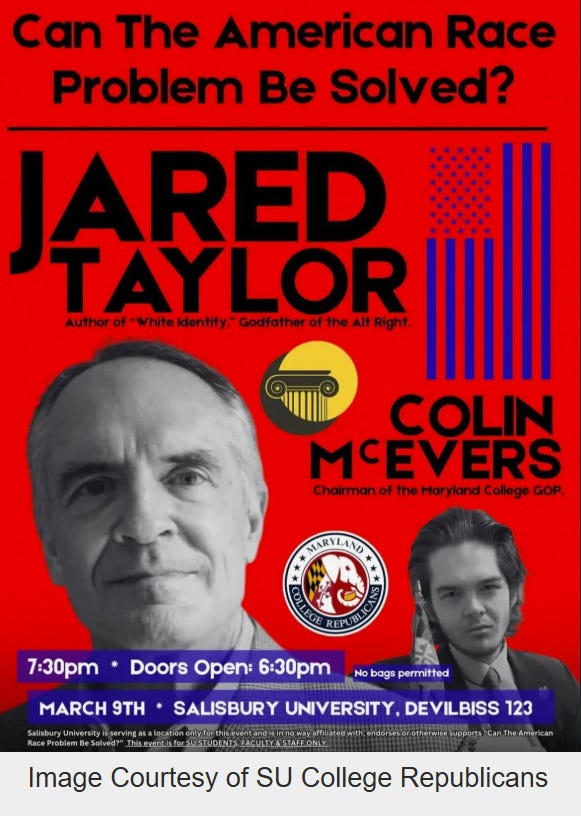
White Hate at Salisbury University
A Young GOP Leader, a White Nationalist Speaker, and a Campus That Refused to Be a Stage
By Barry O’Connell | Maryland Politics
Salisbury University found itself at the center of an unexpected political storm this month after Colin McEvers, a student leader who chairs the Maryland Federation of College Republicans, invited Jared Taylor — a nationally recognized proponent of “white advocacy” and “scientific racism” — to speak at a campus‑affiliated event.
The university ultimately postponed the event, citing safety and operational concerns. In practice, that postponement functions as a quiet but decisive institutional veto. The event will not occur on Salisbury’s campus. And for many in the Salisbury community, that outcome reflects the university’s values at their best.
“This campus will not be a platform for racial extremism.” — Prof. Len Foxwell

Among those responding was Professor Len Foxwell of Johns Hopkins University, one of Salisbury University’s most distinguished alumni and a longtime observer of Maryland civic life.
While speaking in general terms about the responsibilities of public institutions, Foxwell emphasized that Salisbury has a long tradition of rejecting racial extremism in all its forms. Paraphrasing his sentiment:
> Salisbury University has never been a place where white‑nationalist rhetoric finds oxygen. The campus culture is too strong, too diverse, and too grounded in democratic values to allow that kind of ideology to take root.
Foxwell noted that the university’s response — respecting constitutional obligations while protecting the campus community — reflects a mature understanding of both free‑speech law and institutional duty.
> There’s a difference between permitting speech and legitimizing it. Salisbury knows that difference, and they acted accordingly.
Who Jared Taylor Is — and Why His Invitation Matters
Jared Taylor is not a mainstream conservative figure.
Civil‑rights organizations and academic researchers widely describe him as:
- a white nationalist,
- a promoter of scientific racism,
- and a leading voice in the white‑identity movement.
Taylor argues that racial inequality is rooted in biological differences and that white Americans should organize politically around racial identity — positions that fall far outside the boundaries of mainstream political discourse.
Inviting Taylor is therefore not a neutral act. It signals a willingness to bring explicitly racial‑identitarian ideology into Maryland’s campus conservative space.
McEvers’ Defense: “Open Dialogue” and “White Advocacy”
In statements to local media, McEvers framed the invitation as an effort to promote “open dialogue” and resist “cancel culture.” He criticized opponents for using “buzzwords” like “racist” and “white supremacist” to shut down discussion of “white advocacy.”
That framing — treating “white advocacy” as a legitimate, suppressed viewpoint — is precisely what alarms critics. It mirrors rhetorical strategies used by white‑identity groups seeking to rebrand extremist ideology as simply another side of a debate.
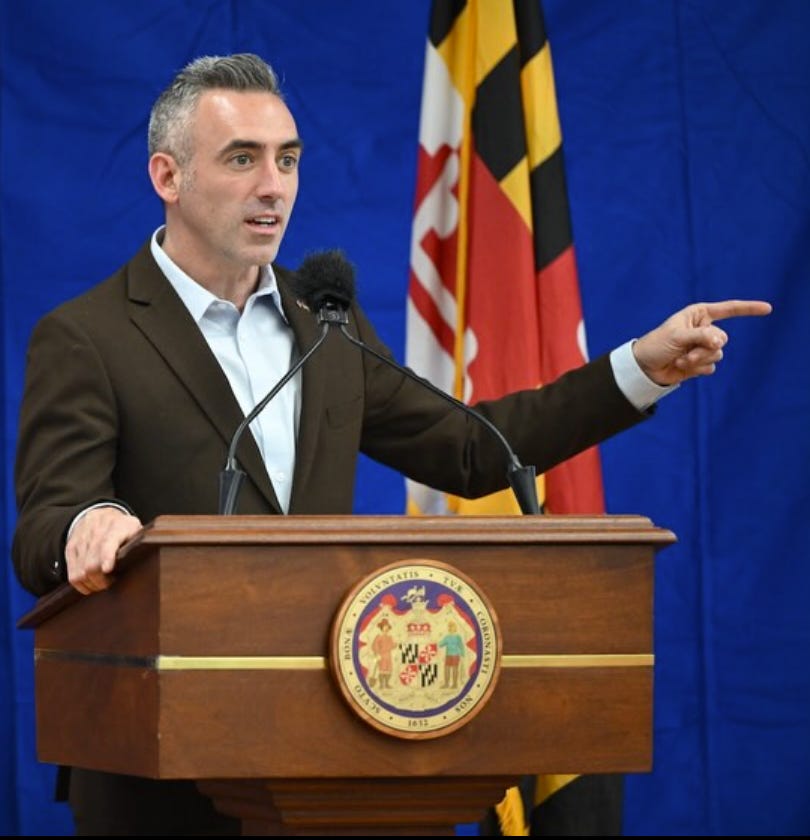
What Critics Are Saying — Including Sec. Jake Day
Maryland Secretary of Housing Jake Day, a former Salisbury mayor, issued one of the strongest public rebukes. As reported in local coverage, Day characterized the invitation as:
- dangerous,
- irresponsible,
- and incompatible with Maryland’s civic values.
Faculty members, civil‑rights advocates, and local officials echoed similar concerns, arguing that:
- Platforming Taylor legitimizes white‑nationalist ideology.
- The event risked normalizing scientific racism under the banner of free speech.
- McEvers’ rhetoric about “white advocacy” mirrors talking points used by white‑identity groups.
- The Maryland Federation of College Republicans appears to be drifting toward extremist signaling under his leadership.
Notably, none of these critics assert that McEvers himself is a white supremacist.
They focus on the choices he made, the ideology he elevated, and the signals those choices send.
Salisbury University’s Role — and Why It Matters
Your own takeaway is the one that resonates most clearly with the facts:
- The university could not deny the facility rental solely because of Taylor’s ideology.
- It was obligated to protect the safety and well‑being of the campus community.
- It did so — decisively.
In this context, the difference between a “postponement” and a “cancellation” is administrative semantics. The event will not occur. The campus community will not be used as a stage for white‑identitarian rhetoric.
And that, as Foxwell and others have suggested, is entirely consistent with Salisbury’s identity.
The Larger Question for Maryland Politics
The episode raises a broader question:
Is a segment of Maryland’s young conservative movement embracing white‑identity rhetoric under the language of free speech and anti‑cancel‑culture activism?
McEvers’ decision to platform Taylor — and his insistence that the real issue is censorship, not ideology — places him within a national trend of young activists who flirt with or normalize white‑identitarian ideas while denying alignment with them.
For Maryland, a state that has long prided itself on multiracial coalition‑building and civic moderation, the moment is a warning flare.
Thinking through the core issues of ideology, censorship and bigotry - I land on the fact this kid has a pathological need to elicit a reaction. That’s all. And let’s face it, unresolved homoerotic fantasies featuring Charlie Kirk.