

When Parties Flip — A Maryland Story
How Maryland’s political coalitions traded places without anyone noticing the ground move beneath their feet.
I. The First Map: When Democrats Were the Working Class
For most of the 20th century, Maryland politics looked nothing like it does today.
If you were a Democrat, you lived in:
- Dundalk, Essex, Middle River
- Baltimore City’s union neighborhoods
- Western Maryland mining towns
- Southern Maryland watermen communities
These were the places where the shift whistle still mattered.
Democrats voted after work.
Union halls doubled as Democratic headquarters.
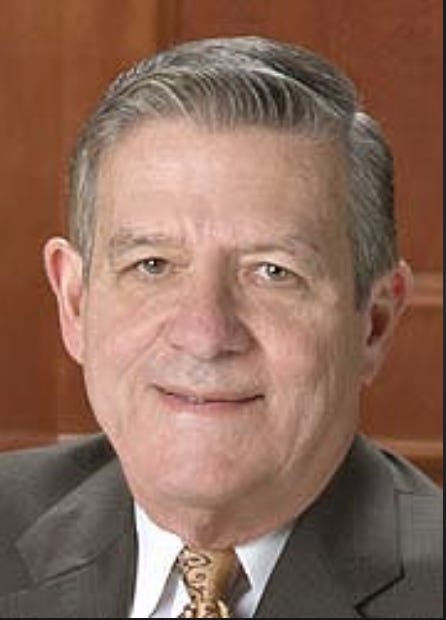
The Dundalk Democrats had a face: Norman Stone Jr.
No one embodied the old Democratic east‑side machine more than Sen. Norman Stone Jr., who served from 1967 to 2019. He was:
- pro‑labor
- socially conservative
- a classic ethnic‑Democratic, working‑class representative]
- the last living remnant of the old Baltimore County Democratic machine
Stone is the perfect example of the kind of Democrat who would be a Republican today.
II. Baltimore’s Pivot: McKeldin, D’Alesandro, and the Birth of the Modern Democratic Coalition
Before the modern map took shape, Baltimore City lived through a political moment that most people forget — a moment when the parties were not yet who they would become.
Baltimore once had a Republican mayor, and not just any Republican.
Theodore McKeldin was one of the most outspoken civil‑rights advocates in the country. He called segregation “morally indefensible,” marched with Black clergy, pushed fair‑housing reforms, and treated Black Baltimoreans as full political partners at a time when many Democrats — especially in the South — were fighting integration tooth and nail.
McKeldin wasn’t a fluke. He represented the old liberal Republican tradition that once had real strength in Maryland’s cities and suburbs — fiscally conservative, socially progressive, and openly aligned with civil‑rights leaders.
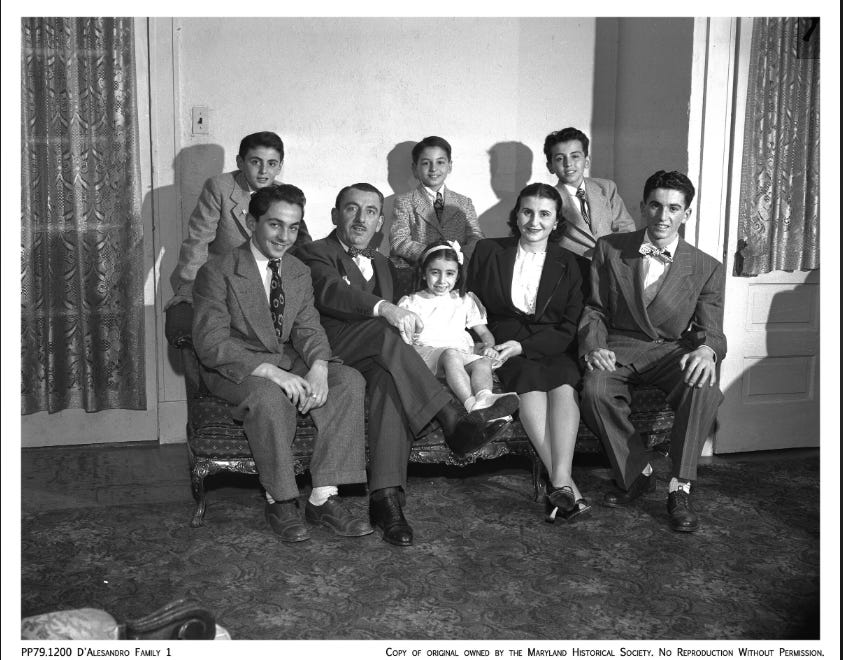
But the Democrat who followed him, Thomas “Big Tommy” D’Alesandro Jr., changed the city’s political DNA.
D’Alesandro didn’t just win elections.
He built the first durable Black–white Democratic coalition in Baltimore:
- appointing Black leaders to city boards
- cultivating deep ties with Black churches
- supporting early civil‑rights measures
- bringing Black political clubs into the Democratic machine
- treating Black neighborhoods as essential, not peripheral
This wasn’t accidental. It was strategic, deliberate, and effective.
And it worked.
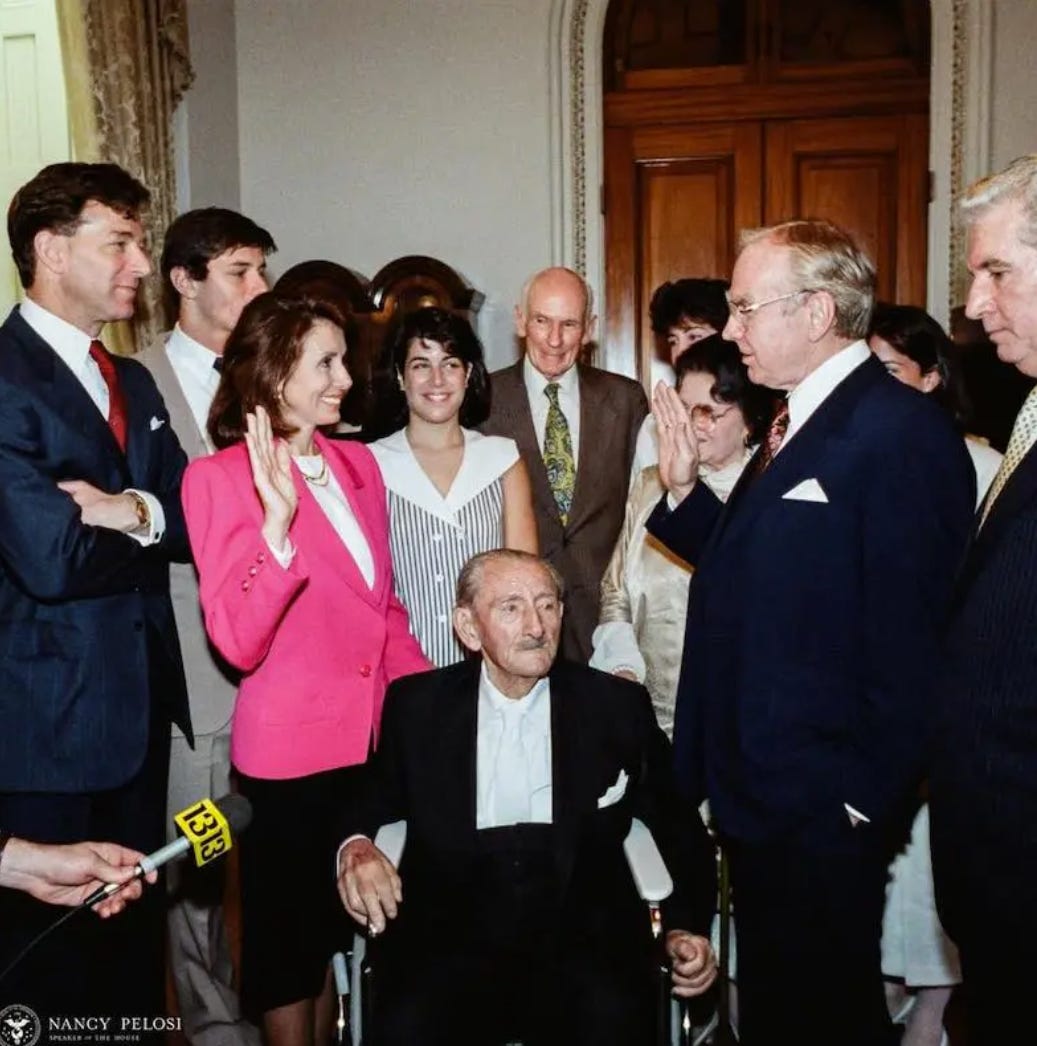
By the time D’Alesandro left office, the Black vote — which had Backrowcennnter been genuinely competitive in the 1940s — was becoming a core Democratic constituency. His political legacy didn’t end with him, either. His daughter, Nancy Pelosi, would grow up to become one of the most effective congres AGA readers, precisely because she mastered the coalition her father helped build.
McKeldin and D’Alesandro weren’t just two mayors.
They were the hinge on which Maryland’s racial and partisan realignment turned.
One Republican opened the door.
One Democrat built the house.
And Baltimore’s political identity — and eventually Maryland’s — shifted for good.
III. The Old Republican Map: Suburbs, Professionals, and the Chamber of Commerce
Maryland’s Republican Party once lived in the places that are now deep blue:
- Montgomer7y County’s early suburbs
- Towson, Timonium, Lutherville
- Severna Park and Arnold
- The Eastern Shore’s courthouse towns
These were the rock‑ribbed Republicans — fiscally conservative, socially moderate, white‑collar, managerial.
The face of this era: Connie Morella
Connie Morella represented the Rockville–Bethesda corridor from 1987 to 2003.
Her district is now held by Chris Van Hollen, one of the most reliably Democratic seats in the country.
The idea of a Republican winning in Rockville today isn’t just unlikely — it’s unthinkable.
IV. The Civil Rights Realignment Hits Maryland
Maryland’s Democratic Party split along familiar lines:
- Baltimore City Democrats moved toward civil rights early.
- Southern Maryland and Eastern Shore Democrats resisted.
- Suburban Republicans absorbed the anti‑busing, anti‑integration vote.
This is when the tectonic plates began to shift.
V. Howard County: From Republican Stronghold to Democratic Engine
Howard County is one of the cleanest examples of the education‑driven realignment.
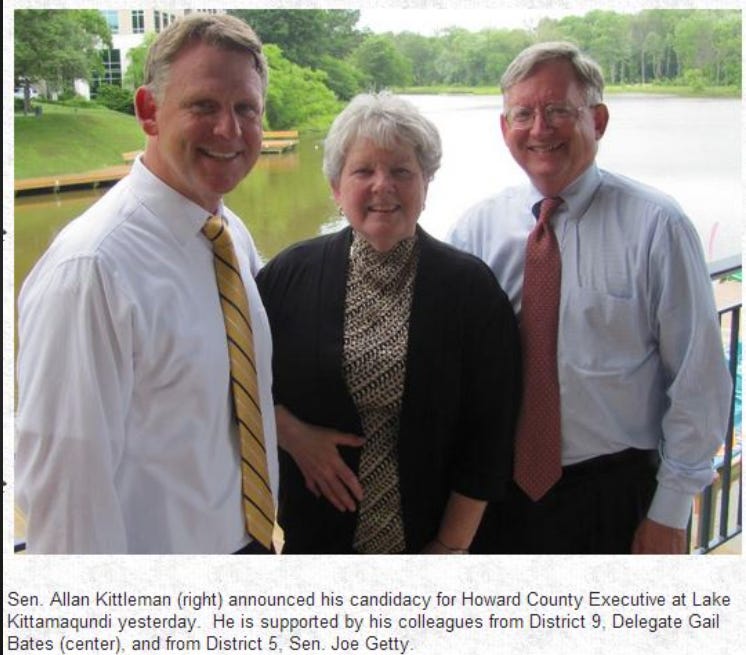
The old Republican era had a face: Gail Bates
For decades, Howard County Republicans like Del. Gail Bates and Sen. Allan Kittleman ran a disciplined, suburban, fiscally conservative machine.
They were the heirs of the old Montgomery County Republican style — polite, professional, moderate.
The new Democratic era has a face: Calvin Ball
Today, Howard County is one of the most reliably Democratic counties in Maryland.
County Executive Calvin Ball represents the new coalition:
- highly educated
- diverse
- suburban
- socially progressive
Howard County didn’t just drift.
It flipped — hard.
VI. Baltimore County: The Great Inversion
Baltimore County is the single best example of the realignment.
Old Democratic Baltimore County had Norman Stone.
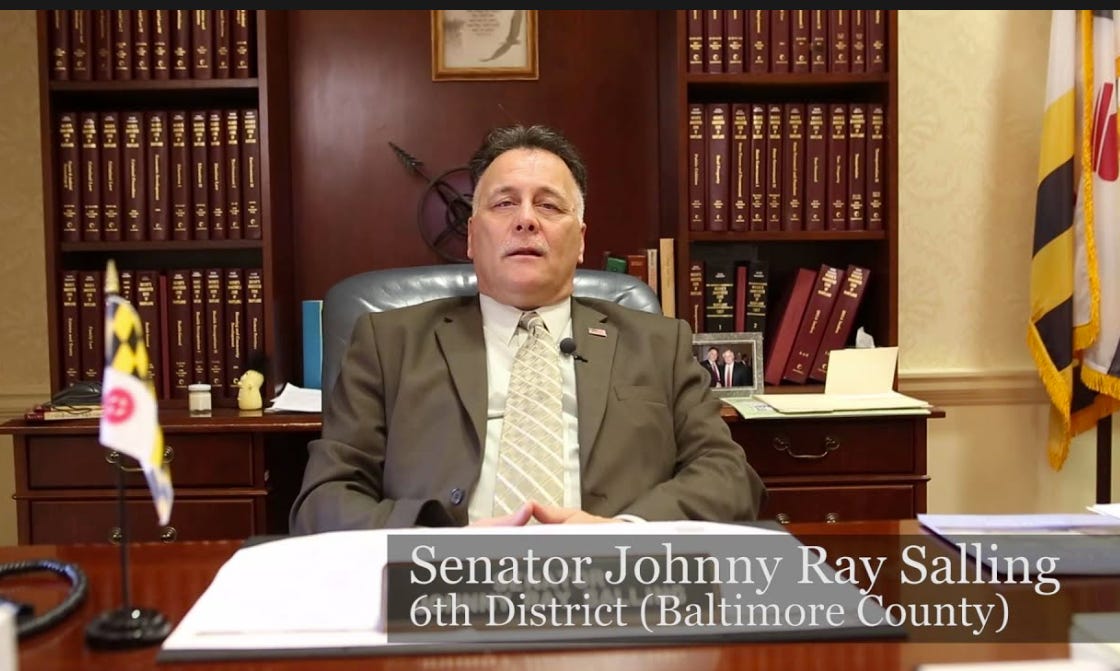
New Republican Baltimore County has Johnny Ray Salling.
Sen. Johnny Ray Salling, a former steelworker from Dundalk, is the perfect mirror image of Norman Stone — same neighborhoods, same culture, opposite party.
The working‑class Democrat became the working‑class Republican.
That’s the realignment in one man.
VII. Western Maryland and Southern Maryland: The Collapse of the Old Democratic Vote
Allegany, Garrett, Washington, St. Mary’s, Calvert — all once competitive or Democratic — are now overwhelmingly Republican.
The issues changed.
The voters didn’t.
The parties moved around them.
VIII. Montgomery County: The Education Flip in Its Purest Form
Montgomery County was once the beating heart of Maryland Republicanism.
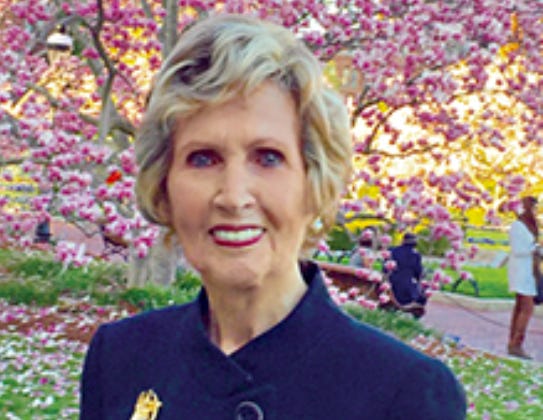
- Connie Morella
- Jean Roesser
- Betty Ann Krahnke
- Howard Denis
These were the suburban, college‑educated Republicans who defined the party for decades.
Today, Montgomery County is one of the most Democratic counties in America.
The coalition flipped.
The voters didn’t move — the parties did.
IX. Prince George’s County: A Different Mechanism
PG didn’t flip because of education.
It flipped because of:
- Black suburbanization
- demographic change
- migration from D.C.
- the rise of a Black middle class
It’s a different story than Montgomery or Howard, but it fits the same timeline.
X. The Modern Map: The Inversion Is Complete
Today in Maryland:
Democrats dominate:
- highly educated suburbs (Montgomery, Howard)
- racially diverse suburbs (Prince George’s)
- urban centers (Baltimore City)
Republicans dominate:
- white working‑class suburbs (Dundalk, Essex, Middle River)
- rural counties (Eastern Shore, Western Maryland)
- exurban pockets (Carroll, parts of Harford)
This is the exact opposite of the map you grew up with.
XI. The Takeaway: Parties Don’t Flip Ideologies — They Flip Coalitions
The Democratic Party didn’t “switch” from the KKK to civil rights.
The people who held those views moved between parties over decades.
Maryland shows this more clearly than almost any state.
- McKeldin → old liberal Republicanism
- D’Alesandro → early civil‑rights Democratic coalition
- Norman Stone → old Democratic working class
- Johnny Ray Salling → same voters, new party
- Connie Morella → old suburban Republicanism
- Chris Van Hollen → same geography, new party
- Gail Bates → old Howard County GOP
- Calvin Ball → new Howard County Democrats
The ground moved.
The parties followed.
If you want, I can now tighten this into an even sharper, more aggressive Maryland Wire version — or we can build a Facebook‑optimized explainer that walks your group through the realignment without triggering the usual reflexive arguments.
This is not a negative comment per se, but the last paragraph gives away where your writing for this article, at least, comes from. Using ChatGPT wisely means coming up with good questions and lines of inquiry, as you did, and then double checking both the facts and the logic of the argument. There is a little difference in someone using AI for research or general ideas - I am leaning heavily on AI to help me look at, analyze, and apply for solar grants here in PG county - to actually passing off as your writing.
In my own research, though, stubborn tropes appear: as an aggregator, it leans heavily on what the majority of people have said, even when it is wrong. In the case of solar, for example, it has consistently reminded me to apply for the federal tax credit - even when, in the same chat thread, I have already informed it that the credit is gone.
The tendency to aggregate is its biggest problem: AI does not do original thought. What you have consistently done is give original queries, and in that way presented new combinations of old ideas - ideas that many of your readers are not aware of.
Broadly, the history of Maryland that you present, and your grounding in knowing how to ask the right questions to get there, is really useful. I am a transplant to PG county from (indirectly - after college in Ohio) upstate New York. I did not grow up in Maryland, and did not grow up in Maryland politics. Beginning to explore it somewhat - as a good citizen should have begun to much sooner than 20 years in to living here - I find your column helpful, but it strikes odd tones every once in a while, and, as a teacher of literature, I know know where that tone is emanating from: my new nemisis: AI.
To whatever extent you are using AI... don't let it take over your own original insights, experiences, and thoughts. Again, it is an aggregator of popular opinion; it is not really an "intelligence".
It's just a tool that lets you know what everyone else is saying.
Great analysis 👍🙏