

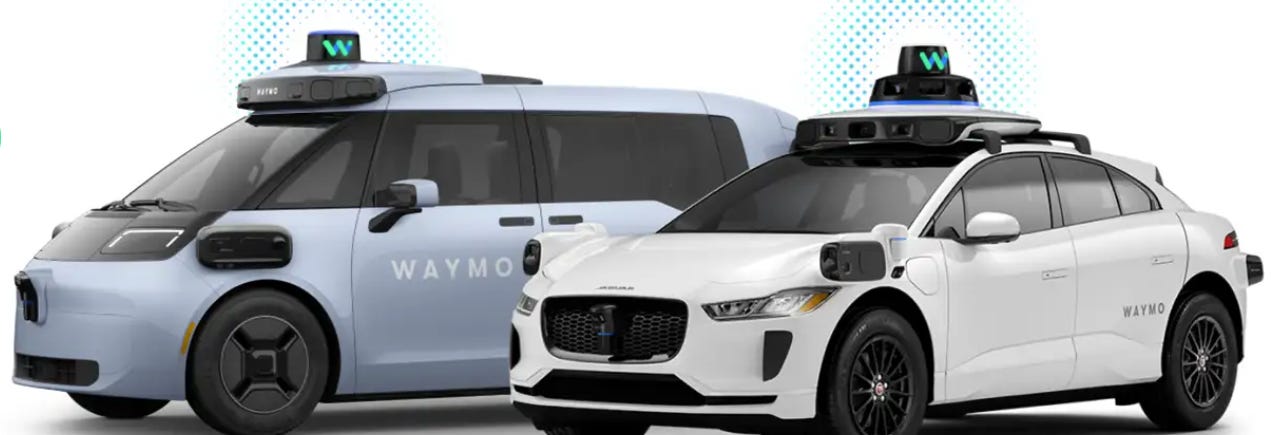
When Annapolis Lobbying Begins with a Hashtag
By J. Barry O'Connell
Publisher, The Maryland Wire
If you keep a close eye on the subtle mechanics of Annapolis procurement, you quickly learn that major policy moves rarely start with a formal press release or a bill reading in the State House. More often, they begin with a quiet signal dropped into policy circles.
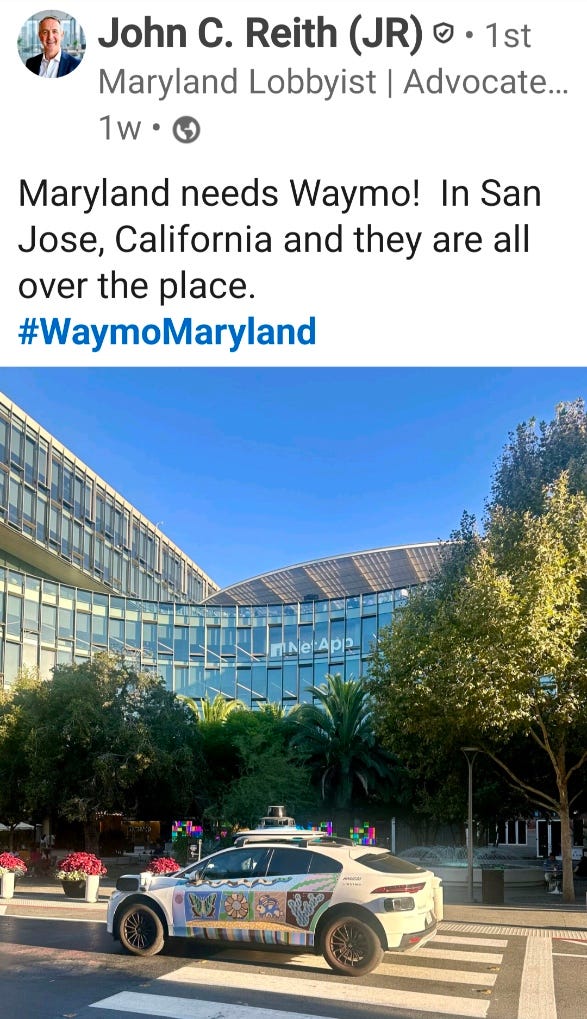
Case in point: a recent LinkedIn post from John C. "JR" Reith.
Reith, Chief Operating Officer and lead procurement lobbyist at government affairs powerhouse Rifkin Weiner Livingston LLC (RWL), posted a photo of a Waymo autonomous vehicle operating on the streets of San Jose, California. His caption was simple and direct: "Maryland needs Waymo!" accompanied by the hashtag #WaymoMaryland.
To the casual observer, it looks like a traveler sharing a neat piece of West Coast technology. But to anyone familiar with the corridors of state government, a post like that from a top-tier lobbyist is a classic "soft launch."
A quick check of public ethics registration records confirms the connection: Waymo LLC is an active client of Rifkin Weiner Livingston.
When a premier firm like RWL takes on a corporate client and begins floating its brand publicly, the wheels are already turning. It means the preliminary work—evaluating state regulatory frameworks, warming up agency leadership, and testing public appetite—is underway.
Clearing the Regulatory Runway
Autonomous vehicles cannot simply drop onto Maryland’s roads overnight. Navigating state oversight requires clearing a complex administrative pipeline managed primarily by the Maryland Department of Transportation (MDOT), the Motor Vehicle Administration (MVA), and the State Highway Administration (SHA).
Any driverless deployment in Maryland requires coordinated approval through MDOT’s Connected and Automated Vehicle (CAV) Working Group. Operating without a human safety driver demands:
Comprehensive Highly Automated Vehicle (HAV) testing permits.
Detailed law enforcement interaction plans to ensure emergency responders can safely communicate with or disable vehicles.
Specialized insurance coverage and real-time remote operational monitoring.
Bringing on a firm with RWL’s footprint indicates Waymo isn't just watching Maryland from afar—they are laying the groundwork to ensure our regulatory environment is ready when they decide to roll out local fleets.
A First-Hand Perspective on the Tech
I have a personal vantage point on this technology. Back in early 2020, I spent time in Chandler, Arizona, working on a risk management project for Wells Fargo. While out there, I participated in Waymo’s early driverless beta test program.
That project, like so much else, ended up interrupted by the onset of COVID-19. But my time riding in those early autonomous vehicles left a lasting impression. The technology was precise, smooth, and remarkably reliable even in its early stages.
Seeing Waymo successfully expand across major metropolitan markets like San Francisco, Phoenix, and Los Angeles over the last few years has been impressive. Speaking strictly as a satisfied early user, I would welcome seeing autonomous fleets operating in Maryland—whether connecting commuter corridors along I-95, serving regional transit gaps, or offering efficient urban rideshare options.
What Comes Next?
Reith's post isn't a signal that a state contract has been signed or that driverless cars will be navigating the Baltimore Beltway tomorrow. State procurement and regulatory approvals are thorough, multi-step processes that ultimately cross agency desks and, where major state partnerships are involved, the Board of Public Works.
What it does signal is that the conversation has officially started. Annapolis is paying attention, the advocacy groundwork is being laid, and #WaymoMaryland might be moving from a lobbyist's hashtag to a real feature of state transportation policy.
See Also:
JR Reith: Rifkin Weiner Livingston LLC (RWL)

[ANALYSIS] The Art of Adaptation: How GOP Operative JR Reith Navigates Supermajority Annapolis