

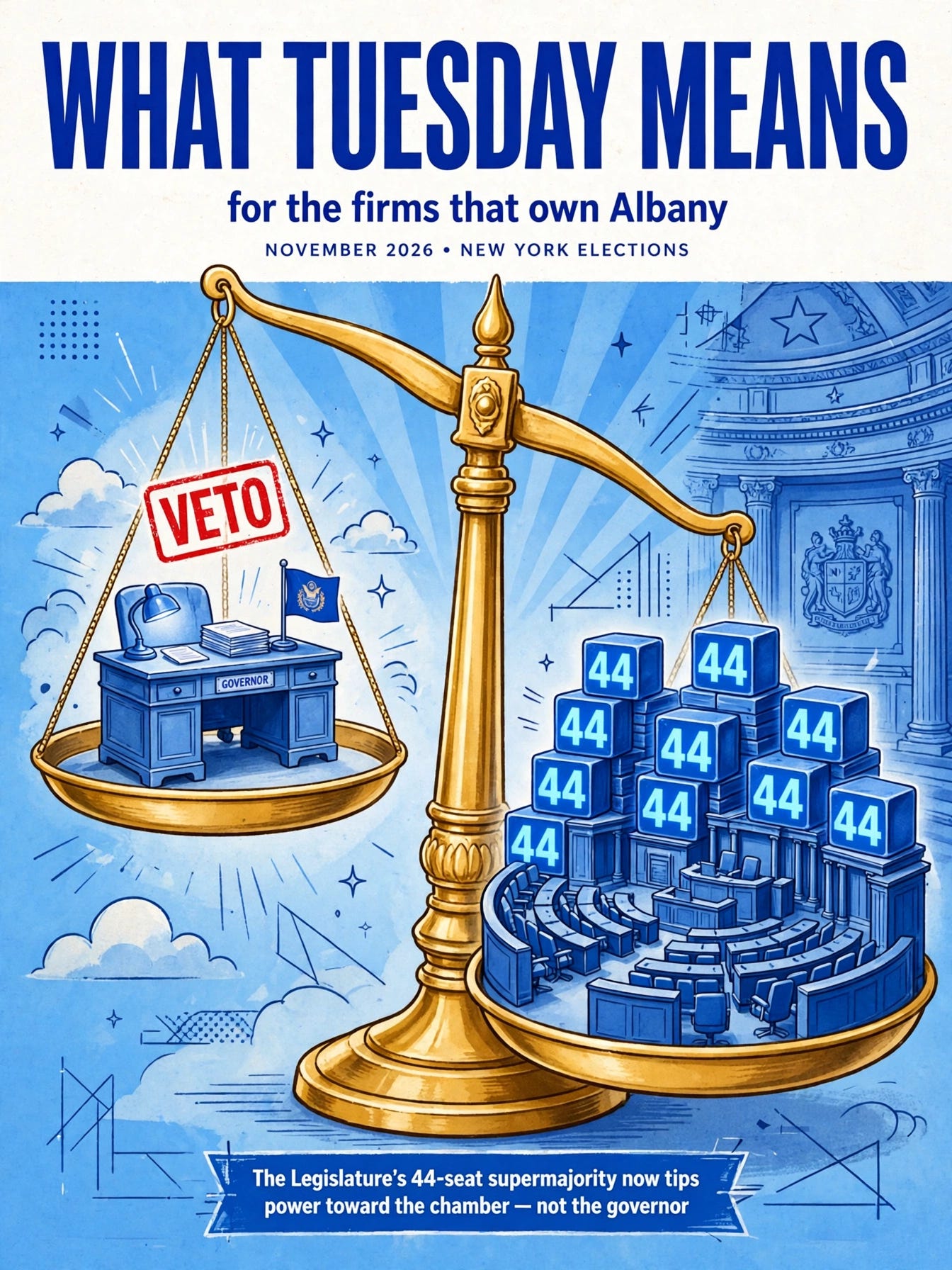
What Tuesday Means for the Firms That Own Albany
Tuesday redrew the power map in Albany, and if you make your living in government relations, the map is your business. Here is the headline number: Senate Democrats are back to a veto-proof supermajority — 41 seats became 44 on Tuesday night, with a 45th still possible. Everything else flows from that.
Start with the math, because the math is the market. Three seats flipped. In SD-1, Democrat Chris Murray — a Setauket environmental attorney — ousted Republican Anthony Palumbo, the first Democrat to hold that seat in 112 years. In SD-38, Nyack mayor Joe Rand beat two-term Republican Bill Weber. In SD-39, Dutchess County legislator Lisa Kaul beat Republican Rob Rolison, reportedly by a large margin. And in SD-44, Democrat Sarah Rogerson led longtime Republican Jim Tedisco by about 5,400 votes with no concession as of this morning — Tedisco has spent more than 40 years in the Legislature, including a turn as Assembly minority leader. If Rogerson’s lead holds, that’s a fourth flip and a 45-18 chamber.
Now the honest caveat, because I won’t sell you a supermajority as something it isn’t. The last time Democrats held these numbers, from 2020 to 2024, they never overrode a Hochul veto without Republican votes. No New York governor’s veto has been overridden since 2006. The override is a threat, not a weapon — the power sits in the leverage, not the execution.
Nine of Ten DSA-endorsed Candidates Won
But leverage gets stronger when somebody actually wants to use it, and that’s what’s different this time. The June primaries already sent a DSA-backed freshman class to Albany — nine of ten DSA-endorsed candidates won, including the takedowns of Senator Jessica Ramos and two members of Congress. Zohran Mamdani, who has been mayor of New York City since January, needs Albany for everything on his list: the city can’t set its own minimum wage, transit fares, or income-tax rates. His $30 wage bill has sat in one Senate committee untouched since January 7. The millionaire’s tax had both chambers’ backing and never made Hochul’s budget. With 44 votes, the conference can override the governor on exactly these items. The 2027 tax fight will be the first test of whether this progressive bloc pulls a trigger the last supermajority never would.
So Who Wins?
Start with the firms wired into the Senate Democratic conference. Brown & Weinraub sits at the top of my Albany ranking for a reason — about $24.3 million in 2025 compensation, number one in every reporting period — and this result is tailor-made for that position. Bolton-St. Johns and Kasirer, locked in their knife fight for second, are built the same way. And there’s a second-order winner nobody’s pricing yet: bench depth. Up to a dozen committee chairs are hitting the conference’s term limits, which means the biggest chair turnover since 2019. Firms with deep benches — again, the scale players — staff the new chairs’ offices and write the new chairs’ bills. Firms that spent the last two years getting to know the DSA orbit have a new client edge walking through the door in January.
And the firm that proved the electoral point most sharply is the one I wrote about Monday: Brown & Weinraub’s New York Forward super PAC went two-for-two on Tuesday, with Grace Lee taking SD-27 at 83.1 percent and Joe Addabbo taking SD-15 at 81.2. Owning the electoral machinery and owning the lobbying rankings at the same time is the whole game now.
One subplot to watch inside the rankings themselves: the knife fight for second place. Bolton-St. Johns and Kasirer have been trading the spot behind Brown & Weinraub for two years, and a veto-proof Democratic Senate with a dozen open chairs is the kind of market where that fight gets decided — chair races are relationship races, and relationships are inventory. Don’t sleep on Mirram Group either: nowhere in the 2025 top ten, up to ninth in the 2026 periods. In a market this fluid, momentum is a leading indicator.
Who Loses?
The Republican-leaning shops, first and hardest. A caucus of 18 or 19 is the least relevant Senate minority in years — and it lost both its veto-sustaining leverage and its best operators. Palumbo wasn’t just a vote; he was the deputy minority floor leader, the ranking member on Codes and Judiciary, and by his own count the author of 80-plus signed bills in six years despite minority status. He was the GOP’s most effective Democratic-facing dealmaker, the Republican a Democratic chair would actually take a meeting with. That bridge is gone. If Tedisco falls too, four decades of institutional memory walk out with him.
The Quieter Losers are the Governor-centric Shops.
For years the smart money in Albany was on the Executive Chamber — Hochul issued more messages of necessity than any governor since 2011, and the legislature passed its fewest bills since Democrats took control. Now the center of gravity moves across the street. The GR battle of 2027 won’t be convincing the governor. It’ll be holding 44 Democrats together, and the firms that win are the ones inside the conference, not the ones with the best second-floor relationships.
Then there’s the Churn
Which is where every firm’s relationship map gets redrawn in January. Andrea Stewart-Cousins faces the conference’s eight-year cap on the leadership post she’s held since 2019 — the conference can amend its own rules, and Senator Liz Krueger is already on record that she’d vote to scrap the limits because otherwise Stewart-Cousins can’t stay. Seven affected chairs surveyed all want her to stay. But nothing is decided, and there’s no consensus successor. Meanwhile the number-two jobs are genuinely open: Michael Gianaris retired in August, so the deputy leadership and the DSCC chair are both vacant — names in the mix include Jamaal Bailey, Andrew Gounardes, and Shelley Mayer — and in the Assembly, Majority Leader Crystal Peoples-Stokes is retiring, opening the number-two slot for the first time in Carl Heastie’s eleven years as speaker. Add Krueger’s own uncertain return as Finance chair after her April stroke, and January looks like the most fluid leadership season in a decade.
What to watch, in order.
First, the conference rules vote: whether Senate Democrats amend the eight-year cap and keep Stewart-Cousins, because everything downstream — chairs, deputies, the whole map — depends on that answer.
Second, the deputy-leader and DSCC races, which will tell you which faction of the conference is actually running the building.
Third, the first override threat: the moment the progressive bloc puts 44 votes behind a tax bill Hochul won’t sign, you’ll know whether the supermajority is a governing majority or just a big number.
Fourth, the copycats — Tuesday proved the firm-run super PAC works, and the second one is coming.
Here’s the bottom line for the GR world.
The firms that spent the last four years building legislative-Democratic depth just got paid. The firms that rented Republican access just watched the building get condemned. And everybody — everybody — needs a new map of the second floor by January 6, because the people holding the gavels, the chairs, and the 44 votes are about to change, and the override threat means the conference, not the governor, is where 2027 gets decided.