

What the I‑95 Corridor Really Cares About
Inside the Issues Driving Maryland’s Democratic Majority
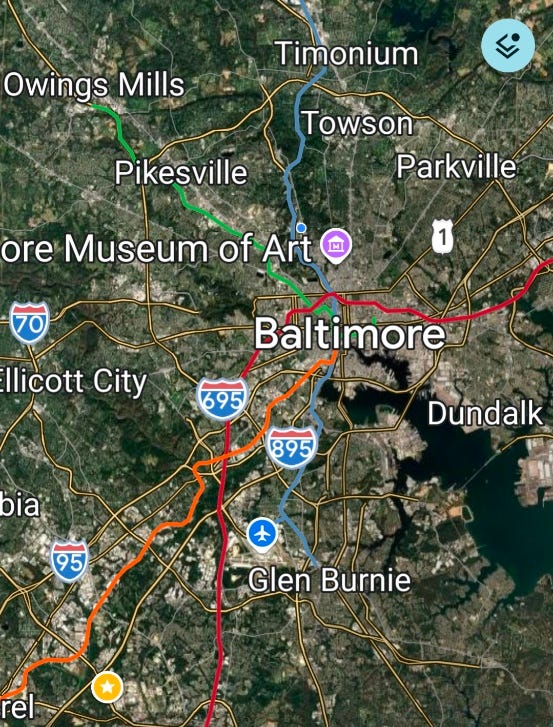
If you want to understand Maryland politics, you start where most Marylanders live: the dense, diverse, economically powerful stretch of counties running from Baltimore City through Anne Arundel, Howard, Baltimore County, Harford, Carroll, and Queen Anne’s. This is the I‑95 corridor, home to the overwhelming share of the state’s population — and the backbone of the Democratic coalition that dominates statewide elections.
For years, analysts have talked about the corridor as if it were a monolith. But new regional data from the Baltimore Metropolitan Council’s Pulse Survey gives us something Maryland rarely gets: a statistically solid look at what voters in these counties actually say matters most.
The picture that emerges is not ideological. It’s practical, economic, and intensely focused on quality of life.
1. The Economy: A Persistent Anxiety Across All Counties
Even in a region with some of the highest incomes on the East Coast, voters describe the economy in strikingly pessimistic terms. Across the corridor:
- A majority rate the economy as “fair” or “poor.”
- Inflation and cost‑of‑living pressures dominate household concerns.
- Wage growth is not keeping pace with expenses, especially for renters and younger families.
This is not recession panic — it’s the slow grind of middle‑class strain. For Democrats, it means the party’s strongest region is also its most economically anxious.
2. Housing Affordability: The Crisis That Defines the Corridor
If there is one issue that unites the I‑95 corridor, it is housing.
- Renters overwhelmingly say they are struggling to keep up.
- Prospective homeowners describe the market as out of reach.
- Even long‑time homeowners feel squeezed by property taxes and insurance costs.
Howard and Anne Arundel counties show the sharpest affordability concerns, but the sentiment is consistent across the region. For Democrats, this is the policy pressure point: voters want solutions, not slogans.
3. Transportation: A Region Split Between Transit and Traffic
The corridor is unified by congestion but divided by what to do about it.
- Baltimore City residents are strongly pro‑transit and want more investment.
- Harford and Carroll residents are skeptical of transit expansion and prioritize road capacity.
- Anne Arundel and Howard sit in the middle — frustrated with traffic, open to transit, but impatient with delays and cost overruns.
The Pulse Survey makes one thing clear: transportation is not a niche issue. It’s a daily frustration that shapes political attitudes.
4. Public Schools: Declining Satisfaction, Rising Expectations
Education remains a top-tier concern, but the mood is shifting.
- Satisfaction with public schools has declined across most corridor counties.
- Queen Anne’s is the only county where satisfaction remains high.
- Parents cite overcrowding, achievement gaps, and inconsistent communication.
For a Democratic majority that has long campaigned on education, this is a warning sign: voters still trust Democrats on schools, but they want visible improvement, not just funding formulas.
5. Taxes and Cost of Living: The Suburban Pressure Cooker
Even in deep-blue counties, taxes are not an abstract debate — they’re a kitchen‑table issue.
- Property taxes are a major concern in Howard, Anne Arundel, and Baltimore County.
- Residents link taxes directly to affordability, not ideology.
- Voters want value for what they pay, and they are increasingly vocal about it.
This is where Democrats must tread carefully: the corridor is liberal, but it is not tax‑insensitive.
6. Environment and Water Quality: A Quiet but Consistent Priority
The Pulse Survey shows a surprising result: across the corridor, the top environmental concern is clean drinking water.
Not climate change.
Not air quality.
Not recycling or waste.
Water.
It’s a reminder that environmental politics in Maryland are hyper‑local and tied to daily life — pipes, taps, and trust.
What This Means for Maryland’s Democratic Majority
The I‑95 corridor is the engine of Democratic power in Maryland, but its priorities are not ideological talking points. They are:
- Economic stability
- Affordable housing
- Functional transportation
- Strong public schools
- Reasonable taxes
- Safe, reliable water
This is a coalition built on practical governance, not partisan identity. The data shows a Democratic majority that is broad, diverse, and deeply focused on quality‑of‑life issues that affect daily life.
If Maryland politics sometimes feel less polarized than national politics, this is why: the voters who decide statewide elections are not culture‑warriors. They are commuters, parents, renters, homeowners, and workers who want the basics to work.
And right now, they’re telling us — with real data — exactly what those basics are.
N.B.
One quick note on geography: This article uses the Baltimore Metropolitan Council’s definition of the “I‑95 corridor,” which is based on commuter flow and regional economic integration, not the narrower political shorthand most Marylanders use. For transportation planners, the corridor includes not only Baltimore City, Baltimore County, Anne Arundel, Howard, and Harford, but also Carroll County to the west and Queen Anne’s County to the east — both of which send large shares of their workforce into the I‑95 spine every day.
That’s why you’ll see Carroll and Queen Anne’s included here even though they aren’t part of the traditional political map of the corridor. The goal is to reflect the actual lived region that shares housing pressures, transportation patterns, school concerns, and cost‑of‑living trends — not just the counties that touch the highway. It’s a broader, data‑driven definition, and it gives us the clearest picture of what matters most to the people who live and work in Maryland’s most influential metro region.
Thomas was a typo. I don't know how it got in there. I think spell check.
How are you Defining the I-95 Corridor as not including Prince George's County?