

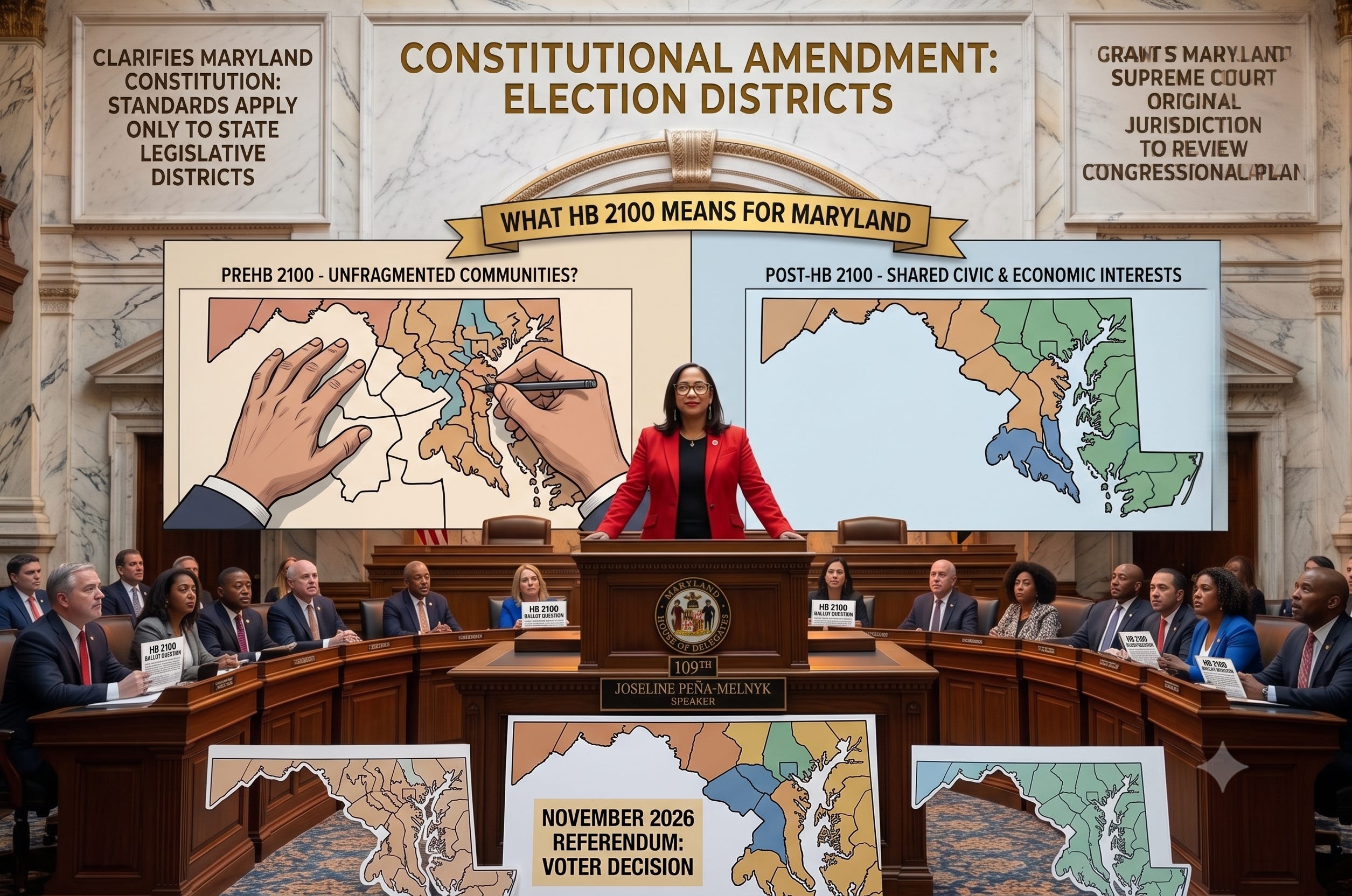
The General Assembly’s Redistricting Amendment: What HB 2100 Means for Maryland
The Maryland General Assembly concluded a high-stakes, three-day special session by passing House Bill 2100, a proposed constitutional amendment designed to reshape the rules of congressional redistricting in Maryland. Passed along party-line votes in both chambers—96–38 in the House and 32–13 in the Senate—the measure sets the stage for a potential mid-decade overhaul of the state's congressional map ahead of the 2028 election cycle.
Here is a breakdown of what the legislation actually does, why Democratic leadership called the special session, and how it alters the political geography of Maryland.
1. What the Bill Does (and Doesn't Do)
HB 2100 does not redraw a single line on Maryland’s current map, nor does it affect the upcoming 2026 midterm elections.
Instead, it addresses a key legal bottleneck stemming from 2022, when Senior Judge Lynne Battaglia struck down a Democratic-drawn congressional map. Battaglia ruled that Article III of the Maryland Constitution—which requires legislative districts to be compact and respect county/jurisdictional boundaries—applied to federal congressional seats as well.
HB 2100 asks voters to amend the state constitution to explicitly clarify that those strict compactness and county-line standards apply only to General Assembly seats, leaving congressional districting explicitly governed by federal standards.
2. The November 2026 Referendum Hurdle
Because HB 2100 is a constitutional amendment, passing the legislature was only phase one. The final decision rests with voters on the November 3, 2026 general election ballot.
If voters approve it: The General Assembly gains clear legal authority to execute a mid-decade redistricting ahead of the 2028 elections, immune to state-level compactness challenges.
If voters reject it: Maryland’s congressional maps remain bound by the 2022 judicial standards until after the 2030 U.S. Census.
3. The National Context: Escalating Mid-Decade Gerrymandering
Maryland Democrats framed the move as a necessary response to a national wave of mid-decade redistricting in GOP-controlled states like Texas, North Carolina, and Florida. Senate President Bill Ferguson and Speaker Joseline Peña-Melnyk argued that Maryland must arm itself with the legal flexibility to counter Republican gains elsewhere.
Republicans, conversely, denounced the special session as a partisan power grab that wastes taxpayer money to eliminate Maryland’s sole remaining Republican-held seat.
4. What It Means for Maryland’s Political Map (2028 & Beyond)
If voters pass the referendum in November, legislative mapmakers will target the state's 7–1 Democratic delegation balance with the goal of creating an 8–0 delegation. Achieving that outcome requires a specific geographic shuffle:
[ Current MD-01 ]                         [ Proposed Post-2026 Strategy ]
Eastern Shore + Harford Co.    --->       Eastern Shore + Anne Arundel / PG Pockets
(Solid GOP - Rep. Andy Harris)            (D-leaning competitive district)

                                          Harford County shifted into MD-02 / MD-03
                                          to absorb GOP voters out of MD-01
Targeting Andy Harris (MD-01): To make the 1st Congressional District competitive for a Democrat, mapmakers must remove Republican-heavy territory. The most direct route is shifting Harford County out of MD-01 and replacing those voters by jumping the Chesapeake Bay to pull in Democratic precincts from Anne Arundel or Prince George’s counties.
The Impact on Johnny Olszewski (MD-02): Absorbing conservative Harford County into the 2nd District would expand MD-02's footprint beyond Baltimore and Carroll counties. While MD-02 would remain reliably Democratic overall, adding Harford's electorate reinforces the district’s working-class, suburban-moderate Democratic character—further insulating an incumbent like Johnny Olszewski against primary threats from the progressive wing of the party.
Barry, thoughtful as usual. But this observation by Mencken seems appropriate for this issue.
“Under democracy one party always devotes its chief energies to trying to prove that the other party is unfit to rule – and both commonly succeed and are right.”