

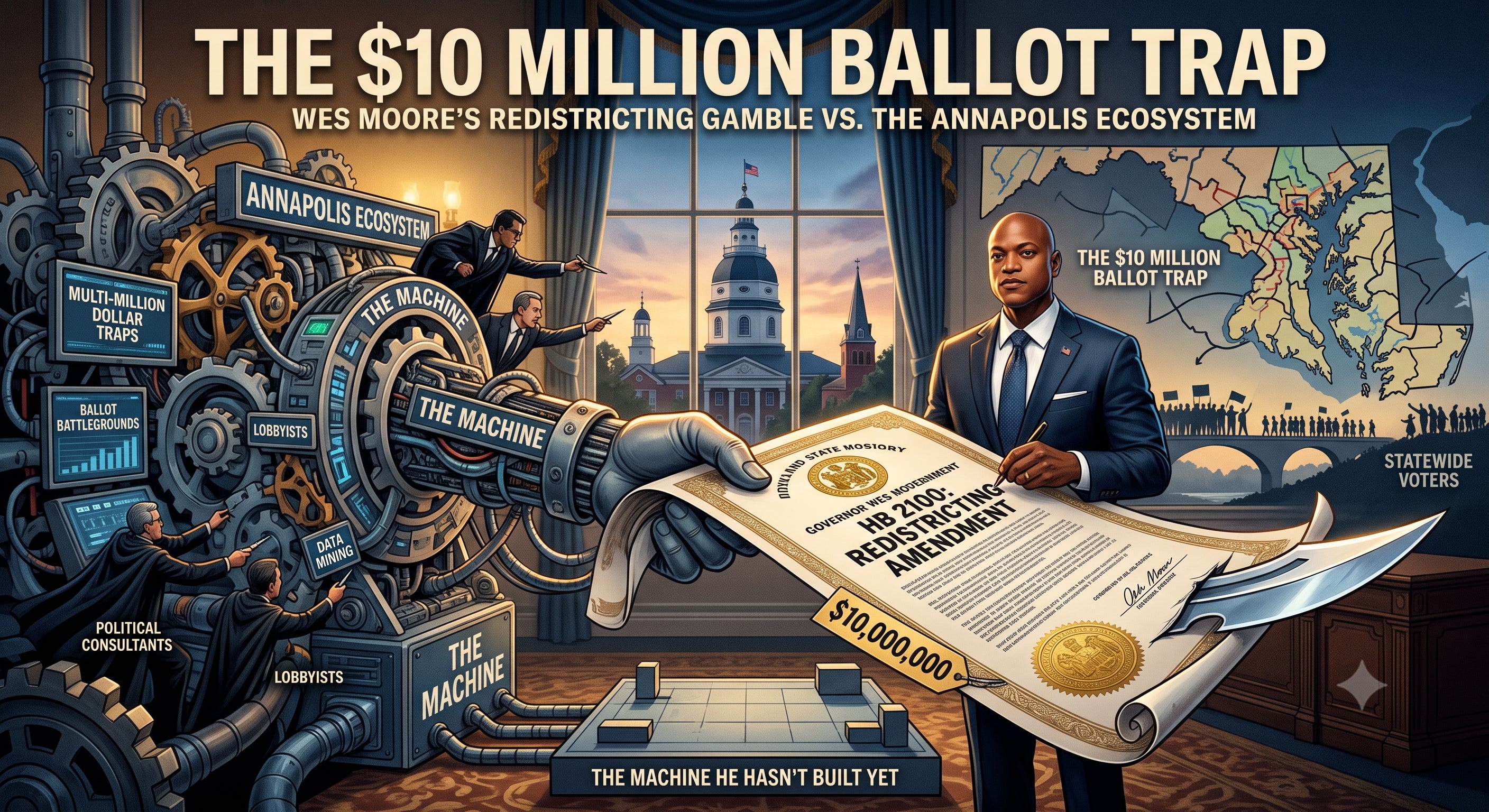
The $10 Million Ballot Trap: Why Wes Moore’s Redistricting Gamble Depends on the Annapolis Ecosystem
Governor Wes Moore signed HB 2100 to set up a clash over Maryland’s congressional maps. But passing a constitutional amendment isn’t a legislative vote—it’s a statewide knife fight. Here is why the governor’s biggest political threat isn't the GOP, but the multi-million-dollar machine he hasn't built yet.
By J. Barry O’Connell
When Governor Wes Moore signed HB 2100 following the General Assembly's special session, the political headlines wrote themselves: Maryland Democrats were officially drawing a line in the sand against national Republican mid-decade redistricting. By putting a constitutional amendment on the November ballot to clarify state standards for congressional maps, the administration signaled it was ready to play hardball.
On paper, it looks like a slam dunk. Democrats hold a 2-to-1 voter registration advantage in Maryland, and constitutional amendments rarely fail in blue states.
Except when they do.
The fatal assumption inside government executive suites is that ballot measures run on the governor's popularity. They don't. Ballot initiatives are blank slates where voter confusion reigns. While candidate campaigns are fought on vision and persona, ballot campaigns are fought on doubt. The opposition doesn't need to convince Marylanders that the current map process is sacred; they just need to whisper two words: "Politician power grab."
If the Republican opposition mobilizes a lean, low-cost "Vote NO" effort—backed by anti-gerrymandering watchdogs and conservative donor networks—they can easily trigger the reflex of moderate and independent voters who default to "No" when confused.
For Wes Moore, the political calculus couldn't be higher. A defeat on a marquee ballot measure on home turf wouldn't just be an embarrassing local setback—it would echo across national political circles. National primary voters, labor leaders, and big-ticket donors look for executives who command their state apparatus. Losing a ballot initiative in a deep-blue state damages the aura of political invincibility, raising questions about his ability to mobilize a base when the stakes are highest.
So how does a governor guarantee a "YES" vote on a technical, non-commercial constitutional amendment? You don't rely on press conferences. You build an operational juggernaut.
And that juggernaut requires one thing: massive, early, and specialized capital.
(Paid Subscriber Paywall Break)
🔒 SUBSCRIBER-ONLY CONTENT 🔒
Thank you for supporting independent political journalism. Read below for the deep dive into the national funding pipelines, labor strategy, and the public affairs windfall about to hit the State Circle.
