

OP‑ED ANALYSIS: Wes Moore’s South Carolina Trip Wasn’t About 2028 — It Was About Flipping The Future
By Barry O’Connell
Maryland Wire
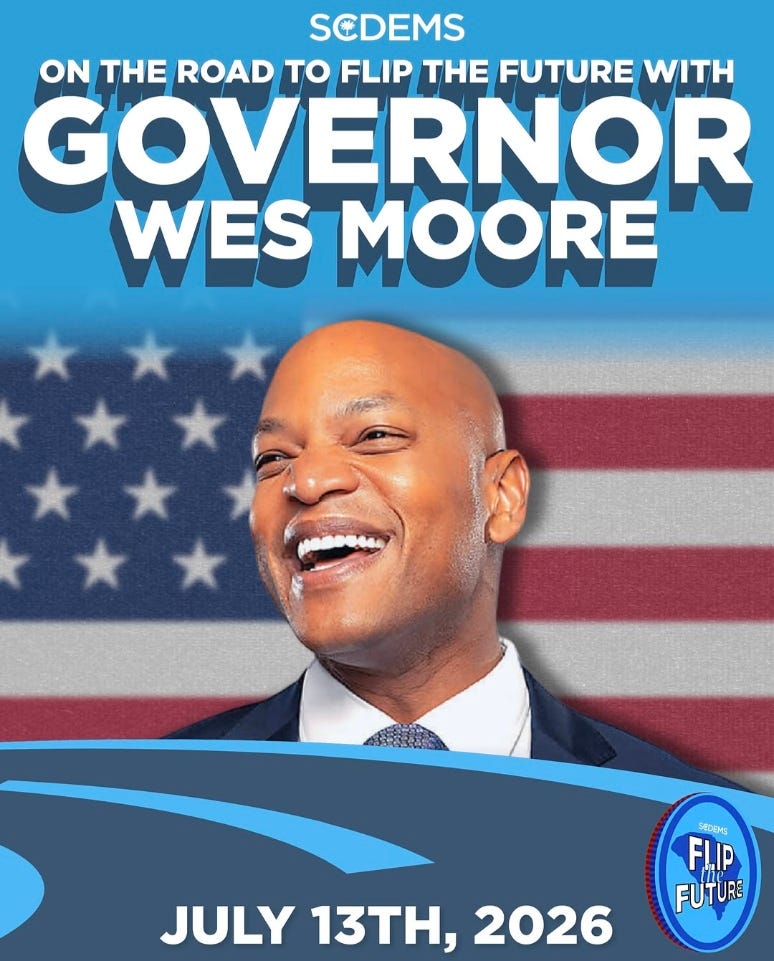
When Governor Wes Moore showed up in South Carolina’s House Districts 67 and 116 last week, the easy interpretation was the wrong one. The chatter online framed it as a stealth presidential audition — Moore “testing the waters,” Moore “building his brand,” Moore “positioning for 2028.” But that’s not what happened, and it misses the deeper significance of why the South Carolina Democratic Party asked him, specifically, to come.
Moore didn’t pick those districts.
The party picked those districts.
And they picked Moore because he is, at this moment, the most effective Black surrogate in the country, with roots that resonate in South Carolina’s political culture.
This wasn’t a personal campaign trip.
It was a party‑building trip — and the party needed him.
The Lindsey Graham Factor: Why Turnout Suddenly Matters Everywhere
The death of Senator Lindsey Graham has scrambled South Carolina politics. A special election is coming, and Democrats — who have been structurally disadvantaged statewide for decades — suddenly need turnout everywhere they have any measurable strength.
That means:
- Charleston County (HD‑116)
- Sumter County (HD‑67)
- Every Black‑majority precinct from the Lowcountry to the Midlands
These are the places where Democrats can bank votes, build infrastructure, and test their organizing muscle ahead of a statewide contest they cannot afford to sleepwalk through.
Moore didn’t choose HD‑67 or HD‑116 because they help him.
He went because those districts help the party.


Why Moore Was the One They Called
There are only a handful of Democrats in America who can walk into a Black church in Charleston or Sumter and command instant credibility without needing an introduction. Moore is one of them.
He is:
- Young, energetic, and nationally recognizable
- A military veteran with service credentials that matter in the South
- A governor with a clean, upward trajectory
- A Black leader whose biography mirrors the lived experience of millions of Southern families
And yes, he has South Carolina roots — like many Marylanders whose families moved north during the Great Migration. That matters culturally. It matters symbolically. And it matters politically in a state where lineage and community ties still carry weight.
If you’re the South Carolina Democratic Party and you need turnout in Black districts, you don’t call a senator from the Northeast.
You call Wes Moore.
The Presidential Glow Without the Presidential Ask
Let’s be honest: Moore benefits from this.
Not because he’s campaigning for himself — he isn’t.
But because party‑building is what presidential‑quality politicians do, and people notice.
There’s a difference between campaigning for yourself and demonstrating that you can campaign for others. The latter is what Barack Obama did in 2006 and 2007 — long before he announced anything. It’s what Bill Clinton did in 1988. It’s what Kamala Harris did in 2016.
Moore’s trip fits that mold:
- He helped Clay Middleton in HD‑116, a Clyburn‑aligned candidate in a district Democrats can pick up.
- He helped Lisa Davey in HD‑67, a Midlands district where Black turnout is decisive.
- He strengthened relationships with county chairs, pastors, organizers, and activists who shape the Democratic electorate.
That’s not campaigning.
That’s capacity‑building — the kind of work that makes a politician look presidential without ever saying the word.
The Politically Polite Way to Say What Everyone Means
There’s a delicate way to describe Moore’s appeal without stumbling into the minefield of racial terminology.
Barack Obama was the son of a Kenyan father and a white American mother — a unique and globally resonant biography.
Wes Moore is African‑American in the traditional sense: the descendant of Black Americans whose families lived through the South, the Great Migration, and the American story as it unfolded here. His roots are familiar. His background is recognizable. His identity aligns with the communities he’s speaking to.
That’s why he works so well as a surrogate in South Carolina.
He isn’t an outsider parachuting in.
He’s a reflection of the people he’s talking to.
The Real Story: Moore as the Party’s Builder‑in‑Chief
If you strip away the speculation, the story becomes clearer:
- Moore went where the party told him to go.
- He campaigned for the candidates the party needed him to support.
- He boosted turnout in districts where Black voters decide Democratic fortunes.
- He strengthened the party’s infrastructure ahead of a special election.
- And yes, he looked presidential doing it — because competent party‑building always looks presidential.
This wasn’t a stealth 2028 trip.
It was a South Carolina Democratic Party operation, executed by the person best suited to carry it out.
And that’s the part worth reporting.