

Putting the Squeeze on the Governor
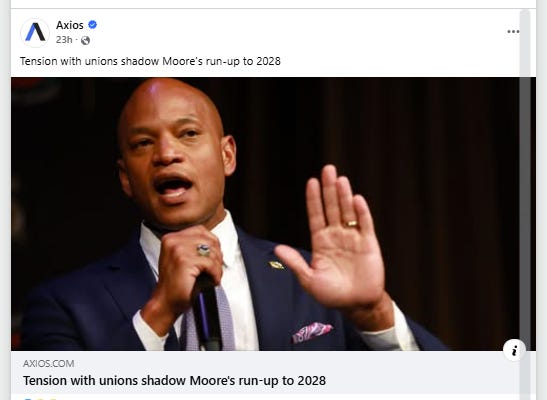
Labor sees Wes Moore rising — and they’re not going to let that moment go to waste.
There’s a new storyline running through Maryland politics, and it didn’t come from Annapolis. It came from labor. Axios reported that union leaders are frustrated with Governor Wes Moore — not because he’s anti‑labor, not because he’s stingy, and not because he’s drifting away from them ideologically. The tension is happening for a much simpler reason:
Wes Moore is rising nationally, and labor intends to collect while the market is hot.
This isn’t betrayal.
This isn’t a schism.
This isn’t a break.
This is leverage.
And labor is doing exactly what labor is supposed to do.
Labor’s Timing Is Perfect
Unions don’t push hardest when a governor is weak.
They push hardest when a governor is:
- popular,
- visible,
- rising,
- and entering a national spotlight.
Wes Moore checks all four boxes.
He’s a friend to labor — a genuine one — but he’s also a governor with a national profile. And when a governor starts showing up in national conversations, unions don’t sit quietly and clap politely. They lean in. They push. They squeeze.
Not because they dislike him.
Because they understand the moment.
The Real Issue: No Governor Can Ever Give Labor Everything
Axios quoted union officials saying Moore “says the right things” but doesn’t always follow through. That’s not a policy indictment — that’s a capacity indictment.
Labor’s needs are bottomless because the problems they face are bottomless:
- staffing shortages,
- inflation pressure,
- vacancy crises,
- burnout,
- public‑sector wage compression,
- long‑term underinvestment.
There is no governor alive who could satisfy all of that.
Not Moore.
Not Hogan.
Not O’Malley.
Not Schaefer.
Not anybody.
So when unions say Moore isn’t giving them “enough,” what they really mean is:
> “We know you can’t give us everything — but you can give us more, and now is the time.”
That’s not hostility.
That’s negotiation.
The Tone Problem
Axios reported something more interesting — and more important — than money:
Some union leaders say Moore can be “combative.”
That’s not about budgets.
That’s about relationships.
Labor doesn’t mind tough negotiations.
Labor doesn’t mind slow negotiations.
Labor doesn’t mind incremental negotiations.
But labor does mind feeling brushed off, rushed, or treated like a nuisance.
Moore is a disciplined, high‑energy, mission‑driven executive.
That’s good for governing.
But it can create friction in labor negotiations, where tone matters as much as substance.
This is the deeper tension — not ideological, not financial, but interpersonal.
Labor Isn’t Angry — They’re Opportunistic
This is the part people misunderstand.
Unions aren’t trying to punish Moore.
They’re trying to shape Moore.
They see:
- a rising national figure,
- a governor with national attention,
- a leader who may be on a bigger stage soon.
And they want to make sure that when he steps onto that stage, he carries labor’s priorities with him — not just Maryland’s priorities.
This is not rebellion.
This is positioning.
Wes Is a Friend to Labor — But He’s Not a Pushover
Wes Moore is pro‑labor, but he’s not the kind of governor who hands over the whole store just because someone rattles the door.
He respects unions.
He works with unions.
He listens to unions.
But he also governs the entire state — not just the labor movement.
And unions know that.
Which is why they push harder.
The Bottom Line
This is not a schism.
This is not a break.
This is not a crisis.
This is labor doing its job and Moore doing his.
Labor squeezes.
Governors resist.
Deals get made.
Relationships get bruised.
Everyone moves forward.
The only difference this time is that Moore’s national profile raises the stakes — and unions intend to make the most of it.
They’re not angry.
They’re not disloyal.
They’re not drifting away.
They’re negotiating with a governor who suddenly has more to lose — and more to give.
And that’s the story.
Moore will have more credibility in this state and nationally by creating mid range sensible economic policies that solve for the 4B projected budget shortfall over his next prospective term. The unsolved economic challenges here won’t help him on any national stage.