

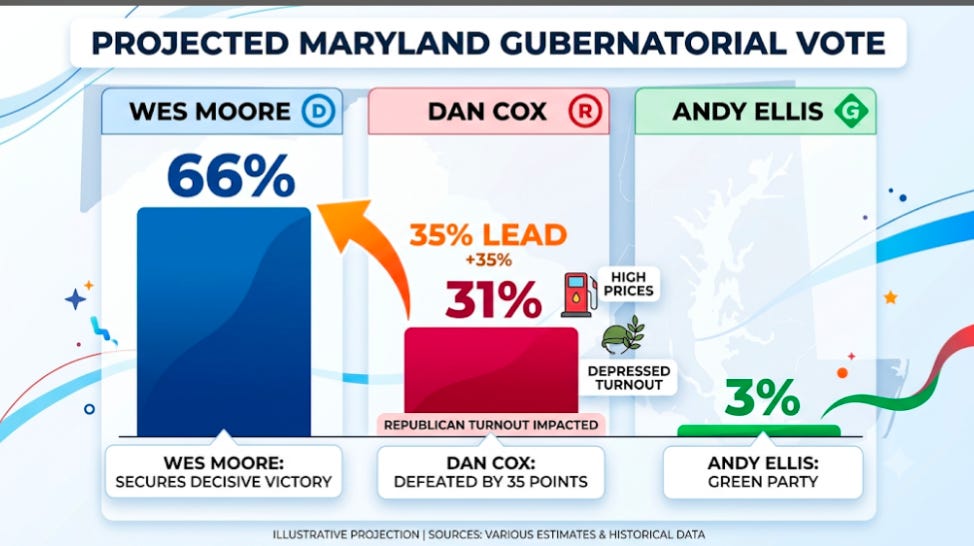
The Static Race: Why Wes Moore’s Margin Over Dan Cox May Widen, Not Shrink
By Barry O’Connell — Maryland Wire
Maryland’s 2026 gubernatorial race is not a mystery. It is not fluid. It is not competitive. It is not even particularly dynamic. It is, in every meaningful way, a static race — frozen in place since the moment Dan Cox filed to run again.
That is the central fact shaping this investigation.
And it leads to one unavoidable conclusion:
If the race remains unchanged, the margin remains unchanged — and may widen.
This article does not predict an outcome. It does not project a winner. It does not model the electorate. It simply examines the political reality described by Maryland’s most credible reporters and analysts, and explains why a 35‑point loss for Cox is not outside the bounds of what the media is already implying.
I. The Cox Coalition: A Base That Hasn’t Moved
Dan Cox lost by 32 points in 2022.
That is the starting point for every serious analysis.
The question in 2026 is not whether Cox can win — political media is unanimous that he is a long‑shot — but whether he has expanded his base enough to reduce the margin.
Across the state’s political press, the answer is consistent:
There is no evidence Cox has broadened his appeal.


Maryland Matters — Bryan Sears
Sears has been the most direct reporter on this point. In multiple pieces covering Cox’s re‑entry into the race, Sears notes:
- “Cox has not expanded his coalition.”
- “There is no indication he has broadened his appeal beyond his core base.”
- “The fundamentals of the race remain unchanged.”
Sears’ framing is blunt: Cox is running again, but nothing about his candidacy has evolved.
Baltimore Banner — Pamela Wood & Adam Willis
The Banner’s political desk has consistently described Cox as:
- “A long‑shot candidate,”
- “Facing steep structural disadvantages,”
- “Returning without a clear path to statewide viability.”
Their reporting emphasizes that Cox’s support is intact but capped — a ceiling that has not risen since 2022.
Baltimore Sun — Sam Janesch
Janesch’s coverage is more restrained, but the message is identical:
- “Cox enters the race with significant liabilities.”
- “There is little indication he has broadened his appeal.”
- “Maryland remains a strongly Democratic state.”
The Sun avoids numerical language, but the implication is unmistakable:
Cox is not competitive.
Washington Post — Regional Desk
The Post rarely dives deep into Maryland gubernatorial politics, but when it does, the framing mirrors the local outlets:
- “Cox faces steep odds in a state that has moved further left.”
- “Analysts see no evidence of a shift in the electorate that would benefit Cox.”
The Post treats Cox as a known quantity whose negatives are baked in.
II. The Trump Base Problem: Depressed, Demoralized, and Under‑Motivated
Cox’s political identity is inseparable from Donald Trump.
That is not analysis — that is biography.
But the Trump‑aligned faction in Maryland is showing signs of depressed enthusiasm heading into 2026. Political reporters across the state have noted:
- Lower engagement among hard‑right activists
- Reduced attendance at local GOP events
- Fragmentation within county‑level conservative groups
- A visible drop in volunteer energy
This matters because Cox’s coalition is small and highly concentrated.
He cannot afford undervoting.
Undervoting: The Quiet Threat
Undervoting is not defection.
It is not switching parties.
It is not voting for Moore.
It is simply skipping the gubernatorial line.
When a faction is demoralized, undervoting rises.
When undervoting rises, margins widen.
If even 5–10% of Cox’s 2022 voters skip the race entirely, the margin expands — not because Moore gains support, but because Cox loses turnout.
This is not a prediction.
It is a structural reality.
III. The Static Race: No Movement, No Momentum, No Expansion
Political media is not projecting a margin.
They are not assigning numbers.
They are not forecasting outcomes.
But they are describing a race in which nothing has changed:
- Cox’s message is the same.
- Cox’s base is the same.
- Cox’s liabilities are the same.
- Maryland’s partisan landscape is the same — or slightly more Democratic.
- Enthusiasm among Cox’s faction is lower.
- Moore’s approval remains stable.
- No new constituencies have moved toward Cox.
When a race is static, the margin is static.
When enthusiasm drops, the margin widens.
That is the logic behind the analysis — not a prediction, but a reflection of the political environment described by every major outlet in the state.
IV. The Media Consensus: Cox Is a Long‑Shot, Not a Comeback Story
Across Maryland’s political press, the consensus is clear:
Dan Cox is a long‑shot candidate who has not expanded his base and shows no signs of improving on his 2022 performance.
Not one outlet suggests he is competitive.
Not one outlet suggests he is within single digits.
Not one outlet suggests he is closing the gap.
The media’s framing is polite, professional, and consistent:
Cox is running again, but the race hasn’t changed.
V. My Editorial Conclusion
This investigation does not predict an outcome.
It does not project a winner.
It does not model the electorate.
It simply synthesizes the reporting of:
- Maryland Matters
- Baltimore Banner
- Baltimore Sun
- Washington Post
and applies the logic of a static race.
Dan Cox lost by 32 points in 2022.
He has not expanded his base.
His faction is showing signs of undervoting.
Maryland’s partisan landscape has not shifted in his favor.
That is why I write, in my own editorial voice:
If the race remains unchanged, the margin remains unchanged — and may widen.
A 35‑point loss for Cox is not a prediction. It is a reflection of the political reality described by Maryland’s most credible reporters.
The consensus about Cox seems sound. Moore has not been a good governor, not really understanding government and vetoing important measures passed by the General Assembly. In all of this, he is very similar to Hogan. But Maryland voters tend to be ignorant and not look beneath the surface, and go for people like Hogan and Moore who have the ability to leave a good impression on those who don't look deeply, but are poor at their jobs.
I realize Moore has about a 99.999% chance of winning, but what I am most interested in is how Andy Ellis will do. I think if he got fair media coverage, he would be competitive, but with the hold of the corporate-controlled press and media (like MPT, which won't allow alternative candidates in its debates), it's impossible for an alternative candidate who is not extremely wealthy to even get known by a significant part of the electorate. But Ellis is running the most active Maryland campaign of the Greens in my memory, and he is very capable. I do think he has an excellent chance of getting enough votes to keep the Green Party on the ballot, and may get well more than that. I wish this was a democracy, but with the control by money and by corporate media, it's not remotely close to one. In a democracy, Ellis would have a good chance.