


Richard Elliott: Well, good day, Barry. This is Richard Elliottt, writer, reporter with the Washington Informer, noted Prince Georgian and friend of the Maryland Wire. I am ready to talk with you today on any variety of topics that you want before Barry begins the monetization that he deserves of the Maryland Wire.
J. Barry O’Connell: Well, thank you very much. I certainly appreciate that. You know, one of the things people are looking at is the special session—that’s the big deal in the next few weeks. We’ve got a special session where the speaker and the president have come together, signed a letter, declared, and this is a matter of law: the only things that can be considered are reapportionment. There’s a quirk in the Constitution—if they don’t put it in the call, you can’t talk about it. And the only thing that they talked about that’s eligible is reapportionment. What are you seeing? Why would they do that, and how do you think it’s shaping up?
Richard Elliott: So in my opinion, the push for data center moratoriums has grown. The state of New York implemented a statewide data center moratorium in the past couple of weeks. Montgomery County is getting ready to do an 18-month one, Harford County has done one. So there’s quite a push from individuals who are skeptical or hesitant or oppositional to data centers to have that as a topic during the special session.
There are also Republicans that want to push for a variety of measures during a special session just, you know, in essence for media attention. So I am not going to say that I would necessarily have broadened it or narrowed it. But having the focus be the apportionment limits the amount of things they will be able to say during the discussion and is going to keep the entire argument about how, why, and when Maryland can legally redistrict—and hopefully be done in a manner that is considered airtight by the current Maryland Supreme Court, which includes multiple justices appointed by Larry Hogan.
J. Barry O’Connell: Okay. Let me ask you a question. Do you think saying only redistricting is an attempt by Bill Ferguson to reestablish himself? I mean, for the last number of years, he’s been cruising along as “mini Mike”—you know, he’s not quite Mike Miller, but he’s a smaller version of Mike Miller. And now he gets slapped around in a primary that he came too close to losing. Is he vulnerable? Is he weaker? Is he trying to establish his authority? Or do you think I’m being overly paranoid?
Richard Elliott: That race between Senate President Ferguson and Bobby LaPin, I would absolutely call dangerously close for a Senate President. Senate President Miller never faced a primary challenge that dangerous during his entire career. It means that Ferguson not only has to reinforce his flank, but he also has to worry as that district continues to have an influx of young white residents that in essence have no ties to the District Team 46, as Black voters in that district continue to get mobilized, and as the Latino population in that district increases.
Do I think that Bobby LaPin was a strong candidate to take on Bill Ferguson? Not particularly. He just raised a lot of money based primarily on criticisms of Ferguson as too conservative on redistricting. But if a different candidate that has more political footing were to take on Ferguson, he could be at real risk of losing.
The question for Ferguson not only is how can he reinforce himself against the insurgent progressive young left in his district, but also to ensure that when state-level redistricting occurs in 2032 or so, that he draws himself a safer district than the one that is currently drawn. I would probably advocate for him drawing his district into both Dundalk and Brooklyn Park, being a tri-county district similar to Mike Miller’s Prince George’s, Charles County, Calvert County tri-district.
J. Barry O’Connell: That’s an interesting idea. You know, I’ve been thinking that he’d have to go into Republican areas, but maybe that would be better. I mean, if he’s not willing to work the district God gave him, then maybe he needs to go pull some Republican votes.
Richard Elliott: Well, I’m going to advocate for that for two reasons:
That would make it easier for Baltimore City to maintain the five Senate slots that it currently has and not necessarily lose any delegates.
It would give Ferguson a voice on two county delegatio s.
That is why I think that would be a particularly wise decision. It would reinforce Baltimore’s political power, and it would also give Ferguson rather considerable authority on the Baltimore County Senate delegation, which I think is a very pivotal one along with Anne Arundel, which is turning bluer by the day.
J. Barry O’Connell: Absolutely right. I mean, yes, and I think that makes a difference. I think he needs to take a serious look at... you know, Fells Point is a great place to live, but Fells Point is less white, more Black and Hispanic than ever. And if you’re not even going to get out and talk to “those people,” then how do you expect to win your district? How do you expect to be strong? How do you expect to maintain—I mean...
Richard Elliott: Ferguson ran what I would call a strong retail campaign. I saw Ferguson out even when it was raining heavily with large contingents of people door-knocking. District 46 is, in my opinion, the most door-knockable part of the state. It is incredibly dense, incredibly walkable, and fairly high turnout. It is a great place for door-knocking, and I felt personally—others may disagree—that Senate President Ferguson, as soon as he felt that he was in a donnybrook, decided to get everything together and truly show how strong of a campaign he can put together.
I think that he ran a very strong one. It’s just that his district has the demographic characteristics where, like some of these districts in New York where progressive candidates are winning, there are a lot of young white voters who have no political tie to the political apparatus and thus are very easy to turn on it. That’s not a criticism or a praise of such voting tactics; it’s just an acknowledgment of the way some districts are geographically constructed. District 46 is the most well-to-do, has the waterfront property, etc. It also has a decent population of Republicans relative to everywhere else in the city, which makes it where there are fewer votes that Ferguson has to fight for in the primary.
J. Barry O’Connell: Bill took an easy walk through all of his races until this year.
Richard Elliott: Well, that’s hard to say for the Della race, but for the other ones, yes. He was carried to some degree by Team 46, including the prodigious campaign skills of Brooke Lierman. This campaign was a rough one and a tough one, and he fought it out.
I expect that in the future, Ferguson is going to reinforce himself among his colleagues as he did with the redistricting fight last year. He was not the only one that did not want redistricting brought to a vote in the Senate. I will say that again: Bill Ferguson was not the only individual that did not want redistricting taken to a vote on the floor in the Senate. There are several other senators in purple districts where redistricting would not necessarily be a majoritarian issue.
Let’s look at Virginia, for example—a less blue state, but redistricting was taken to a vote in Virginia and it was what, about a 54% vote, something in that realm. So redistricting is viewed by quite a few voters as costly, a boondoggle, taking out the only representation for some people, etc. That is a view of a fairly large number of Marylanders. And when you take, for example, the purple parts of Howard County, the purple parts of Anne Arundel, the purple parts of Baltimore County—that is a difficult issue to defend when, sure, most Democrats support it, but pretty much every Republican opposes it, and I don’t think a majority of independents support it.
So Bill Ferguson deliberately stood on the sword on behalf of several of his colleagues, and I think it’s reinforced their support for him, which is, in my opinion, the most important support for him as the Senate President.
J. Barry O’Connell: I think he wins re-election as Senate President.
Richard Elliott: Absolutely. In fact, I think that he’s reinforced himself even among the Republicans. He might be more popular now than Mike Miller was at basically any point among the general body of his colleagues outside of perhaps the last couple years of Miller’s tenure as Ben Jealous was the nominee. Outside of that, I think that Bill Ferguson has more strongly reinforced himself among his colleagues in a bipartisan manner.
J. Barry O’Connell: Alright, I’m old fashioned. Call me crazy, but I think Bill needs to start going to some of the church fairs, picnics, potlucks—getting out, shaking some hands, seeing more people. I think the “imperial presidency” ill suits his district now. You could say that I’m wrong, but I still think the closer you are to your voters, the closer you are to victory.
Richard Elliott: Political power is no substitute for a handshake, a hug, and a signed wedding card, birthday card, or funeral card. They work best in tandem. In fact, that was the Mike Miller sauce. Mike Miller knew his district probably better than any other person knew their district at any point in his entire career. By the time he retired, imagine how many people could say, “Mike Miller attended my mom’s or my grandma’s or my wedding, or a funeral of a person I knew, or this business opening.” I’ll never argue against retail politics.
J. Barry O’Connell: Hopefully he’ll do well. Now let’s get down to the nitty-gritty. What about the Speaker? She had Republican delegates who thought they could wipe their feet on her during session, basically insulting her and yelling at her and carrying on like damn fool idiots from the floor. Does the Speaker reassert speakership power that she has not shown so far, or is she going to go along being everybody’s friend?
Richard Elliott: I think that this year will set that tone because of the sheer number of new freshmen there are. I think there are going to be something in the realm of a dozen new delegates in Annapolis, if not more. Her ability to ingratiate the new people, regardless of party, to being team players and not just messing with the process and procedure because it earns media hits—that will determine quite a bit of it.
There’s a new delegate elected from that cohort, Jake Taylor, who I believe is going to be representing Bel Air in Harford in the General Assembly. If Jake Taylor chooses to follow the tactics of a Lauren Arikan or a Kathy Szeliga in the General Assembly, that will set the tone that these new Freedom Caucus individuals do not care about bringing resources to their district, their committee assignments, or their subcommittee assignments.
There are only three things that most Maryland Republicans can really fight for:
The resources they bring home to their district
The committee that they serve on
The subcommittee or subcommittees that they serve on
That’s about it. There’s not ever going to be a Republican leading a committee, and very few leading subcommittees. So if Jake Taylor chooses to follow the path of the Szeligas and the Arikans, it will bode poorly for the future governing possibilities of rural Marylanders, and I would lament that.
J. Barry O’Connell: Well then, let’s ask the toughest question of all: Would rank-and-file Republicans—not the lunatic Freedom Caucus, but the moral, decent, intelligent Republicans, of which there are many (well, at least a few)—be better off supporting redistricting to get rid of Andy Harris?
Richard Elliott: I saw an article in the Maryland Wire that highlighted that specific angle, and I understand your attitude: why not remove the conservative center of gravity to make it where the state party has to operate on some governing logic of electability?
As things currently stand, I expect that the Maryland Republican Party is going to become increasingly conservative, white grievance-oriented, anti-immigration, and just generally not focused on the actual issues that address the state. That is my opinion. The emergence of certain young voices that I will not give name recognition to in the Maryland Republican Party highlights this.
However, there are also individuals like Mr. T.E. Wills in Prince George’s County, recently elected to the Republican Central Committee, who I think represent the possibility of working with other people in political leadership to achieve results in the community—whether that be attending community events, raising issues at forums, or helping to promote energy issues, which I think is going to be the predominant issue in Maryland in the 2030s.
So I think that there is some element of moderation within the Maryland Republican Party and a desire to work with other people. But the current stage is clear: Andy Harris and his wife, Nicole Harris, are the conservative center of gravity. They are more impactful in many ways than Larry Hogan, the former governor, or Kelly Schultz, the former gubernatorial candidate. It is likely that Maryland Republicans will continue to nominate very conservative people who are unelectable at the state level into the foreseeable future. That is my expectation, and it is going to lead to growing elements within the Maryland Green Party and Libertarian Party.
J. Barry O’Connell: I can see that. I think they’re going to become increasingly isolated. You know, I used to follow church politics years ago, and one of the things was that you would regularly read articles talking about church attendance on Sunday mornings. At least once a month, it seemed like one of the writers would write, “At the current rate of decline, the Church of England will cease to exist in 20 years.” Sometimes I feel I could start writing articles like that: “At the current rate of decline, the Republican Party will cease to exist in Maryland.” It depends on how many seats they can hold. Can they maintain their current levels? Are they going to lose some seats?
Richard Elliott: Where is the state hemorrhaging population? Generally in the Republican areas, where either older voters pass away or younger voters move to Pennsylvania, West Virginia, Delaware, or Virginia—largely over cost of living and tax concerns. These are the areas that are losing votes.
In my opinion, in the 2032 redistricting, there will probably only end up being 9 or 10 remaining Republican senators in the state because our districts are incredibly large. It is rather difficult to have a concentrated area of Republicans. By the mid-2030s—maybe the 2038 election—there might not be any Republicans elected to state legislative office outside of Dundalk in any of the “Big 8” counties: Prince George’s, Baltimore City, Baltimore County, Montgomery, Anne Arundel, Howard, Charles, and Frederick. In most of Frederick and those other counties, there might not be any elected Republicans outside of Dundalk by 2038, depending on how the lines are drawn in North Baltimore County.
J. Barry O’Connell: How did Tim Fazenbaker do in the primary?
Richard Elliott: Tim Fazenbaker—conservative, Trumpian Republican—won the County Council District 9 race, the newly created district with the expansion of the maps. Tim Fazenbaker is likely to defeat Arkia Wade given the voter registration differences in that district. Tim Fazenbaker won by using media effectively; there were several articles in the Dundalk Eagle about him and few for his opponents.
Tim Fazenbaker used a tactic not generally seen in Republican primaries: a sample ballot. He was able to win a relatively decisive victory and is likely to become one of the most important players in long-term state Republican politics because of how concentrated the vote is in the Dundalk area. It is probably the most “Republicans per square foot” area of the state—I would stand on that.
J. Barry O’Connell: You know what I find very disturbing about Tim Fazenbaker?
Richard Elliott: Tell me.
J. Barry O’Connell: I hope I don’t shock you when I say this, but Tim Fazenbaker is an honestly good, moral, decent person. That is so refreshing, especially compared to the Freedom Caucus. When you see somebody who disagrees with you but is a good person—not trying to gain some sort of evil influence, but trying to help people and actually caring about people—I wish Tim were a Democrat! But he does have conservative views.
Richard Elliott: If Tim Fazenbaker is able to be elected to the Baltimore County Council (which I would expect, but let’s not hold our breath), I think he will have a much better working relationship with other elected members of the Baltimore County Council to bring resources to Dundalk than Todd Crandell, the previous council member, who was intoxicated and pulled a gun on police and his wife. May he get the help that he needs.
J. Barry O’Connell: What can I say to that? Alright...
Richard Elliott: Would you like to talk about the theoretical 2030 Comptroller and Governor races? Both have high levels of intrigue.
J. Barry O’Connell: Absolutely. Yeah, I think that would be interesting. Let’s start with the Comptroller’s race. Do you think it will be an open seat, and what are you seeing there?
Richard Elliott: I am under the assumption currently that Comptroller Brooke Lierman is going to run for governor, in which case there would be an open seat. In that case, I think the following are two of the best-known candidates at present:
Jessica Fitzwater, the County Executive in Frederick County, who won a narrow victory in 2022.
Guy Guzzone, the Senate Chair of the Budget and Taxation Committee.
These are two candidates I have heard multiple times over the past couple of weeks when asking people about theoretical candidates. Guy Guzzone has something like $1,000,000 or more in his campaign account. Jessica Fitzwater, as County Executive of Frederick County, would very likely be able to hold Frederick County, Carroll County, Allegany County, Garrett County, and Washington County, perform pretty well in Montgomery, and have some inroads even in Howard.
J. Barry O’Connell: Oh my goodness. Well, bad news for them.
Richard Elliott: What’s the bad news?
J. Barry O’Connell: Bad news for them is Courtney Finklea Green didn’t die. I think Courtney would make a splendid Comptroller.
Richard Elliott: I’ve heard rumors of her interest in candidacy for the Comptroller position. If Courtney Finklea Green were to run, look at the support she’d be able to pull out of Prince George’s and Southern Maryland. Guy Guzzone and Jessica Fitzwater, I think, would both do very poorly in Southern Maryland, where there is a large number of Black voters, and on the Eastern Shore, where there is a decent percentage of Black Democrats or progressive Democrats who would probably vote for an outsider candidate.
The candidacy of Wes Moore showed that there are a large number of voters in the state who will vote for a refreshing new voice if they trust their perspective. That is an attitude that could be reflected from Courtney Finkley Green, who has done a wonderful job of running the Maryland 529 program.
J. Barry O’Connell: I would agree with you there, and I would suggest that Courtney may have stronger support on the Eastern Shore than most people would ever realize. Courtney is probably one of the single most popular Democrats in Cecil County—and most people don’t know that.
Richard Elliott: She has attended the Scottish Games, and people are unaware that in Cecil County, Democratic campaigns are largely organized under the watchful eye of John Dixon, who does a very good job of getting his troops to march and align.
If Courtney Finkley Green were to put together the following pieces, I think that she is a very formidable candidate:
Working with John Dixon to get signs up and down the Eastern Shore from Elkton all the way to Cambridge.
Getting the pieces aligned in Prince George’s County behind the sample ballots, door-knocking, and getting every element behind her—whether reform or anti-reform, establishment or anti-establishment.
Having inroads in Charles, St. Mary’s, and Calvert.
Outside of those three, doing whatever she can in Baltimore City to ingratiate herself among the voters there. Signs are essential in a Comptroller campaign—signs might be the most important thing, in my honest opinion.
J. Barry O’Connell: Well, I would normally say signs are perhaps the most important thing, but this time we’ve got the specter of data centers. Jessica Fitzwater is the “Princess of Data Centers.” I mean, they love her, she loves them, she wants to build data centers everywhere she goes. In fact, Jessica can’t go to the store without looking at an empty field and going, “We could put a data center there!”
Richard Elliott: I will add that Jessica Fitzwater was supported by David Trone and supported David Trone. There is clearly a rather large divide in the party between Trone Democrats and Alsobrooks Democrats. I think that if Jessica Fitzwater were to run, she could virtually guarantee that Angela Alsobrooks endorses against her candidacy.
J. Barry O’Connell: I’m not sure Guy Guzzone would give up his seat unless he was convinced it was a slam dunk, because he’s a powerful man in Annapolis. He would have to step back from running for re-election and give up being possible President of the Senate.
Richard Elliott: I’ve said this to Guy Guzzone myself: his expertise and quick work helped to fix multiple taxation problems when people’s information was sent to the wrong places or given the wrong notices. Guy Guzzone and his team helped to rectify these problems as quickly as possible, and I applaud him for this.
The Comptroller’s office requires individuals of high competence, high qualifications, and high character regarding the importance of Maryland’s financial tanglework. It is not an easy job. It is not a job where you can just up and replace everybody and hope for the best.
J. Barry O’Connell: Well, I’ve been hearing that a number of the Franchot people would be willing to go back on at least an interim or consulting basis to help the transition if Courtney were the Comptroller. I think she could count on people like her good friend Len Foxwell to help guide her through the minefield of setting up the Comptroller’s office, or bring back legendary Maryland political giants like Clem Kaikis and put him back in charge of bringing in the hundreds of millions of dollars in business taxes that are not being paid or not being paid on time.
We’ve seen a 76% decrease in the taxes brought in—that’s because Clem was reassigned to doing public relations work and they’re not focusing on dealing with the business environment. I think people like that—by taking Peter’s old team...
Part 2
Richard Elliott: Good evening, Barry. I think there is a major change that has occurred today that is of great interest to the readers of Primary Watch and the Maryland Wire.
J. Barry O’Connell: Okay, what you got?
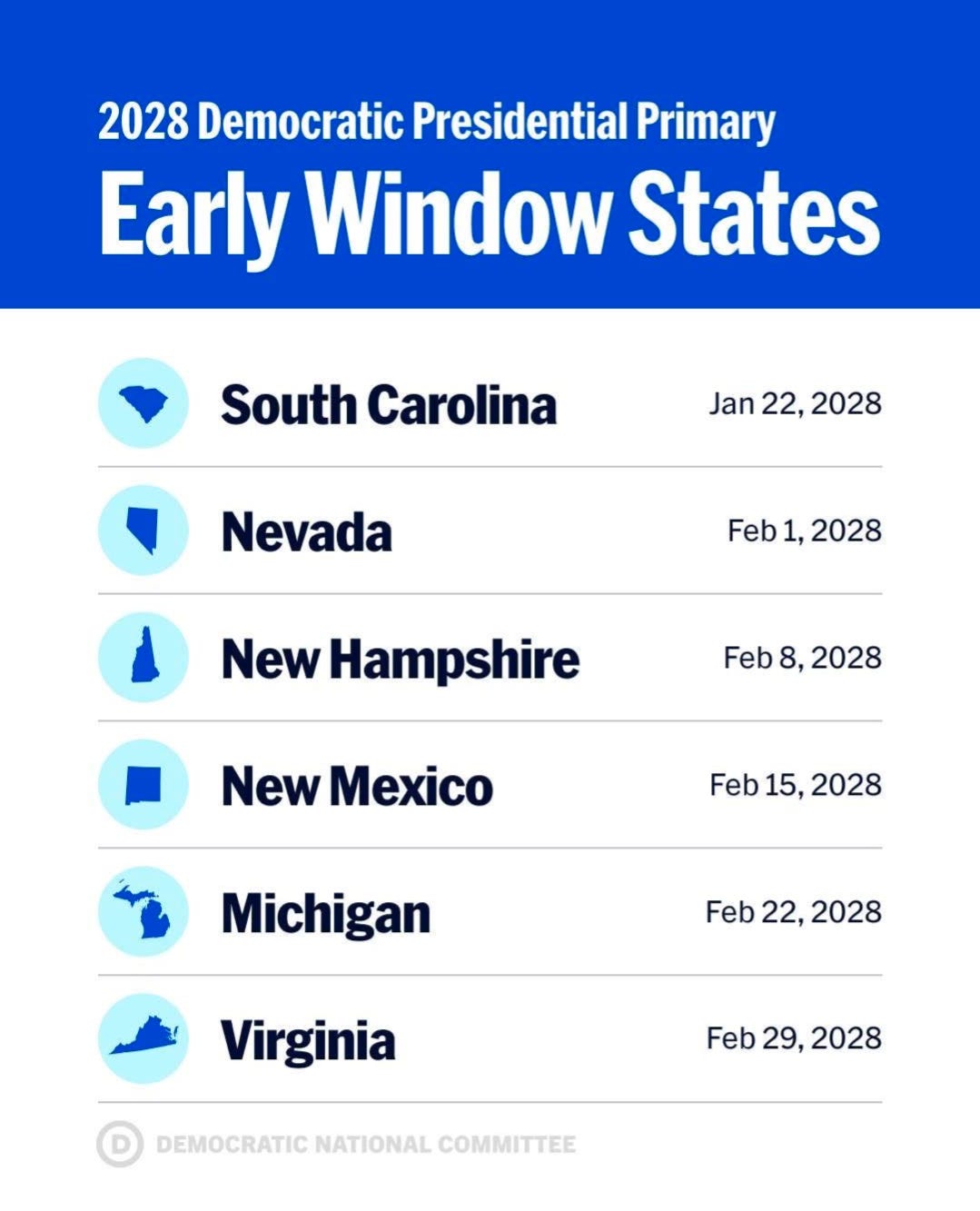
Richard Elliott: Earlier today, the Democratic National Committee voted that the state’s order for the presidential primary would be as follows: South Carolina, Nevada, New Hampshire, Michigan, New Mexico, Virginia.
Let’s go with the order and what it means. South Carolina is a plurality Black Democratic primary. Jim Clyburn, the longtime congressman, is by far the most influential voice there. However, in a race where this is the first state, I could imagine a candidate like Governor Wes Moore, a candidate like Senator Cory Booker, or several others choosing to enter simply to see how well they can do. And as we’ve talked about in previous episodes, Governor Wes Moore was in South Carolina campaigning just, you know, in the past couple of weeks. So there is absolutely an angle there to elevate the candidacy of a little-known candidate at this moment on the national scale like Governor Wes Moore, or to lock in the frontrunner status of Vice President Kamala Harris.
J. Barry O’Connell: What I’m hoping for is that the day after the primary, people at their breakfast tables across America say, “Who the hell is Wes Moore?”
Richard Elliott: And I think that there are going to be a lot of people who will see—whether it be him giving formal speeches in front of a microphone, whether they be informal speeches to rally campaign volunteers, or the video messages that you send on the ground—I think that Wes Moore will be very well received by individuals that prognosticate based on opening day results.
Let’s move to the second state: Nevada. Nevada is mostly known for the Bernie Sanders 2020 upset, where he won the state in rather decisive fashion. Nevada is a heavily Latino state, a heavily working-class state, and has a lot of union workers. It’s also a caucus state. Right now, Kamala Harris has a very strong lead with Latino voters. If I were to look forward in the future, I do think that Kamala is going to be a very strong candidate for the state of Nevada’s presidential caucus.
J. Barry O’Connell: If she runs.
Richard Elliott: If she runs—assuming she runs, which I do assume at this moment.
New Hampshire would be the third state. At most recent polling, Pete Buttigieg is leading in New Hampshire with about 22% of the vote, while Alexandria Ocasio-Cortez has something along the lines of 22% of the vote as well. New Hampshire is a more politically independent state. Arguably the most important endorsement in New Hampshire outside of the in-state electeds is the endorsement of next-door Senator Bernie Sanders. So there is a real potential for New Hampshire to be either a state where a progressive can continue to show momentum or where Pete Buttigieg is able to buttress his wide support among white Democrats in order to win a state.
J. Barry O’Connell: Okay.
Richard Elliott: Michigan is the fourth state. Michigan is a very interesting state. First of all, it’s an open primary, so Michigan has a large number of what I would call progressive independent voters—people who are likely under the age of 40, likely are college-educated. That group is going to break, for example, for Abdul El-Sayed in the upcoming Senate primary. I don’t know how that group would necessarily vote for president in a race where there is not a surefire progressive candidate for the presidential slot. I simply believe that Vice President Harris inherits that mantle because most of the other potential candidates are more conservative on certain issues. Michigan is also a swing state. And for paying listeners who are paying attention, Barry O’Connell advocated for Michigan to be one of the first several states.
J. Barry O’Connell: Okay, let me ask you a question. Why not AOC?
Richard Elliott: Why not AOC? What—
J. Barry O’Connell: In Michigan. Because if she... okay, she doesn’t even place, maybe she doesn’t even run in South Carolina. She goes to New Hampshire, she does very well, then she runs in Michigan. If she did well in New Hampshire, wouldn’t she have a strong chance in Michigan?
Richard Elliott: Absolutely. And I have talked to multiple people today that talked about the momentum theory. South Carolina is the opening state—it doesn’t necessarily provide momentum; it provides an early case for viability. Whereas AOC—who could do well in Nevada, who could do well in New Hampshire, who could do well in Michigan, who could do very well in New Mexico—she has a pathway to momentum, a swing with this current pipeline. And I would even say that in South Carolina, if there are five or six or seven candidates, I could absolutely imagine AOC being in the top three or so candidates. I could imagine, for example, AOC outdoing a Pete Buttigieg.
J. Barry O’Connell: Okay.
Richard Elliott: But the point that you’re making is absolutely correct. This timeline is almost ideal for a left-wing challenger candidate, an insurgent candidate. And I think that it throws cold water on the candidacies of Pete Buttigieg, Gavin Newsom, and Josh Shapiro as presidential candidates. That is my opinion.
New Mexico... let’s move to New Mexico. New Mexico is almost certainly the most Latino Democratic primary in the country. I would argue that it also sways somewhat progressive, somewhat insurgent. It was also—I’m not going to call it a swing state—but it was a state where Donald Trump came dangerously close to winning in the 2024 election. So it is a state where Democrats really need to get their inroads going and ensure that it remains strong. And I might be incorrect here; it might be another caucus state.
J. Barry O’Connell: I think the progressives tend to do very well in caucus states because they’re mean-spirited bullies who pick on people and intimidate good, moral, decent Democrats.
Richard Elliott: I believe that caucus states tend toward benefiting:
States with more college-age and retired populations.
States that have more well-to-do middle-aged people.
States that have well-developed internal political cultures.
I do not believe that caucuses are the best representation of the will of the voters because caucus states much more often reflect the attitude and vision of what I would call low- and mid-level political bosses rather than that of individual bundles of voters. Am I arguing against caucuses? Not necessarily. I just assert that they are less democratically sound than primaries where everybody’s vote is equal, where everybody’s time is equal.
J. Barry O’Connell: I caucused for Hillary Clinton in 2016 in Washington state, and it was a really nasty show. It was one of the nastiest political events I’ve ever seen among Democrats. It got so bad that the Bernie Sanders bullies were there—usually older guys, older white guys—shouting down the Hillary women, mostly young women under 30. And it got so bad that I actually had to stand up in my caucus group and tell a person that he was a disgrace to the Democratic Party and he should not speak to a woman that way. So they’re prone to bullying.
Richard Elliott: Caucuses are prone to bullying the same way that the polls are prone to shout-downs. When you have people who are very passionate, who are very motivated, who are not necessarily being paid, etc., it can become very heated. So I am proud to say that Maryland has a Democratic primary rather than Democratic caucuses.
J. Barry O’Connell: Okay.
Richard Elliott: The final state on that list was Virginia, Maryland’s sister state. Virginia as the sixth and final early primary state, I think, is a very unique opportunity for Marylanders to get involved for the candidate they think will gather momentum and go to Virginia to support those candidates.
Virginia is a rather unique state because it’s really three or four states thrown together:
You have Southwest Virginia—that’s the mention of West Virginia and the Appalachian states that would go heavily for a progressive candidate. It’s not organized politically; it was strong for Bernie Sanders.
You have Northern Virginia, which I think would be very strong for a Pete Buttigieg, very strong for a Kamala Harris.
You have Southeast Virginia, the Chesapeake region that includes Norfolk and Hampton Roads, which is very heavily Black. It’s where the Senate President Pro Tem in Virginia is from—an area that I think would go strongly for a Kamala Harris, but if Wes Moore is still on the ballot at that time, he could do well.
And then you have sort of the central area of the state as well, which is moderate suburbanites.
So Virginia, as the sixth and final state within the bunch, poses a great opportunity for Marylanders of interest and intrigue to go to Virginia and ramp up support for their personal candidates, which is something I will very likely be doing myself.
J. Barry O’Connell: Let’s hope so. Now let me hope for a good, moral, decent Democratic candidate.
Richard Elliott: Absolutely. Are there any questions you would like to ask about this early six-state spread, what it means for the candidates, or any other questions, Mr. O’Connell?
J. Barry O’Connell: Nope.
Richard Elliott: Well, I thank you so much. I can’t wait for the opportunity to edit this, and let’s go Democrats.
J. Barry O’Connell: Sounds good. Talk to you later.
Richard Elliott: All right. Thank you so much. Bye-bye.