

The Week in the Village: Shakeouts, Shortfalls, and a New Scoreboard
A Large firm in Annapolis had it’s second partner leave this year, the budget hole got deeper, and October 1 rewrote the rules for half the village. Here is what mattered this week — and what to watch next.
Pour the coffee. It was one of those weeks where the ground moved in several places at once, and if you do government relations in Maryland for a living, a couple of these shifts will change how your next six months look. Counting down:
5. Data centers became a real lobbying fight
Harford County Executive Bob Cassilly (R) is holding the line on his county’s outright data center ban — the only one in Maryland — while Del. C.T. Wilson has carried the pause argument in the House and Wes Moore tries to balance growth against community blowback. This week the fight got a congressional echo: Rep. Jamie Raskin opened a probe into data-center “gag orders,” sending letters to Amazon, Google, Meta, and Oracle demanding their NDAs with officials since 2021. Translation for the village: a brand-new industry just discovered it needs Annapolis help at the county, state, and federal levels simultaneously. Expect new clients.
Also in the energy lane: Kumar P. Barve’s Public Service Commission ended the multi-year rate plan pilot and ordered a comprehensive utility-rate reform process, then rolled out the state’s first energy storage awards — Chalk Point’s 400 MW and Jade Meadow III’s 40 MW. Regulated utilities and their contract lobbyists will live in that PSC proceeding all winter.
4. The nonprofits get a new general
Maryland Nonprofits, the statewide association with 1,800-plus members, named Lindsey Baker its next president and CEO. She starts October 19, succeeding interim chief Carmen Marshall, who carried the association through the 2026 session. More than 41,000 charitable organizations operate in Maryland, and a remarkable share of the sector runs on state grants, state contracts, and Medicaid rates. The sector’s government-relations operation just changed leadership at the exact moment state money gets scarce. Whoever your nonprofit clients are, their trade association has a new boss, a new voice, and a learning curve that starts in a budget war.
3. October 1 rewrote the practice rules
More than 370 bills became law on Thursday. Most are noise for your practice; a handful are not. The franchise-law rewrite changes the ground under every franchise relationship in the state. The predatory-pricing ban goes after dynamic grocery pricing — and creates a new compliance practice overnight. Housing-certainty and transit-oriented development bills move the land-use chessboard that half the village bills hours on. Fire and rescue workers pick up new medical-cannabis protections; essential retailers now have to take cash. I broke the eleven that matter down in a separate piece; the short version is that October 1 quietly created new work for lobbyists in franchising, retail, housing, and cannabis — check whether your client list touches any of them.
2. The $3 billion vise closed another notch
The Board of Revenue Estimates put the fiscal 2028 structural gap at roughly $3 billion. The tech tax — booked at $500 million — has collected about $100 million. Potomac Edison gets a $280 million court-ordered refund. Agencies are building 3 percent cut lists, and their budget proposals are due in January. Behind it all, the Blueprint’s costs approach $3.8 billion a year just as its dedicated revenues run dry, and Wes Moore has said publicly the Blueprint “cannot continue in its current form” while House Appropriations Chair Ben Barnes resists rolling education reform back. That is the session: a Democratic governor and a Democratic legislature arguing over whose ox gets gored, with every discretionary dollar — your clients’ grants, contracts, and rate cases — in the pile.
And keep one eye on the accountability machine. The Audit and Finance Compliance Unit’s first status report to the Joint Audit and Evaluation Committee was due October 1. As of this writing it has not been posted publicly. When it surfaces — and when the repeat-findings dashboard goes live by next October — “how many years has this finding sat unresolved” becomes a public fact about every agency you deal with. The lobbyists who learn to read it first will know where the bodies are buried.
1. The shakeout at Perry White Ross & Jacobson
The week’s biggest village story is personnel. Tom Coale’s departure from Perry White Ross & Jacobson became official October 1 with the launch of The Coale Firm, his independent government relations and public affairs practice — announced with the public blessing of Tim Perry and Jonas Jacobson, and the promise of referral partnerships. Coale arrived at the firm in 2023, built a top-15 compensation practice in three and a half years, and did the math every successful partner eventually does: when the clients are really yours, independence pays.
He is not alone. Eddie Pounds — Prince George’s-bred, land use, cannabis, and licensing — left the firm earlier this summer to hang his own shingle. Two partners out in roughly three months at the biggest firm in Annapolis is not a crisis; it is a pattern. It is also the live illustration of the two kinds of lobbyists: firms sell relationships and hold clients for decades, while specialists sell expertise on a problem — and the specialists with portable practices are increasingly deciding they don’t need the firm’s roof to do it. Watch two things: who keeps the clients in each split, and who else at the big firms is quietly running the same arithmetic.
Still echoing from Sunday’s GR Power List: Len Foxwell told me G.S. Proctor should have been #2 on the list “if I was ranking by power.” The list was revenue-anchored, and Proctor sits around $2 million a year. When a smart operator like Foxwell says power and revenue have diverged, that is a name to watch heading into session.
The week ahead
Three things. First, the compliance unit’s October 1 report should surface through the Joint Audit and Evaluation Committee — who asks for it publicly first tells you who wants the accountability fight. Second, the agencies’ 3 percent cut lists will start leaking; if your clients hold state contracts or grants, find out whether they are on somebody’s list before the governor’s January budget makes it official. Third, Lindsey Baker’s October 19 start at Maryland Nonprofits: the nonprofit sector’s new voice will introduce itself to Annapolis right as the budget vise tightens, and the introductions she makes in the next three weeks are the ones that matter.
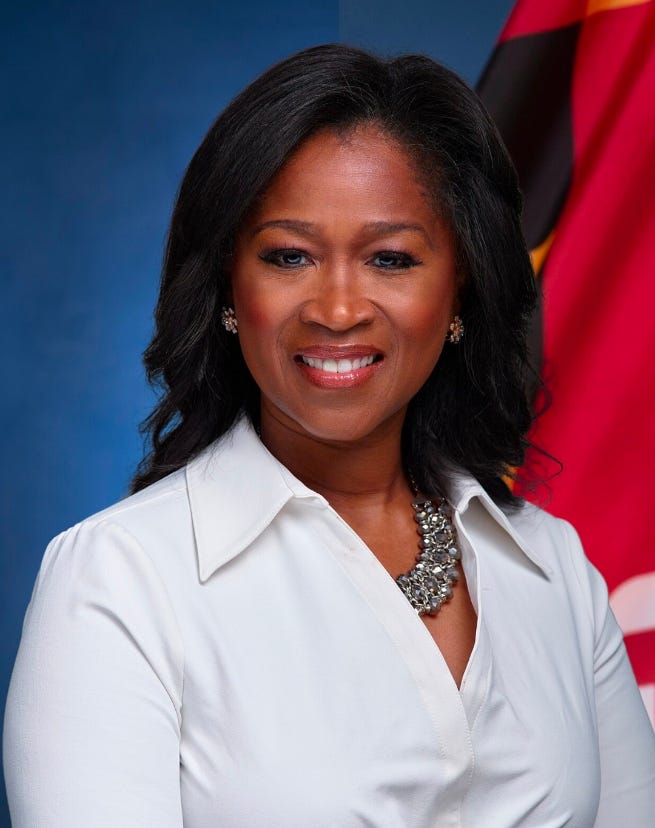
🌅 Morning Spotlight: Serena Coleman McIlwain
Title: Secretary, Maryland Department of the Environment Vibe: Unstoppable executive power, policy visionary, and a commanding force on the climate stage.
When Governor Wes Moore needed someone to spearhead Maryland’s boldest environmental agenda in decades, he didn’t just pick an advocate—he chose a seasoned operational titan. Confirmed in March 2023 as the 11th Secretary of the Environment, Serena Coleman McIlwain brings three decades of executive leadership, deep policy expertise, and undeniable presence to Annapolis.
Why She’s a Power Player:
The Resume: Before taking the reins in Maryland, she served as Undersecretary of the California Environmental Protection Agency and held senior executive roles at both the U.S. EPA and the U.S. Department of Energy.
The Brainpower: Armed with two Master’s degrees—a Master of Public Administration from George Mason University and an M.S. in Administration & International Studies from Central Michigan University—she bridges high-level administrative strategy with complex science.
The Mission: From modernizing Maryland’s green energy infrastructure and fighting environmental injustice to restoring the Chesapeake Bay, McIlwain runs one of the state’s most critical agencies with high-energy gravitas and flawless execution.
The Takeaway:
Dashing, highly articulate, and fiercely efficient, Secretary McIlwain represents the ideal intersection of executive elegance and transformative policy leadership in Maryland politics. She’s not just holding court in Annapolis; she’s shaping the state’s future on the global stage.
See you Monday.