

Voter ID Impact v Intent
When Neutral Rules Aren’t Neutral: What Griggs v. Duke Power Teaches Us About Voter ID
A Supreme Court Case With a Simple Lesson
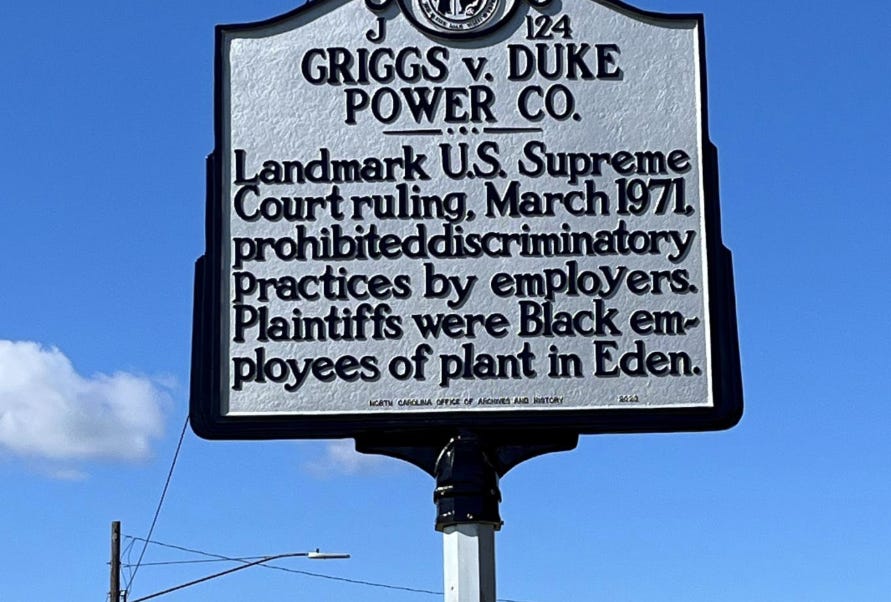
In 1971, the Supreme Court handed down Griggs v. Duke Power, a case that reshaped how we understand discrimination in American law. The Court didn’t focus on what the employer intended. It focused on what the policy did.
Duke Power had replaced its old, explicitly discriminatory rules with new ones that looked neutral: a high school diploma and two aptitude tests. On paper, everyone faced the same requirements. In practice, the rules excluded Black workers at far higher rates — and the company could not show that the requirements were actually necessary for the jobs.
The Court’s conclusion was straightforward:
> A rule can be neutral in form and still discriminatory in effect.
That principle — impact over intent — is the heart of the case.
Why This Matters Beyond Employment Law
Griggs wasn’t just about one company. It was about how institutions can unintentionally reproduce inequality through rules that appear fair.
The Court recognized a structural truth:
- People do not begin from the same starting line.
- A rule that burdens one group more heavily than another can reinforce existing disparities.
- A policy’s fairness must be judged by its effects, not its presentation.
This is a principle that applies far beyond the workplace.
Voter ID Through the Griggs Lens
Voter ID laws are often defended with a simple argument:
“Everyone has to show the same ID, so it’s fair.”
Griggs teaches us to ask a different question:
Does everyone face the same burden in meeting the requirement?
Research shows that the burdens of obtaining government‑issued ID — cost, transportation, time off work, access to underlying documents — fall unevenly across demographic groups. Low‑income voters, elderly voters, and some racial and ethnic minorities face more obstacles in securing compliant identification.
The academic literature on turnout effects is mixed. Some studies find little measurable change in overall turnout; others find localized or demographic‑specific impacts. But the unequal burden itself is well‑documented.
And under the Griggs framework, unequal burden is the point.
Intent Is Not the Standard
Griggs did not require proof of discriminatory motive.
It required proof of discriminatory effect.
That’s the key insight MAGA can recognize:
- A rule can be written neutrally.
- A rule can be applied uniformly.
- A rule can still produce unequal outcomes.
And when the right at stake is fundamental — the right to vote — even small disparities matter.
The Real Question: Is the Burden Necessary?
Griggs also requires a second inquiry:
Is the requirement necessary for the function it claims to serve?
In employment law, the employer must show that the rule is job‑related and consistent with business necessity.
In voting, the state must show that the rule is necessary to protect the integrity of elections.
That’s where the debate belongs — not in accusations about motives, but in evidence about necessity, burden, and effect.
A Framework for Understanding, Not a Weapon for Blame
Using Griggs as a lens doesn’t accuse anyone of bad faith.
It doesn’t require assumptions about why a law was passed.
It doesn’t label anyone as discriminatory.
It simply applies a long‑standing legal principle:
> Neutral rules must be evaluated by their real‑world consequences.
Some of you will accept that logic immediately.
Some will reject it because it challenges narratives you rely on.
But the argument itself is grounded, reasonable, and rooted in Supreme Court doctrine — not partisanship.
The Takeaway
Griggs teaches us that fairness is not measured by how a rule looks on paper.
Fairness is measured by how a rule operates in the world.
Voter ID laws may be written neutrally, but the burdens they impose are not evenly distributed.
And when a rule affects access to the ballot, those burdens matter.
That’s not an accusation.
It’s a principle of American law.