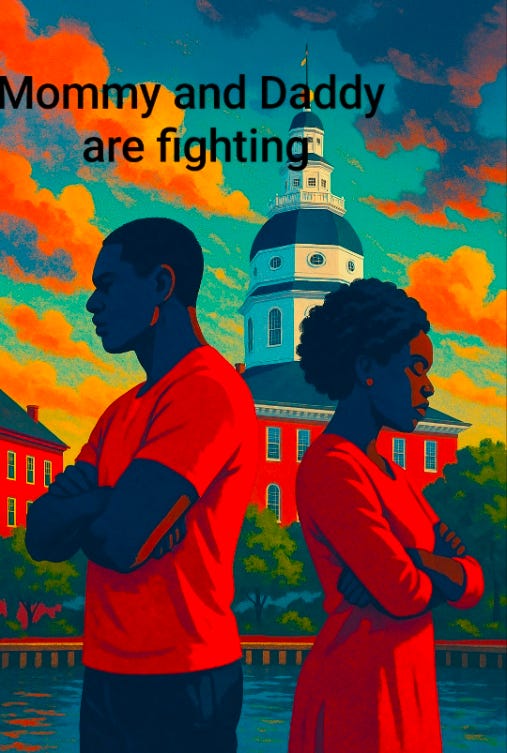
There’s a storm brewing in Annapolis, and it’s not just about budget numbers or policy proposals. It’s about power, ambition, and the uneasy dance between Maryland’s Governor Wes Moore and the increasingly independent Maryland General Assembly.
Governor Moore came into office promising transformation — a new day for Maryland politics. His approval ratings remain strong, his national profile continues to rise, and whispers of a future White House bid are no longer confined to backrooms. But inside the State House, the honeymoon is clearly over.
Who speaks for Maryland?
The Maryland General Assembly — dominated by Democratic supermajorities in both chambers — is no longer acting like a political partner. It’s acting like a rival power center. Legislators have grown bolder, pushing their own agenda, often at odds with the governor’s. And increasingly, the question being asked in Annapolis isn’t whether Moore can lead Maryland — it’s whether the legislature will let him.
At the heart of the rift is a difference in mission. Moore wants results he can run on — both for reelection in 2026 and, many believe, for something bigger. His proposals aim to balance the state budget, avoid new taxes, and deliver measurable success on education, infrastructure, and public safety. That agenda requires discipline, tough choices, and a willingness to say no to powerful interest groups.
The legislature, on the other hand, has grown accustomed to saying yes — yes to every lobbyist with a checkbook, yes to every advocacy group demanding new spending, yes to local pork and pet projects. The result? A budgetary collision course. Moore’s administration imposed a hiring freeze, refused to backfill programs without long-term funding, and warned against unsustainable commitments. The General Assembly pushed back with competing priorities and political muscle.
Power Struggle
It’s not just about money. It’s about control.
Legislative leaders increasingly act like co-governors — rewriting policy proposals, slashing executive plans, and delivering public rebukes to the governor’s office. The dynamic has sparked deep frustration inside Moore’s inner circle, where the sense is growing that some Annapolis insiders care more about scoring points with lobbyists than advancing the people’s agenda.
And that, in the end, is the biggest difference: Governor Moore wants to fight for ordinary Marylanders. The General Assembly wants to protect its influence.
This isn’t a partisan fight — both sides are Democrats. But it’s the most important political tension in Maryland today. It’s about how power is used, who it serves, and whether Annapolis will support the governor’s bold vision — or block it out of turf wars and ego.
Policy tug-of-war
In the coming months, this conflict will intensify. Budget battles, legislative overrides, and power plays are all but guaranteed. And with Moore’s national ambitions growing clearer, so too will the stakes.
Will the Maryland General Assembly rise to meet the moment? Or will it continue operating like a fiefdom of lobbyists and insiders?
The voters are watching. So is Washington.
And if Wes Moore is to have a clear path to reelection — or beyond — he’ll have to win not just the support of Maryland’s people, but the battle for control inside Annapolis itself.