

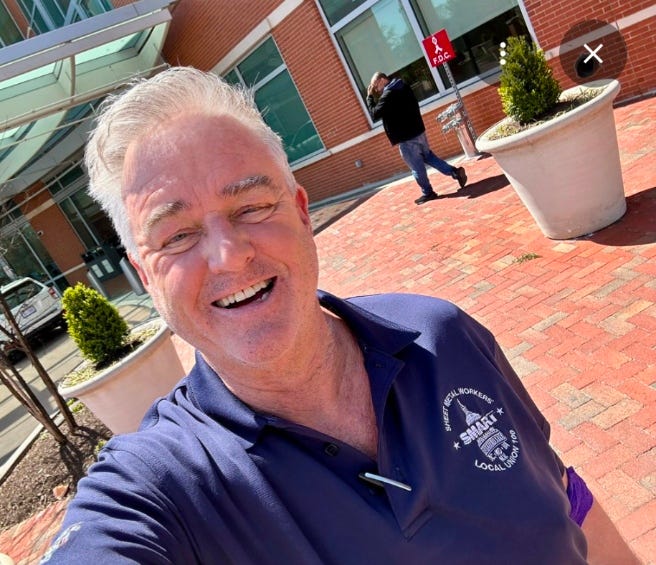
Trone Screws Up
Did Someone Mishear Jamie Raskin? A Constitutional Convention Rumor Ripples Through Western Maryland
There’s a new whisper making its way across Western Maryland’s Democratic circles — the kind of political rumor that starts as a raised eyebrow in a county meeting and ends up as a worried text message to anyone who follows constitutional law even casually.
The claim?
That Rep. Jamie Raskin — constitutional scholar, impeachment lead, and one of the most outspoken critics of an Article V constitutional convention — supposedly said something supportive of one.
If your first reaction is that doesn’t sound like Jamie, you’re not alone.
And that’s exactly why this little rumor has legs. It doesn’t fit. It doesn’t match his record. And it raises a bigger question about how Democratic candidates talk about constitutional reform, especially in a year when the stakes couldn’t be higher.
The Rumor That Doesn’t Line Up
Some Democratic activists in the western counties say they’ve heard that Raskin expressed openness to a constitutional convention — the same convention Common Cause, the League of Women Voters, and nearly every progressive legal group have warned could become a “runaway” rewrite of the Constitution.
For years, Common Cause has been blunt:
A convention cannot be limited.
Delegates cannot be controlled.
And once the door opens, everything from voting rights to civil liberties is on the table.
Jamie Raskin has said the same thing — repeatedly, publicly, and with the kind of clarity only a constitutional law professor can deliver.
So how did this rumor start?
That’s where the story gets interesting.
Enter David Trone — And a Possible Misunderstanding
David Trone is a successful businessman, a prolific donor, and a candidate who speaks in broad strokes. He’s not a constitutional scholar, and he doesn’t pretend to be. But he is known for compressing complex issues into confident one‑liners that sometimes flatten the nuance. Sometimes it’s so bad that people wonder if he’s drunk when he says some of the things that he says. Of course it’s hard to tell when he’s drinking and when he is not.
It’s entirely plausible that in a conversation about constitutional reform — or even about the need to “fix” structural problems in American democracy — Trone heard something like:
> “We need to address constitutional issues.”
…and interpreted it as:
> “Jamie supports a constitutional convention.”
That’s not malice. That’s not strategy.
That’s just the way political telephone works. Especially with the congressman who’s half in the bag most of the time and doesn’t really have a clear understanding of the issues or the problems to some of the things he says.
But when the subject is an Article V convention, the stakes are too high for sloppy phrasing.
Why Democrats Are Nervous About This Topic
Democrats have spent a decade warning that the far right has been quietly organizing toward a convention. ALEC, the Koch network, and a constellation of conservative groups have been pushing states to pass resolutions calling for one.
They’re close — uncomfortably close.
So when a Democratic candidate appears to misunderstand the danger, or misstate another Democrat’s position, it sets off alarms.
This isn’t a minor policy disagreement.
This is the Constitution.
And Democratic voters — especially the ones who follow this issue closely — want to know that their candidates understand the difference between:
- constitutional amendments, which follow a known process, and
- a constitutional convention, which is a leap into the unknown.
Jamie Raskin knows that difference.
His record is clear.
The rumor is not.
A Teachable Moment for the Party
This episode, small as it may seem, reveals something about the Democratic Party’s internal communication problem.
Voters want clarity.
They want precision.
They want to know that the people asking for their vote understand the constitutional terrain.
And when a rumor like this surfaces — especially one that contradicts a well‑documented public record — it’s a reminder that campaigns need to be careful with their language, especially on issues where the right has been playing a long game.