

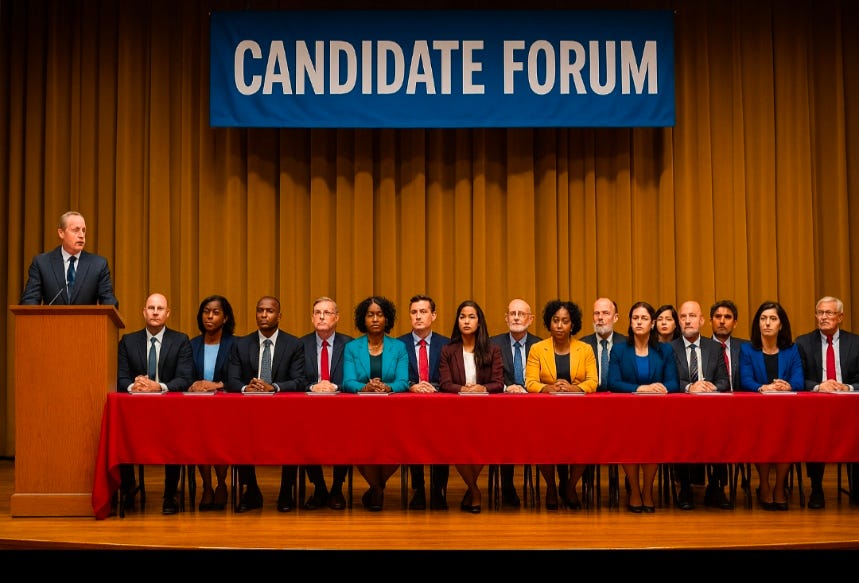
Why So Many Long‑Shot Candidates Run — And the Problems It Creates
Maryland makes it remarkably easy to run for office. You walk into the election office, sign the form, write the check, and you’re on the ballot. No petitions. No signature drives. No gatekeeping. It’s one of the lowest‑barrier systems in the country, and the result is predictable: every cycle brings a handful of serious contenders and a long tail of candidates who have no realistic path to victory.
Political scientists have actually studied this phenomenon, and the motivations fall into five broad categories. Understanding them helps explain not only why these candidates run, but also the very real complications they create for voters, civic groups, and the democratic process.
1. The Issue Evangelists
These candidates aren’t running to win — they’re running to be heard. They want to force a conversation about a specific issue: housing, policing, climate, schools, transportation, or whatever their cause may be. Their goal is to push the frontrunners into taking a position.
In a low‑barrier state like Maryland, this is a rational strategy. A candidate with no money and no organization can still get a microphone at a forum and inject their issue into the bloodstream.
2. The Resume Builders
Some candidates run because they want to be seen as “politically active.” They’re building name recognition for a future race, or they want to be considered for boards, commissions, or civic appointments. Running and losing is still a credential — and in Maryland, it’s a cheap one.
3. The Vanity Candidates
This is the group people think of first, though it’s smaller than the stereotype. These candidates enjoy the attention, the yard signs, the introductions at community meetings. They like being “in the arena.” They’re not delusional; they’re expressive. Running is a form of self‑expression.
4. The Protest Candidates
In counties dominated by one party — Prince George’s, Montgomery, Baltimore City — the primary is the only place to register dissent. Protest candidates run to challenge the machine, signal frustration, or represent a faction that feels ignored. They know they won’t win, but they want to make a point.
5. The Miscalculation Candidates
This is the most human category. Some candidates genuinely believe lightning might strike. They think the frontrunner might implode, or that voters will “see something special” once they get in front of them. Political scientists call this overconfidence bias. It’s the same optimism that leads people to start businesses or audition for talent shows.
The Downside: When the Ballot Becomes a Parking Lot
All of these motivations are understandable. Some are even admirable. But they create real problems — especially in a state where civic groups, PTAs, neighborhood associations, and local media outlets try to host candidate forums.
The Time Problem
Imagine a race with eight candidates. Three have a plausible path to victory. Five do not. If the forum focuses on the three serious contenders, each gets meaningful time — maybe 12–15 minutes of actual speaking after the moderator’s housekeeping, rules, and audience instructions.
But if all eight candidates are included, the math collapses:
- The same one‑hour forum now gives each candidate only a few minutes.
- Answers become clipped, shallow, and rushed.
- Voters learn less, not more.
- The serious candidates can’t articulate full positions.
- The long‑shots often use their limited time to grandstand or repeat slogans.
The result is a forum that feels more like a speed‑dating session than a civic exercise.
The Fairness Problem
Nationally, debate organizers use polling and fundraising thresholds to decide who gets on stage. Maryland can’t do that. Most local races have:
- no independent polling
- no public fundraising data until late
- no media infrastructure to vet candidates
So civic groups default to the simplest rule: invite everyone on the ballot. It feels fair, but it often produces the least informative event.
The Voter Fatigue Problem
Voters have limited patience. A forum with eight candidates — five of whom have no chance — becomes a test of endurance. People tune out. They leave early. They stop watching the livestream. The very purpose of the forum is undermined.
The Signal‑to‑Noise Problem
When every candidate gets equal time, the serious contenders lose the ability to differentiate themselves. The long‑shots, meanwhile, can dominate with theatrics, applause lines, or niche issues that don’t reflect the priorities of the electorate.
So Why Does It Matter?
Because Maryland’s low barriers to entry create a paradox:
- Democracy becomes more accessible,
- but information becomes harder to access.
Voters get more names on the ballot but less clarity about who is actually viable. Civic groups try to be inclusive but end up diluting the very information voters need.
None of this means the long‑shot candidates are bad people or that their motivations are illegitimate. Many are sincere, passionate, and civically minded. But the structural reality remains: when everyone gets a microphone, the voters get less signal and more noise.
In my experience, especially with those elected post 2010, you have woefully underestimated the number of candidates in category #2 and #3
Probably won't work, but what if the "eight" candidates had to do a ranked choice voting to determine their order of speaking? Use reverse alphabetical order to break ties.