

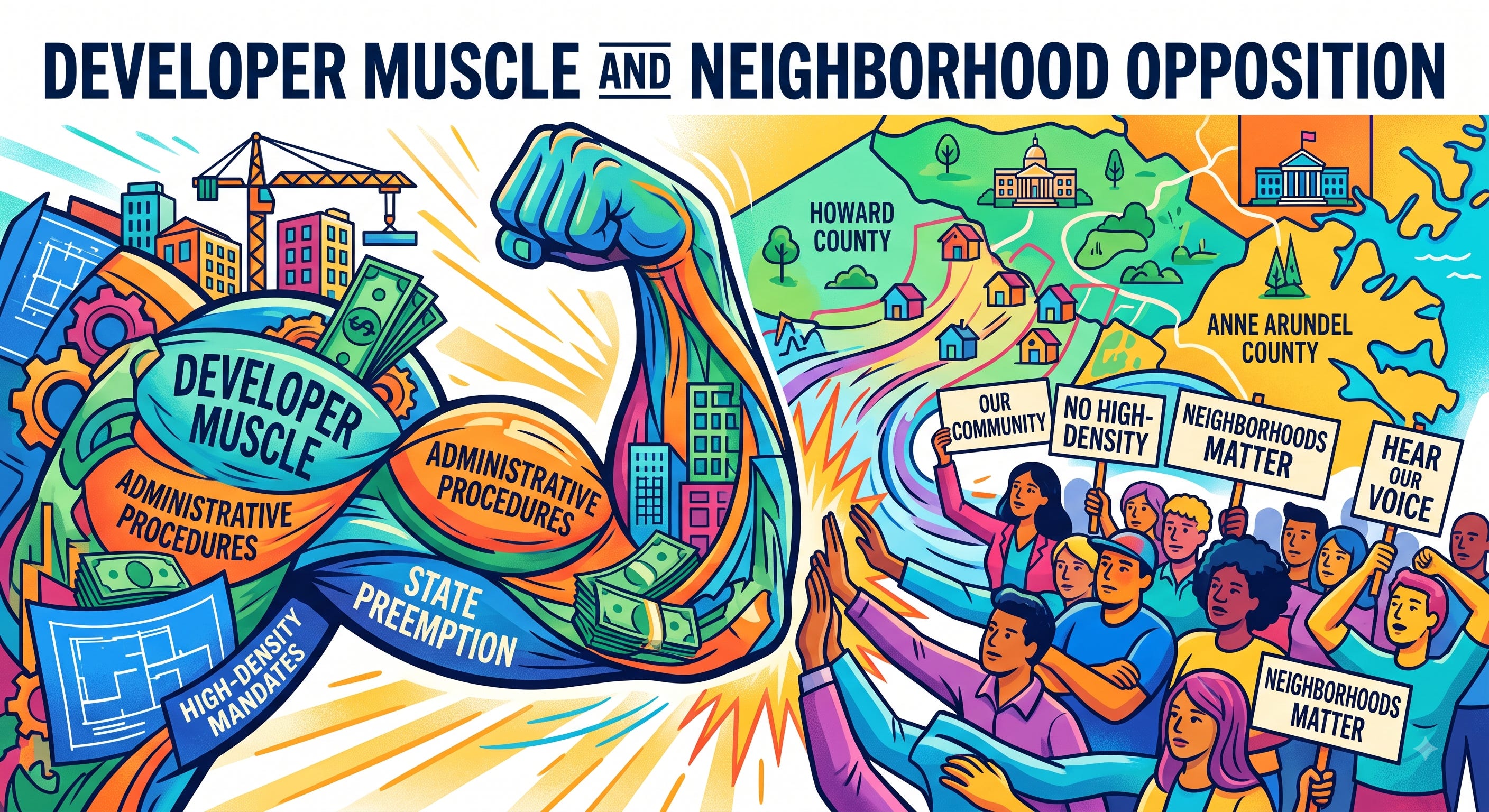
When local activists in Howard County and Anne Arundel County talk about "developer muscle," Tom Coale and Perry Jacobson (PWRJ) are often the first names cited. Their reputation wasn't earned through backroom deals, but through an aggressive strategy that leverages administrative procedures, state preemption, and high-density housing mandates to push projects past fierce neighborhood opposition.
Several high-profile cases illustrate where Coale and PWRJ faced heavy community pushback and how they navigated the political fallout:
1. The W.R. Grace Plastic Recycling Facility (Columbia / River Hill)
This case stands as one of the most explosive Howard County zoning fights in recent years. Chemical giant W.R. Grace sought to build a pilot plastic recycling research facility at its Columbia complex, located near the Cedar Creek and River Hill neighborhoods.
The Community Pushback: Residents organized en masse, packing hearings and citing fears of chemical emissions, noise, traffic, potential explosions, and falling property values. Councilmember Deb Jung championed a Zoning Regulation Amendment (ZRA) intended to restrict plastic pyrolysis and incineration near residential areas to block the plant.
The Coale Strategy: Representing W.R. Grace, Coale aggressively argued before the Howard County Council and Board of Appeals that the facility constituted "research and development" under existing zoning rules—not heavy manufacturing or incineration—and that the Department of Planning and Zoning (DPZ) had properly approved it. Coale warned that retroactively changing zoning rules to target a long-standing corporate employer set a dangerous economic precedent that would scare institutions away from Howard County.
The Result: The fight split the County Council 3-2, leading to an administrative and judicial battle over DPZ authority vs. Council oversight, cementing Coale’s role as the go-to attorney when corporate clients face intense neighborhood backlash.
2. Senior & Affordable Housing ZRAs (e.g., Yale Presbyterian / Cedar Lane)
Howard County's land-use code contains strict conditional use standards and density caps for Age-Restricted Adult Housing (ARAH). When developers hit a wall under standard zoning, Coale routinely utilizes Zoning Regulation Amendments (ZRAs)—effectively changing the county code text to fit the project.
The Community Pushback: Neighborhood associations in Columbia and Ellicott City frequently accuse developers of using ZRAs as a "backdoor rezoning" tool to bypass established master plan density limits and setback buffers. In projects like the Yale Presbyterian site proposal, neighbors voiced severe concerns over traffic, stormwater runoff, and building height.
The Coale Strategy: Coale reframes these technical zoning battles around a compelling public policy argument: the crisis of affordable senior housing. By tying specific zoning relaxations (like reduced setback distances or higher density calculations) to affordable housing goals, he forces opposition groups into the politically uncomfortable position of appearing to fight senior housing.
3. The Annapolis Civic Park & City Dock Re-Development (Anne Arundel)
PWRJ is deeply entrenched in Annapolis and state-level government relations. Major commercial and maritime developers in the historic district frequently retain the firm when attempting to modernize, expand, or rezone properties along the water.
The Community Pushback: Historic preservationists (like Historic Annapolis), Ward 1 residents, and local maritime businesses routinely fight high-density commercial concepts, height variance requests, and parking exemptions at City Dock and along West Street. Preservationists argue that aggressive variances destroy the historic fabric of the capital.
The PWRJ Strategy: The firm excels at building broad coalitions with local business associations, trade unions, and state agencies. Rather than fighting preservationists in city council chambers, PWRJ focuses on securing state funding, economic development grants, and administrative approvals that make opposition from local preservation groups politically difficult to sustain.
4. The Downtown Columbia Master Plan & CA Battles
During his years at Talkin & Oh and continuing through his tenure at PWRJ, Coale was deeply involved in the evolution of Downtown Columbia, including disputes surrounding the Columbia Association (CA) and Howard Hughes Corporation developments.
The Community Pushback: "Reston/Columbia traditionalists" have long argued that high-density residential towers, increased commercial footprints, and changes to open space agreements undermine James Rouse’s original vision for Columbia.
The Coale Strategy: Coale utilized his civic prominence, commentary platforms, and legal practice to champion urban density, walkability, and housing diversity. He frequently argued that preserving Rouse's vision required adapting to 21st-century economic realities rather than freezing Columbia in amber.
Why Their Approach Triggers Watchdogs
What frustrates community watchdogs like HoCo Watchdogs or local civic alliances is not that Coale or PWRJ break laws—it’s that they are procedural masters:
They shift the forum: When a project faces guaranteed defeat before a hostile community association or district councilmember, they move the battleground to administrative boards (Board of Appeals, Planning Board) or state regulatory agencies (MDE) where technical legal arguments carry more weight than public outrage.
They rewrite the rules: Rather than asking for a variance (which requires proving unique property hardship), they file ZRAs to rewrite the county code text itself—creating a precedent that helps their client while altering land-use rules for the whole county.
They control the narrative: Coale’s background in media and political campaigns allows him to frame complex, profitable real estate deals as essential public policy victories for housing equity, economic growth, or environmental sustainability.