

The Unraveling Inside Prince George’s County
By Jimmy O’Toole
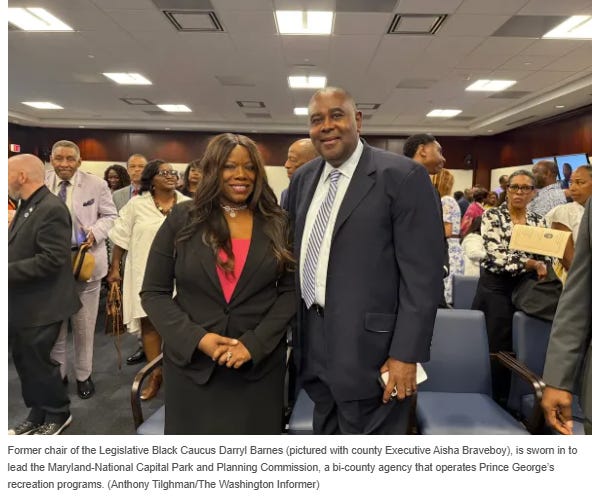
In Prince George’s County, the real story is rarely the headline. It’s the machinery behind it—the timing, the alliances, the quiet purges, and the political debts that never seem to stop coming due. And right now, that machinery is grinding loudly around the embattled chair of the Planning Board, Darryl Barnes, who finds himself at the center of an 11‑page misconduct complaint that reads like the prelude to a forced exit.
The allegations are serious enough—attempting to hire his sister, procurement irregularities, failing to disclose his status as a registered lobbyist, and other potential ethics violations. But the real question isn’t whether Barnes is guilty or innocent. It’s why this document surfaced now, and who benefits from its release.
In politics, timing is never an accident.

Cui Bono: Who Benefits?
The answer, as always in Prince George’s County, lies in the shifting balance of power. The administration of County Executive Aisha Braveboy—who inherited a government already strained by structural deficits, internal rivalries, and years of accumulated patronage—stands to gain the most from Barnes’ removal.
Last legislative session, the county failed in its push to split the Montgomery and Prince George’s planning departments, a move that would have given Prince George’s more autonomy and more control over its own planning apparatus. That failure, in the eyes of many insiders, marked the beginning of the end for Barnes.
Now, with a May 22 vote looming, the political class is treating his departure as a foregone conclusion.
And the presumed successor?
Council Member Edward P. Burroughs III.
The Rise of Burroughs—and the Rumors That Follow Him
Burroughs is widely viewed as the frontrunner to take over the Planning Board, a position that currently oversees a staff of 16, with a proposal already circulating to expand it to 25. In a county where resources are tight and political favors are plentiful, that kind of expansion represents real power.
But Burroughs brings his own storm clouds.
Rumors have been swirling for months that he is the subject of an active FBI investigation. The catalyst appears to be a revelation—first reported publicly months ago—that Burroughs’ father was placed in a $130,000 county job with no visible deliverables, no public-facing responsibilities, and no evidence of regular attendance.
If subpoenaed, video logs and email records may show a pattern that looks uncomfortably like a no‑show job—the kind of political hiring that runs afoul of the Shakman Decrees, the federal anti‑patronage rules originally designed to dismantle Chicago’s political machine.
If true, this would be more than a local ethics issue. It would be a federal one.
The Staff Caught in the Middle
While the political class maneuvers, the rank‑and‑file employees inside the Planning Board and related agencies face a different reality. Many have been pressured into actions they may not have understood—timesheet irregularities, altered project charges, deleted video evidence, or administrative shortcuts that seemed harmless at the time.
But in a federal investigation, intent matters. And so does documentation.
Employees who never sought to be part of a political drama may now find themselves in the blast radius of one.
A Culture of Silence—and the Cost of Speaking Up
Prince George’s County has long suffered from a culture where insiders whisper, outsiders speculate, and the truth rarely surfaces until it’s too late. The current Council Chair, Krystal Oriadha, presides over a body where alliances shift quickly and loyalties are often temporary.
Meanwhile, the county’s most prominent political figure—U.S. Senator Angela Alsobrooks, a blessing to Maryland and a stabilizing force in Washington—has been out of county government for years. Her absence is felt. The guardrails she once provided are gone.
What remains is a government struggling under the weight of its own internal contradictions: too many political promises, too few resources, and a growing sense that the old ways of doing business are finally catching up with the people who benefited from them.
The Road Ahead
Barnes may fall. Burroughs may rise. Or the entire structure may collapse under the weight of federal scrutiny. But one thing is certain: the story unfolding inside Prince George’s County is bigger than any one official.
It is a test of whether a county long plagued by insider politics can confront its own reflection—and whether the people who keep the government running every day can protect themselves from the fallout.
For their sake, and for the county’s, I hope they do.
Your insights are probably correct but sometimes your facts are way off. “Angela Alsobrooks has been out of county government for years.” Not even close. 18 months.
Anytime a new administration takes over, especially in government and law enforcement, transparency should not be feared it should be welcomed.
As a former candidate for Sheriff and someone who has spent decades in public integrity and federal law enforcement, one of the first things I would consider in any new administration would be a comprehensive audit process. Not because you assume guilt, but because you want to ensure you are not inheriting someone else’s historic dysfunction, corruption, waste, or questionable practices.
The best way to move forward is often to start with a clean slate.
In my humble opinion, Prince George’s County should welcome oversight, audits, and accountability reviews whether internal, independent, federal, or all three. That is not an attack on the county. It is an opportunity to rebuild public confidence.
Real leadership says:
“Come look at everything.”
“Help us identify weaknesses.”
“Help us restore trust.”
“Help us improve systems.”
That is transparency.
And honestly, extraordinary times require extraordinary leadership steps especially in law enforcement and public administration, where public trust has eroded nationwide.
If there are no problems, the audits confirm that.
If there ARE problems, the community deserves honesty, correction, and reform.
Either way, the people win.
Therefore, I would urge the County Executive and county leadership to welcome or even invite comprehensive audits of questionable departments, contracts, procurement practices, and operational systems.
Not for political theater.
Not for revenge.
Not for headlines.
But for restoration of trust, credibility, and confidence in Prince George’s County government.
The people deserve transparency.
And transparency should never be feared by honest leadership.