

The Trouble With Too Much Money
Why Unexplained Wealth Leaves a Trail — And What Voters Should Notice
There’s an old joke in political circles that the only thing harder than raising money is explaining where it came from. Most public officials live on salaries that are respectable but hardly extravagant. They pay mortgages, buy groceries, and maybe splurge on a vacation if the budget allows. Their lives look like the lives of the people they represent.
But every so often, someone in public life starts living just a little too well — and that’s when eyebrows go up.
This isn’t about envy. It’s about math.
Because when someone has more money than they can safely explain, their spending patterns change. Not because they’re clever, but because the system forces them into strange choices. You can’t put unreported income into a bank account. You can’t use it on a mortgage application. You can’t deposit it into a college savings plan. You can’t even buy a car with it unless you want to answer awkward questions about where the money came from.
So people with money they can’t document end up spending it in ways that normal people don’t.
And that’s where the trouble begins.
The Leslie Johnson Mystery: $79,000 and a Bra
When federal agents raided the home of former Prince George’s County Councilmember Leslie Johnson, she attempted something that still boggles the imagination: she tried to walk out of the house with $79,000 in cash hidden in her underwear.
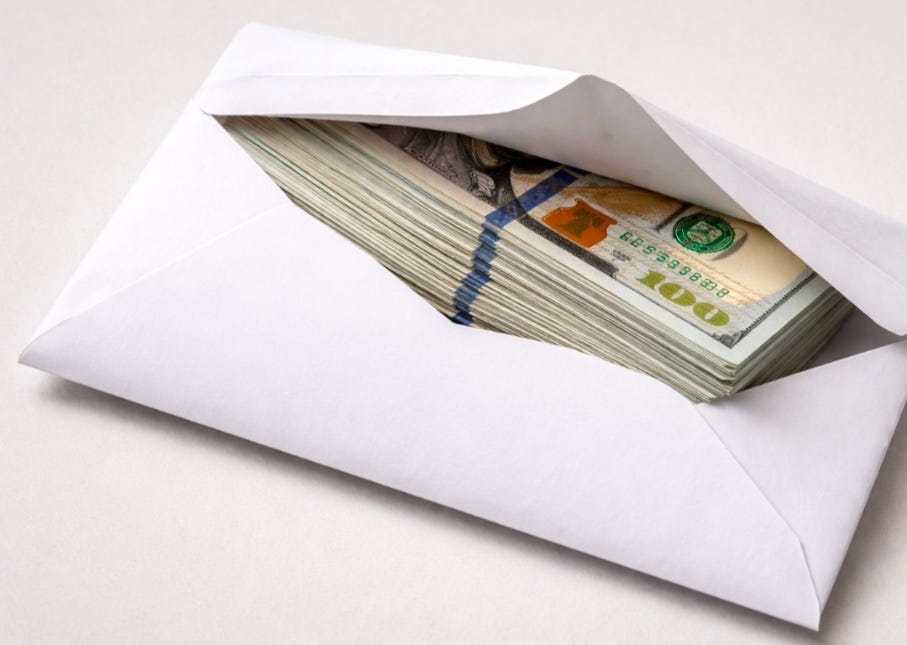
Now, most Marylanders don’t keep $79,000 in cash lying around. And even fewer attempt to store it in their clothing. For context, $79,000 in used bills is roughly a four‑inch stack — not the sort of thing that tucks neatly into a bra unless you’re working with physics the rest of us don’t understand.
How she thought this would work remains one of life’s little mysteries.
But the larger point is simpler:
normal people don’t have that kind of cash in their homes.
And when they do, it’s usually because something is very wrong.
Why Undocumented Money Creates Strange Spending Habits
People with income they can’t report face a basic problem:
They have money they can spend, but they can’t explain.
That creates predictable distortions in how they use it.
1. They avoid anything that requires documentation
- mortgages
- car loans
- bank deposits
- investment accounts
- tuition payments
- anything involving a W‑2 or tax return
These are the places where unreported income goes to die.
2. They gravitate toward luxury goods that don’t require paperwork
- designer shoes
- handbags
- jewelry
- watches
- artwork
- collectibles
These items can be bought in cash, displayed privately, and resold later. They don’t trigger bank reporting rules. They don’t require income verification. They’re the perfect outlet for money that can’t go anywhere else.
This is why, every so often, you’ll see a public official with a modest salary suddenly sporting a lifestyle that looks like it belongs in a different tax bracket.
It’s not the item itself that matters.
It’s the mismatch.
The Art Problem: When the Walls Are Worth More Than the House
One former state senator famously decorated her modest home with artwork worth more than the house itself. Now, most people who buy expensive art also buy expensive houses. That’s how the world usually works.
But when the house is modest and the art is extravagant, something is off.
Art is a classic outlet for unreported money because:
- it can be purchased in cash
- it can be moved
- it can be hidden
- it can be resold quietly
It’s not proof of wrongdoing.
But it’s a pattern.

The Shoes Problem: When Luxury Walks Into the Frame
Every now and then, a public official posts a photo that unintentionally tells a story. A pair of $1,000‑plus designer shoes. A handbag that costs more than a month’s salary. A watch that belongs on a hedge‑fund manager, not a county employee.
Again — the item isn’t the issue.
The optics are.
When someone with a modest official salary suddenly displays luxury goods that don’t match their income, people notice. And they should.
Because unexplained wealth is one of the oldest red flags in public‑integrity work.
What Voters Should Watch For
This isn’t about accusing anyone. It’s about understanding the signals.
Here are the patterns that matter:
1. Lifestyle that exceeds income
If the salary says “middle class” but the lifestyle says “private jet,” something’s off.
2. Sudden upgrades with no visible explanation
New cars, new jewelry, new wardrobe — all at once.
3. High‑value items that can be bought in cash
Art, collectibles, luxury accessories.
4. Avoidance of documented financial channels
No mortgage, no car loan, no investments — but plenty of spending.
5. Cash-heavy behavior
People who deal in envelopes, not bank accounts.
None of these are proof.
But they are signals — the kind that journalists, auditors, and voters should pay attention to.
The Bottom Line
Most public officials are honest. They work hard, they live within their means, and they serve their communities with integrity.
But every so often, someone starts living in a way that doesn’t match their paycheck. And when that happens, it’s not cynicism to ask questions. It’s citizenship.
Because the trouble with too much money isn’t the money itself.
It’s what people do when they can’t explain where it came from.
I had a client who had gold bars. He sold them and it got reported to the IRS. They are subject to a 28% capital gains tax on the Federal level. Same for the Art. Fortunately, my client had a receipt for the purchase. Hopefully the people who are paying from envelopes will get caught in the end.