

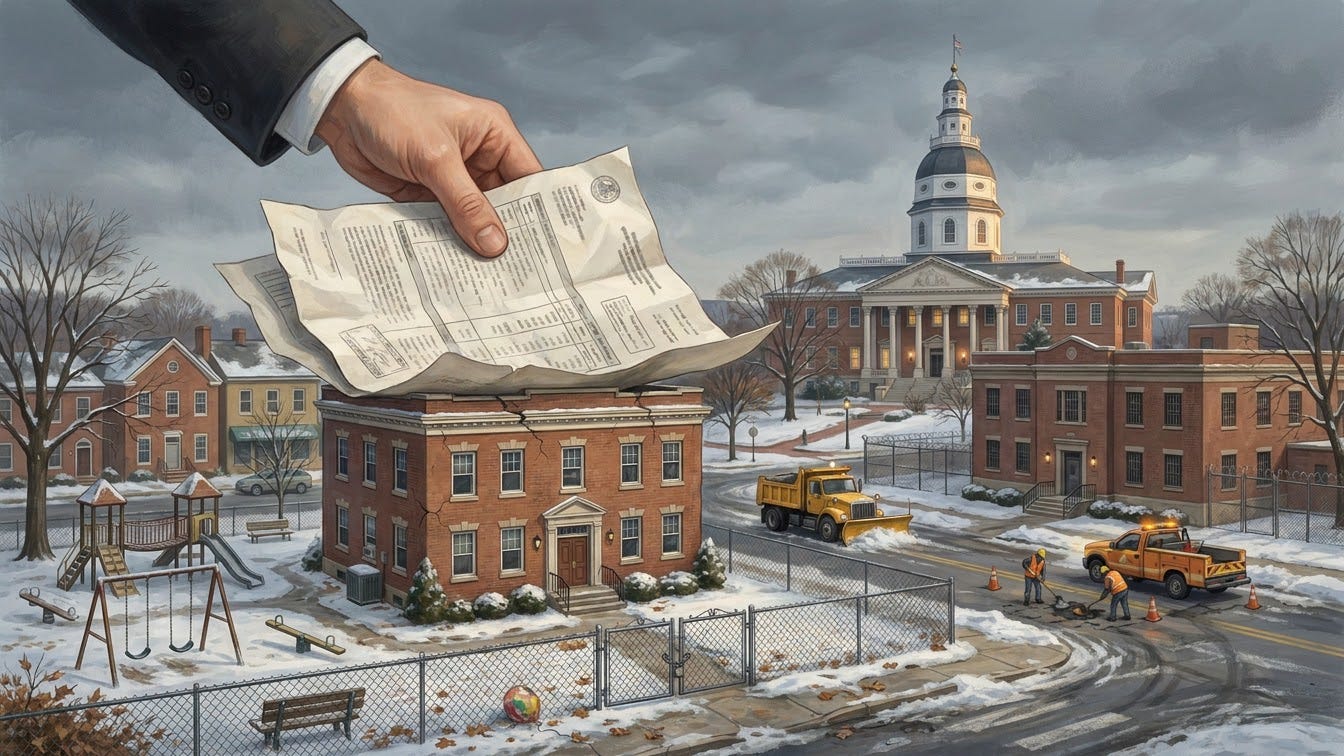
The State Cuts, the Counties Pay
Annapolis has to close a $2.6 billion hole. Watch how much of it ends up on county budgets where almost every dollar is already spoken for.
In today's paid section: Gov. Wes Moore, Senate President Bill Ferguson, House Speaker Joseline Peña-Melnyk, House Appropriations Chair Ben Barnes, DLS budget analyst David Romans and Senate Minority Leader Steve Hershey. The Maryland Association of Counties' Michael Sanderson, Kevin Kinnally and M.C. Keegan-Ayer. New Budget and Taxation members Shaneka Henson, Sara Love and Ron Watson, and Appropriations newcomers Abena Affum-McAllister, Dan Duggan and C.L. Marshall. And from Prince George's: County Executive Aisha Braveboy, Council Chair Krystal Oriadha, and council members Edward Burroughs, Jolene Ivey, Sydney Harrison, Shayla Adams-Stafford, Ingrid Watson and Tom Dernoga, plus the Maryland-National Capital Park and Planning Commission.*
Coffee and a Hard Number
If you're reading this with a second cup of coffee and leftover pie, here's something to chew on. State analysts told the Spending Affordability Committee this month that Maryland faces a $2.6 billion projected structural budget deficit in fiscal 2028, with ongoing revenue covering about 92% of ongoing spending.
The governor and the two presiding officers have responded with what they call a four-year plan. Moore, Ferguson, and Peña-Melnyk announced a joint four-year budget strategy that includes reviewing spending and program results. They have not named specific cuts or ruled out new taxes or fees.
Most coverage stops there: the state has to cut. What it leaves out is that the state can cut its own spending without cutting what it requires someone else to spend.
The Oldest Trick in Annapolis
The General Assembly pulls this move every few years, and it works because hardly anyone outside county finance offices notices. The state keeps a program mandated by law and then hands most of the bill to the counties without the money to pay for it.
Teacher pensions are the textbook case. The State pledged supplemental grants in 2012 when it shifted a significant portion of teacher pension costs to county governments. Before this change, the State fully funded teacher pension contributions.
Then it went back for more. In 2025, counties had to absorb $97.7 million in new costs for State-managed teacher pension increases, while local governments still have no control over teacher salaries or retirement policy. The same law made counties pay 90% of the State Department of Assessments and Taxation's operating costs, a $21.2 million unfunded mandate.
This year brought another round. MACo counts it up: $137 million in new annual retirement costs shifted to counties and a $27.7 million loss in annual supplemental retirement grants over two budget cycles.
The state books those as savings. The counties book them as bills.
Streets, Snow and Jails Don't Care Who Pays
This is the part most people miss. A county budget isn't a pile of money that a council can spend however it likes. Most of it is locked up before the first budget hearing.
The state requires the counties to fund their schools. In fiscal 2026 alone, local appropriations for public schools came to $8.85 billion. State law requires them to run local jails. They maintain the roads. Snow removal isn't written into a statute, but by any practical measure it's a mandate: a county that leaves its roads unplowed after a February storm will hear about it from every resident, and it deserves to.
None of those costs go away when Annapolis stops paying its share. The obligation stays where it was. Only the name on the check changes. If the state doesn't pay, the county does.
The Road Money Cliff
Roads are where the next shift hits. Counties maintain more than 80% of Maryland's roadways and rely heavily on Highway User Revenues to fund critical infrastructure.
That money is about to drop. Analysts project transportation aid to counties and municipalities will fall about $101 million (21.5%) in fiscal 2028. Counties tried to head it off last session, but the bill to preserve the formula did not pass in the 2026 session, setting the stage for a broader conversation on transportation funding in the post-election 2027 legislative session.
So the potholes, bridge repairs and plowing stay the same, and the state's check gets a fifth smaller.
What's Left to Cut
Picture a county budget director in January. Schools are mandated, jails are required, roads have to be kept up, and the pension bill just went up because of a law passed 30 miles away. What's left?
The things people love and nobody is legally required to fund: parks, rec centers, senior programs, the Fourth of July parade, library hours, youth sports leagues. Every dollar the state pushes onto the county comes out of that shrinking pile.
MACo's president put it simply at a task force meeting this summer: "Counties need a menu, not a mandate."
That's the theory, anyway. In Prince George's County, it's playing out in a very particular way.
Prince George's Raids the Parks
Prince George's has big school costs, a large detention center, miles of county roads and a tax cap. County Executive Aisha Braveboy can't call any of that the state's problem; her budget office has to find the money. When it runs short, though, the council doesn't cut its own programs. It goes looking for somebody else's money.
Holiday giveaways are standard practice on that council. Shayla Adams-Stafford, Ingrid Watson, Tom Dernoga and Jolene Ivey have all handed out turkeys and groceries at Thanksgiving. Council Chair Krystal Oriadha went further. In June 2025 her office threw a free District 7 Crab Feast at the Hillcrest Heights Community Center, promoted on the council's official website, with registration through her county office. Nobody else on the council has gone that far.
Then look at where the council goes when it wants more. Oriadha has set aside about $6.5 million for Community On The Frontline, an organization run by Janna Parker, Oriadha's friend and the godmother of her son. District 8 council member Edward Burroughs has sought to steer a similar amount to Joan's House, an Oxon Hill-based nonprofit. That money comes out of park and recreation funds. This spring the council voted to pull $39 million out of the Maryland-National Capital Park and Planning Commission's budget.
Ivey and Sydney Harrison opposed it, and Ivey said the transfer would "become a slush fund for the County Council." Annapolis agreed. House Appropriations Chair Ben Barnes helped lead the push to curtail the council's authority to pull from the commission's budget, and the budget Moore signed explicitly prohibits Prince George's County from continuing to transfer money from the commission's budget. Then a circuit court judge temporarily blocked the $39 million transfer.
It's the same game one level down. The state pushes its costs onto the counties, and a county council that has spent everything it can reach goes after the parks.
Counties Can Win These Fights
This isn't hopeless, and the record proves it. In 2025, counties beat back the worst of it, including a 100% shift of teacher pension costs, and kept their Program Open Space money.
The same 2025 budget also required counties to pay half of wrongful incarceration compensation settlements. One year later, the General Assembly repealed that cost-sharing, and MACo backed the repeal. Counties that show up organized, with numbers, can win.
What to Watch in January
For lobbyists representing counties, and for every client whose program gets county money, here's my advice. When Moore, Ferguson and Peña-Melnyk present their four-year plan, don't ask how much the state saves. Ask who picks up the bill.
Watch the new faces on the money committees. Henson, Love and Watson join Senate Budget and Taxation, and Affum-McAllister, Duggan and Marshall join House Appropriations. None of them have voted on a cost shift in those seats yet, and a smart county lobbyist will reach them before the BRFA does.
There may also be an unlikely ally. Hershey supports the spending review but opposes tax increases and shifting state costs to local governments. If Republicans and county-minded Democrats find each other on this, the four-year plan could look very different by sine die.
The Bottom Line
A state budget is easy to balance if the state gets to keep the mandates and send the bill to someone else. That isn't cutting. It's relocating.
This January, when somebody in Annapolis says they "found savings," find out whose budget they found them in. The answer will show up later in a closed rec center, a shorter library schedule or a canceled parade, and the people who lose those things will blame their county council instead of the legislature that caused it. In Prince George's, some of them will have a point.