

The Special Session Mechanics: How It Actually Works
First, let’s clear up the procedural ground rules: No, this is not a joint session, and the two houses do not merge.
The Maryland Constitution keeps the House of Delegates and the Senate strictly independent. Here is how a standard three-day special session actually breaks down:
Day 1: Convene & Joint Committee Hearing
├── Both chambers gavel in separately to formally introduce legislation.
└── House and Senate committees meet for joint public hearings (e.g., in the Joint Hearing Room).
Day 2: Chamber Separation & Second Reading
├── Senate handles Senate bills on the floor.
└── House handles House bills on the floor; amendments are debated.
Day 3: Final Passage (Third Reading) & Adjournment
├── House votes on final passage of House bills and sends them to the Senate.
├── Senate votes on final passage of Senate bills and sends them to the House.
└── Both chambers cross-vote, pass the identical measures, and adjourn Sine Die.
The only time you see the Senate President and the Speaker share a platform during a special session is during joint committee hearings or ceremonial moments. When it comes to floor debate, voting, and keeping order, the Senate does Senate business in the James Senate Office Building and State House chamber, and the House stays strictly within its own walls.
The Real Story: Can the Speaker Hold the Floor?
While the vote counts are never in doubt—Democrats hold a 100–39 supermajority—the real political theater in Annapolis right now isn’t about the final tally. It’s about chamber discipline.
Political observers across the state are watching Speaker Joseline Peña-Melnyk closely. The question isn’t whether she can keep her own 100-member Democratic caucus in line—she has proven she can hold the party rank-and-file together. The real test is whether she can contain the Republican minority, specifically a fired-up Freedom Caucus that has shown zero interest in playing by traditional State House politeness.
Why Sine Die Matters for This Session
Remember the final night of the regular session? When leadership pushed to restrict vote explanations to beat the midnight deadline, members like Delegate Matt Morgan and conservative floor leaders didn’t just register “no” votes—they made noise. They forced points of order, challenged parliamentary rulings, and turned the final minutes into a high-visibility media spectacle.
That wasn’t a one-off outburst; it was a blueprint.
The Freedom Caucus Playbook
In a fast-tracked, three-day special session, the minority party’s only real leverage is Procedural Disruption:
Prolonging second-reading debates with point-by-point amendments.
Forcing roll-call votes on minor procedural motions.
Demanding strict adherence to (or pushing the boundaries of) parliamentary decorum to provoke a gavel-down response from the dais.
The Balancing Act on the Dais
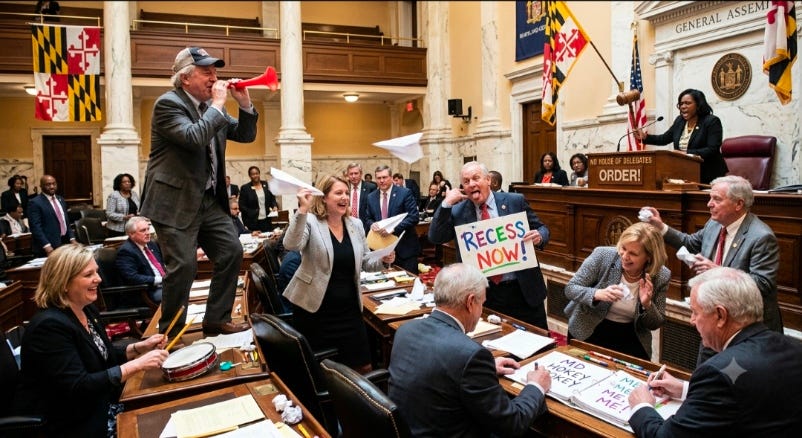
If leadership acts with too heavy a hand—shutting down debate early or dropping the gavel at the first sign of grandstanding—it feeds directly into the conservative narrative that the supermajority is silencing opposition voices. But if floor debate is allowed to drift, a focused three-day session can quickly devolve into a chaotic circus.
The Bottom Line: Watch the rostrum closely over these three days. The policy outcomes may be pre-baked, but how the Speaker manages minority pushback will tell us everything about how floor discipline will look heading into the next legislative cycle.
You make it sound like only conservatives oppose what they are going to do. Pro-democracy voters do. This is already one of the leading voter suppression states, and the session is to make things less democratic. Maryland has a bad case of Dominant Party Syndrome. Dominant parties are usually strongly anti-democracy, and that most definitely is the case in Maryland.