

There’s a phrase that floats around political discussions like a specter: the ruling class. It conjures images of smoke-filled rooms, backdoor deals, and a small elite pulling the strings. But what if we’ve misnamed the group we’re actually talking about?
What if the so-called “ruling class” is really the show-up class and work class. The people who consistently volunteer, organize, fund, and clean up after the rest of us?
📊 The 80/20 Reality
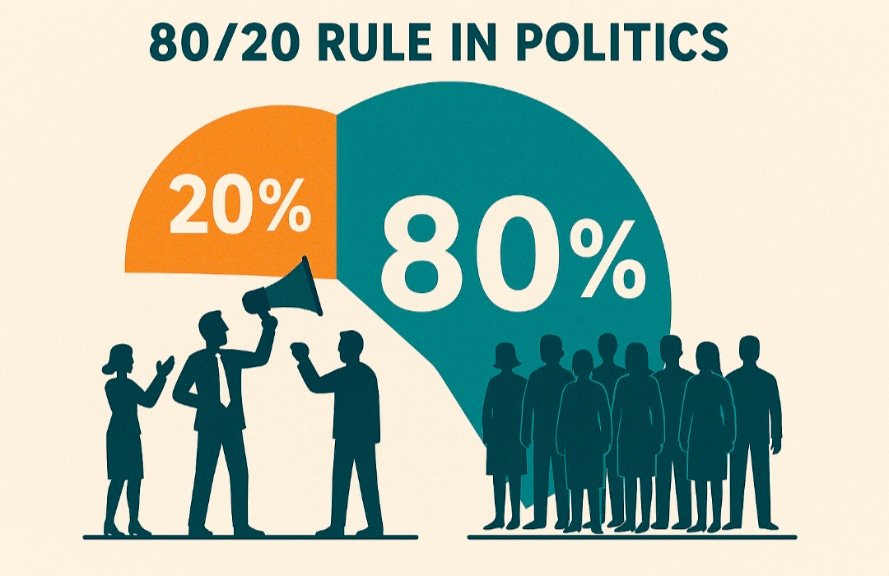
Anyone who’s led a church congregation, PTA, civic group, or campaign knows the 80/20 rule by heart:
- 20% of the people give 80% of the money
- 20% of the people do 80% of the work
- And when it’s time for cleanup, it’s the same 20% who stay behind with trash bags and folding chairs
This isn’t just anecdotal. The Pareto Principle has shown up across nonprofit work, politics, and even churchyard cleanups. A small group of people consistently carries the weight of community life.
🧠 Decision-Making vs. Duty-Bearing
Yes, it’s often the same faces making decisions—but they’re also the ones showing up early, staying late, and doing the heavy lifting. They’re not just power brokers; they’re the potluck organizers, the budget balancers, the ones who know how to fix the coffee machine and run a spreadsheet.
They’re not the ruling class in the aristocratic sense. They’re the reliable class. The count-on-them class. And they exist across every political spectrum—Republican, Democrat, Libertarian, Communist, or otherwise.
🧍♂️ The Misperception Gap
Here’s the irony: the people who don’t show up often view the ones who do as gatekeepers. They see them as entrenched, controlling, or exclusionary. But in reality, these folks are just the ones who said “yes” when the clipboard came around.
They didn’t seize power—they accepted responsibility.
And responsibility, unlike power, is rarely glamorous.
🛠️ Civic Infrastructure Runs on Volunteers
Whether it’s stormwater policy in Maryland or a churchyard cleanup in South Baltimore, the machinery of civic life runs on the same fuel:
- People who show up
- People who stay late
- People who say “I’ll take care of it” without fanfare
These are the folks who keep the lights on, the bylaws updated, and the potluck tables wiped down.
🧭 Reframing the Narrative
Let’s stop calling them the ruling class. Let’s call them what they are:
- The infrastructure class
- The volunteer backbone
- The civic stewards
They’re not perfect. They make mistakes. But they’re there. And that counts for something.
It's certainly true when it comes to actually getting the work done in the organization -- the same small group that always show up. But that might not be the same as who has the power to decide what's going to be done and by whom. Do they really /rule/?