

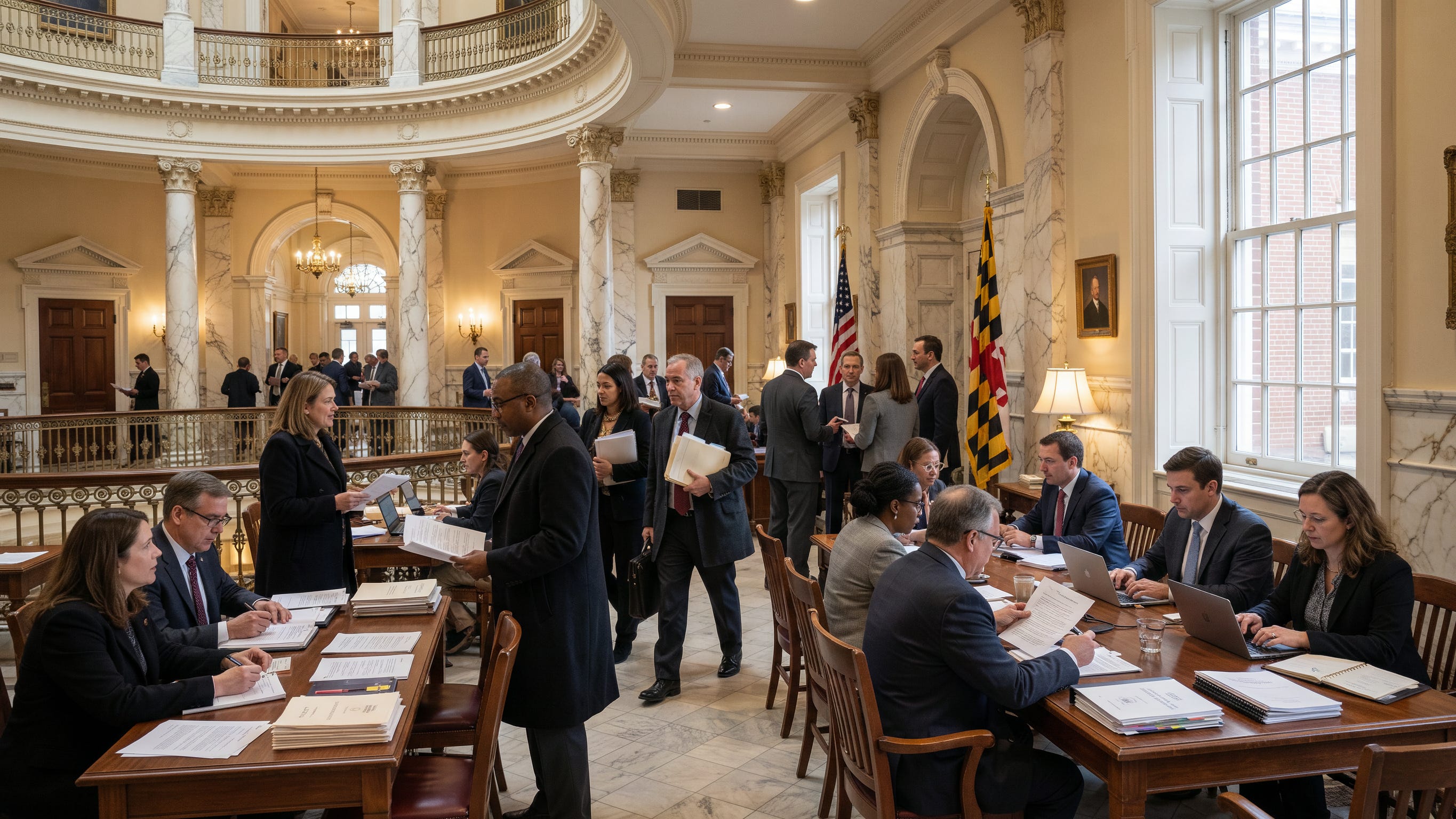
The Prefile Clock Starts Ticking: How Friday’s DLS Drafting Cutoff Shapes 2027 Session Lobbying, Regulatory Battles, and Year-End Contract Releases
By Barry O’Connell
While Sunday’s news cycle remained quiet ahead of the Thanksgiving holiday week, statehouse lobbyists and government contractors need to mark two major operational milestones that quietly locked in over the weekend ahead of this morning’s Monday opening bell.
First, Friday, November 20 marked the statutory deadline for Maryland General Assembly members to submit complete bill-drafting requests to the Department of Legislative Services (DLS) for 2027 Session prefile introduction. Lawmakers now have until Thursday, December 10, 2026, to formally direct DLS in writing to introduce those bills ahead of the January 13, 2027 session gavel.
Because Maryland’s 2027 session opens a new four-year legislative term with zero bill carryover from 2026, every regulatory mandate, procurement reform, and tax-credit extension must be re-introduced from scratch—putting a premium on early coalition positioning over the next 17 days.
Second, the Board of Public Works (BPW) quietly uploaded its initial December 2, 2026 Meeting Agenda (updated November 20) to the state portal, giving state contractors and agency monitors an early look at the final major procurement docket before year-end holiday slowdowns.
Simultaneously, state and municipal buyers pushed a late-Friday wave of fresh engineering, cybersecurity, and winter-operations filings onto eMaryland Marketplace Advantage (eMMA)—led by Baltimore City’s On-Call Wastewater Processing & SCADA Engineering solicitation (BPM059833) and MDOT MVA’s PCI DSS Cybersecurity Compliance RFP (BPM059848).
Here is where legislative prefile battles, the newly posted December 2 BPW agenda, and today’s Thanksgiving-week procurement cutoffs converge.
🔒 THIS STORY IS FOR PAID SUBSCRIBERS 🔒
Subscribe today to unlock the full breakdown—including how the Nov. 20–Dec. 10 DLS prefile window dictates early 2027 committee positioning, what late-Friday eMMA filings open for cybersecurity and environmental engineering primes, and how the Fourth Circuit’s Kalshi ruling alters 2027 gaming and fintech legislation.
