

MARYLAND WIRE MAGAZINE FEATURE
The Poll That Isn’t a Crisis: Wes Moore, the Economy, and the Illusion of a Republican Opening
By Barry O’Connell
Maryland Wire Magazine
I. The Number That Launched a Thousand Hot Takes
Every political class in Maryland woke up buzzing over a single number: 48%.
That’s the new job‑approval rating for Governor Wes Moore in the latest UMBC survey conducted by Mileah Kromer — a pollster whose methodology is so consistently clean that even people who dislike the results trust the work. (I once joked she’s one of the seven smartest people in Maryland academia. It wasn’t really a joke.)
But the instant reaction — the breathless “Moore is slipping” chatter — misses the real story. This isn’t a referendum on Wes Moore versus any Republican. It’s not a sign of a surging Dan Cox, a suddenly viable John Myrick, or a renaissance for Ed Hale, the former Democrat turned eccentric Republican aspirant.
This poll is about one thing:
Wes Moore vs. the economy.
Not Wes Moore vs. the Republican Party.
Not Wes Moore vs. a challenger.
Not Wes Moore vs. his own base.
Just Wes Moore vs. the economic mood of a state that feels squeezed, anxious, and pessimistic.
II. The Anatomy of a Dip: Why 48% Isn’t What It Looks Like
Let’s start with the structural reality.
UMBC’s poll shows:
- 59% of Marylanders say the state is on the wrong track.
- 76% rate the economy as “fair” or “poor.”
- Majorities say groceries, gas, electricity, and housing are less affordable.
- The pessimism is broad, emotional, and not tied to any specific policy.
In that environment, every governor in America would take a hit.
Moore’s decline from the low 50s to 48% is not a Maryland story — it’s a macroeconomic story.
And the distribution of the drop tells the tale:
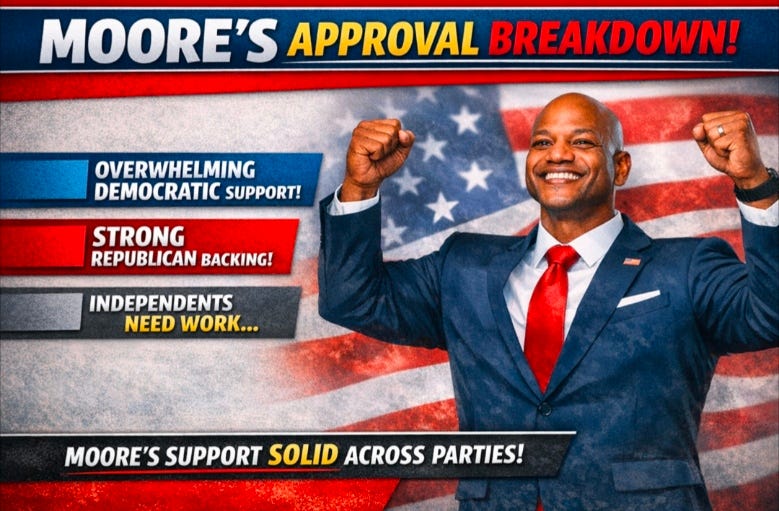
- Democrats still approve 69–20.
- Republicans disapprove, but not overwhelmingly — 25% approval is unusually high for a Democrat.
- Independents are the soft spot: 50% disapprove, 39% approve.
This is the classic pattern of an approval‑rating dip driven by economic frustration, not political realignment.
If this were a choice environment — a real head‑to‑head race — you would see Democratic erosion. You would see Moore’s base cracking. You would see Republicans consolidating.
You see none of that.
III. The Republican Field: A Vacuum, Not a Threat
Let’s be blunt.
There is no Republican in Maryland who currently has:
- the money,
- the organization,
- the statewide acceptability,
- or the ideological positioning
to take meaningful chunks out of Wes Moore’s coalition.
Dan Cox
He will get the MAGA vote.
He will not get all the Republican vote.
He will get almost no independents.
He is not the candidate you run when you want to win Maryland.
John Myrick
Good guy.
No money.
No statewide profile.
No infrastructure.
No path to the kind of fundraising needed to become a threat.
Ed Hale
A quirky, arrogant, former Democrat with no natural constituency.
Republicans aren’t going to nominate him.
Democrats aren’t going to defect to him.
Independents aren’t going to discover him.
The Republican bench is not weak — it is nonexistent.
Which is why interpreting Moore’s 48% as a sign of electoral danger is a category error. There is no one to capitalize on the softness.
IV. The Approval vs. Choice Distinction: The Heart of the Matter
This is the part most pundits miss.
Approval rating answers:
“Do you like how the governor is doing?”
Ballot choice answers:
“Who do you want to be governor?”
Those are not the same question.
They do not produce the same numbers.
They do not measure the same instincts.
In a state like Maryland — with a 2‑to‑1 Democratic registration advantage — a Democrat can have a 48% approval rating and still win a general election comfortably.
Why?
Because approval is a mood.
Choice is a decision.
And when the decision is between:
- a fiscally serious, center‑left governor with broad goodwill,
vs.
- a Republican Party that has not produced a statewide winner since Larry Hogan — and is now dominated by a MAGA faction that cannot win Maryland,
the outcome is not complicated.
Moore’s approval rating dipped.
His electoral position did not.
V. The Independent Voter Problem — and Why It’s Fixable
The only group showing real movement is independents.
They are frustrated with the economy.
They are frustrated with affordability.
They are frustrated with the direction of the state.
But they are not frustrated with Wes Moore personally.
They are frustrated with the moment.
This is the kind of softness that rebounds when:
- inflation cools,
- wages rise,
- the budget stabilizes,
- or the governor delivers a high‑visibility win.
It is not ideological.
It is not partisan.
It is not structural.
It is emotional.
And emotional softness is reversible.
VI. The Quiet Strength: Republicans Are Weirdly Friendly to Moore
This is the most under‑reported number in the poll:
25% of Republicans approve of Wes Moore.
In a polarized era, that is astonishing.
It means:
- Moore is not seen as a partisan warrior.
- He is not viewed as hostile to conservatives.
- He is not triggering the reflexive opposition that defines national politics.
- He is governing to the right of the legislature in ways that Republicans recognize.
This is not a coalition that collapses.
This is a coalition that endures.
VII. The Real Story: A Governor Absorbing the State’s Anxiety
The UMBC poll is not a warning sign for Wes Moore’s political future.
It is a snapshot of Maryland’s economic mood.
It tells us:
- Marylanders are anxious.
- They are frustrated.
- They are pessimistic.
- They are projecting that frustration onto the governor.
- But they are not abandoning him.
- And they are not embracing anyone else.
This is not a governor in trouble.
This is a governor carrying the weight of a difficult moment.
And in Maryland politics, moments change faster than coalitions.
VIII. The Bottom Line
Wes Moore’s 48% approval rating is:
- a reflection of economic pessimism,
- not a sign of Republican strength,
- not a sign of Democratic erosion,
- not a sign of a competitive race,
- and not a sign of a collapsing coalition.
It is the kind of dip every governor takes when the economy feels tight.
And unless a Republican emerges who can raise real money, build real infrastructure, and appeal to independents without alienating their own base — which is not happening — this poll changes nothing about the 2026 landscape.
Maryland is still Maryland.
Wes Moore is still Wes Moore.
And the Republican Party is still the Republican Party.
The story here isn’t political.
It’s economic.
And it’s temporary.
Gaming out what investment in 18 counties might look like on the ground by sunsetting PFA1997 and TPA2008:
It would stop looking like county-by-county survival management and start looking like regional market building.
The ground-level shift would not be abstract. It would show up in a few very concrete ways.
First, the development conversation would move away from “what site can we fund?” toward “what economic systems already operate here, and how do we strengthen them?”
In practice, that means the 18 rural counties would stop chasing isolated projects and start organizing around corridors, clusters, and linked enterprise networks: farm and food systems, craft beverage, waterfront economies, outdoor recreation, heritage tourism, equine, small manufacturing, logistics-adjacent suppliers, health and wellness, and Main Street retail that depends on visitor flow.
Second, capital would behave differently. Right now, a lot of rural development energy gets pushed toward site-readiness, one-off grants, business attraction, and fragmented small programs.
If PFA and TPA2008 were sunset, you could replace those filters with regional investment logic. On the ground, that means more money for shared-use infrastructure: cold storage, aggregation, processing, kitchen incubators, event-support infrastructure, rural broadband for business operations, booking and ticketing systems, shared marketing platforms, distributed wayfinding, cooperative logistics, shoreline access improvements, docks, trail connectors, and adaptive reuse of underused buildings. Instead of waiting for one big employer or one marquee project, counties could build the connective tissue that makes many smaller enterprises more productive.
Third, tourism would stop being measured mainly through hotel logic and start being treated as a broader visitor economy. In rural counties, that changes behavior fast. Day trips, trail movement, dispersed spending, festivals, waterfront stops, farm retail, tasting rooms, outfitters, and event-based commerce all become legible. On the ground, that means a county would care not only about room nights, but also whether a visitor stopped at three businesses, bought local goods, booked an experience, returned within 60 days, or extended into a neighboring county. That kind of measurement changes what gets funded and promoted.
Fourth, county lines would matter less operationally. You would see formal cross-county packaging and development entities instead of “informal collaboration.”
Wine trails, oyster trails, paddling trails, agritourism loops, craft beverage corridors, and heritage routes would no longer be side projects. They would become economic products with budgets, staffing, and performance goals. That is a huge difference. A trail would stop being a brochure concept and become a demand system.
Fifth, local governments would start behaving less like promoters and more like conveners of enterprise ecosystems. In the 18 counties, economic development offices would likely divide into a few practical functions: regional partnership building, operator support, infrastructure deployment, and data capture.
They would spend less time trying to manufacture identity and more time organizing assets that already exist. The conversation would become, “Where are our strongest enterprise concentrations, what is constraining them, and what shared infrastructure unlocks growth?”
Macro-economically, the result would probably be slower-looking but more durable growth. You would likely get less splashy ribbon-cutting and more compounding gains.
More business starts and second-site expansions. Better survival rates for small operators. More value-added capture staying local. More inter-county circulation of dollars.
Higher local retention of visitor spend. More year-round activity instead of seasonal spikes. More mixed-income job creation because the model would support technicians, marketers, trades, hospitality workers, food processors, logistics coordinators, guides, makers, and operators all at once.
At the granular level, it would look like this:
A farm is no longer just a farm. It is measured as production, retail, events, education, lodging, wellness, beverage, and workforce training if that is how it operates.
A waterfront town is no longer judged only by marina slips or a summer event calendar. It is assessed as part of a regional water economy tied to seafood, recreation, hospitality, heritage, and environmental stewardship.
A Main Street is no longer treated as a standalone retail strip. It is part of a visitor-routing and operator-support system connected to farms, trails, venues, and local makers.
A county fairgrounds, event zone, or underused civic site becomes a multi-use economic platform, not just a venue.
There would also be real losers. Some entrenched habits and interests would weaken. Counties that rely on guarding turf would have to share strategy.
Tourism offices that are comfortable as promotional shops would have to confront performance and infrastructure questions.
Better-resourced corridor counties would lose some structural advantage if rural clusters were finally allowed to organize as investment-worthy systems. Some state agencies would resist because this would require new data categories, new reporting methods, and new accountability.
The transition period would be messy. You would need replacement mechanisms immediately, or you risk chaos. If PFA and TPA2008 simply disappeared with nothing to replace them, rural counties would not magically flourish. They would have a vacuum.
The real upside only comes if sunset is paired with a new framework: regional investment districts, better tax coding, operator-level data infrastructure, cross-county funding mechanisms, and a more honest visitor economy model.
So the grounded answer is this:
On the ground, the 18 rural counties would begin to look less like isolated places competing for crumbs and more like linked economic terrains with identifiable systems, shared infrastructure, and measurable enterprise activity.
The biggest change would not be cosmetic. It would be that activity currently treated as scattered, seasonal, or “too small” would finally become visible enough to organize, fund, and scale.
Political cycles are just that: cycles.
What’s not temporary is the state’s persistent disinvestment in 18 counties, the 1997 PFA and TPA2008 statutes that have created a nonprofit industrial complex and spawned a rural counties “must be more innovative and resilient” narrative.
Both are statutes not serving how business actually operate in modern economics. TPA2008 is especially damaging as the eight sales tax codes in statute do not disaggregate farm and agricultural revenue.
If you want to debate economics, let’s talk about that. Eighteen counties have working lands and waters, but there is no capital investment to support the existing infrastructure, let alone expand it.
The Maryland Future Board is looking to be passed this session and signaling its priorities in the bill draft and the 50MM Equitech Growth Fund deprioritized agriculture in its strategic plan, even though statute weighted agriculture equally with “jobs of the future,” and DECADE Act lighthouse sectors including cyber, quantum, and biotech—all Baltimore - DC corridor based sectors.