

The Only Question Democrats Should Be Asking About 2028
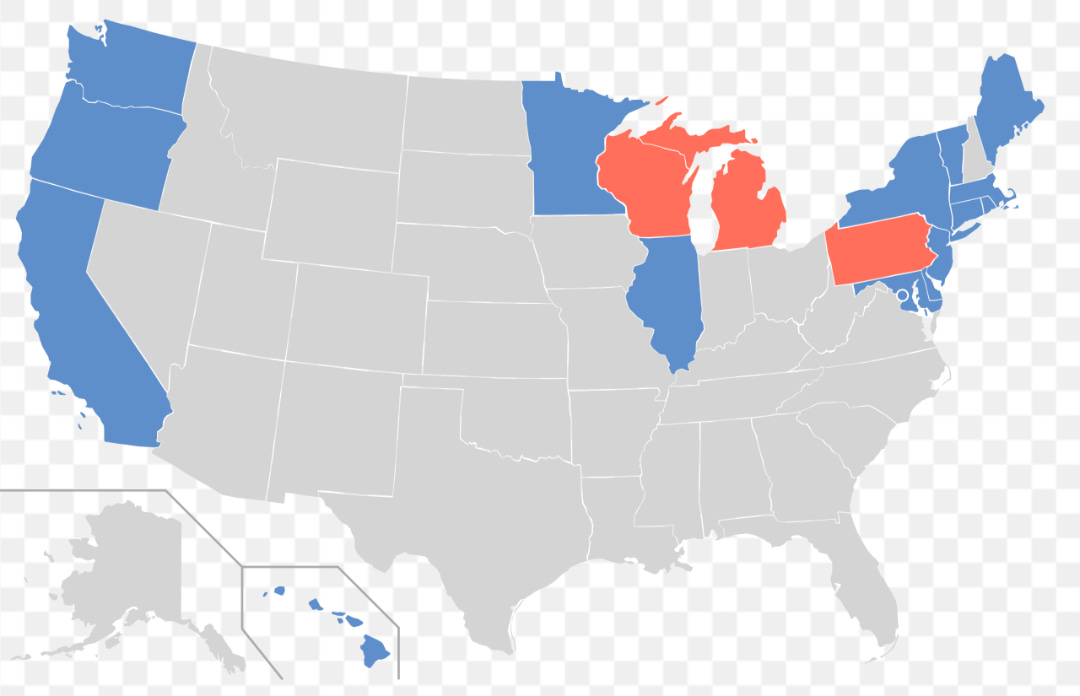
As I sit here putting together 28PW, my working premise for 2028 is brutally simple: every Democrat who wants to be president has to answer one question—can you win Pennsylvania, Michigan and Wisconsin?
If we carry those three, we’re probably sitting in the Oval Office. If we don’t, we’re probably watching Donald Trump, or someone in his image, get sworn in again. I don’t have to like that reality. You don’t either. But it’s the way the board is set up right now. Theree are only 3 swing states.
What the last decade actually tells us
Let me walk you through the pattern as I see it.
In 2008 and 2012, Barack Obama carried Pennsylvania, Michigan and Wisconsin with room to spare. The topline national results are easy enough to check:
- 2008: https://en.wikipedia.org/wiki/2008_United_States_presidential_election
- 2012: https://en.wikipedia.org/wiki/2012_United_States_presidential_election
He did it the way Democrats have to do it: huge margins in Philadelphia, Detroit and Milwaukee, plus strong showings in the suburbs and just enough vote out of the smaller towns to keep the Republican edge from running away with the map. For state‑level detail, see the individual state pages, for example:
- Wisconsin 2008: https://en.wikipedia.org/wiki/2008_United_States_presidential_election_in_Wisconsin
Obama won the presidency twice.
In 2016, Hillary Clinton won the popular vote and lost the presidency because the blue wall cracked. Trump took Michigan, Wisconsin and Pennsylvania by tiny margins. You can see it in the national and state results:
- 2016 national: https://www.nytimes.com/elections/2016/results/president
- Closest states overview: https://www.usnews.com/news/the-run-2016/articles/2016-11-14/the-10-closest-states-in-the-2016-election
Michigan, Wisconsin and Pennsylvania were all decided by tens of thousands of votes, combined smaller than a decent football crowd. Trump got the White House.
In 2020, Joe Biden went back to the basics. He clawed back Pennsylvania, Michigan and Wisconsin—again, you can see the margins in any standard results map or write‑up, for example:
- How Biden won MI and WI: https://www.cnbc.com/2020/11/06/these-maps-show-how-joe-biden-won-michigan-and-wisconsin.html
- Election coverage on the “blue wall”: search “Biden Michigan Wisconsin Pennsylvania results” or refer to state pages
He won the presidency.
In 2024, Kamala Harris couldn’t hold the wall. Post‑election work from places like Pew Research and Catalist makes clear that her losses ran straight through Pennsylvania, Michigan and Wisconsin, with weaker Democratic turnout and some modest Republican gains among younger and non‑white voters. Useful reads:
- Pew on 2024 voting patterns: https://www.pewresearch.org/politics/2025/06/26/voting-patterns-in-the-2024-election/
- Catalist 2024 report: https://catalist.us/whathappened2024/
- A blunt Black‑voter retrospective: https://elections-daily.com/2025/09/24/how-black-voters-cost-kamala-harris-the-2024-election/
Trump is once again president.
That’s the track record I’m looking at. When we win Pennsylvania, Michigan and Wisconsin under Obama and Biden, we take the White House. When we lose them under Clinton and Harris, we don’t. It’s not abstract theory. It’s four straight presidential cycles.
It’s not about Kansas. It’s about Philly, Detroit and Milwaukee.
Because of that track record, I don’t spend much time worrying how a Democratic vice‑presidential nominee plays in a rural county in Kansas. I’m a lot more interested in how they look in West Philly, on the east side of Detroit, and on Milwaukee’s North Side.
The big Democratic vote banks in these states are not scattered evenly across the map. In Pennsylvania, for example, we’re talking about:
- Philadelphia and the close‑in collar counties around it
- Pittsburgh and Allegheny County
- The Lehigh Valley and Scranton–Wilkes‑Barre
The northern tier and the coal counties in the southwest—Lycoming, Greene, Washington, Fayette, big chunks of Westmoreland—are not where Democrats win the state. We don’t suddenly become competitive there in 2028. The mission in those places is to lose by less, not to pretend we’re going to carry them.
Where the election lives and dies is in the cities. Obama and Biden understood that. They turned out every vote they could find in Philadelphia, Detroit and Milwaukee. Clinton and Harris simply did not match that performance.
There’s plenty of reporting on how Biden’s 2020 win rode improved performance in key counties versus Clinton’s 2016 showing, for example:
- Michigan/Wisconsin county maps: https://www.cnbc.com/2020/11/06/these-maps-show-how-joe-biden-won-michigan-and-wisconsin.html
The turnout story I’m watching
Here’s what the data tells us, and it lines up with what I’ve been seeing and hearing.
Nationally, Black turnout hit a historic high in 2012 and then fell sharply in 2016, even as overall turnout hit records. Pew’s breakdown is essential reading here:
- Pew on Black turnout 2012 vs 2016: https://www.pewresearch.org/short-reads/2017/05/12/black-voter-turnout-fell-in-2016-even-as-a-record-number-of-americans-cast-ballots/
Since then, research from the Brennan Center has documented that the racial turnout gap has widened again—white turnout consistently outpacing turnout among voters of color:
- Brennan Center, “Growing Racial Disparities in Voter Turnout 2008–2022”: https://www.brennancenter.org/our-work/research-reports/growing-racial-disparities-voter-turnout-2008-2022
At the city level, you’ll find fact‑checks and local reporting showing drop‑offs and flat performance in heavily Black neighborhoods:
- Milwaukee Black turnout fact‑check: https://www.politifact.com/factchecks/2020/mar/19/facebook-posts/milwaukee-black-voter-turnout-2016-trump-clinton/
- Milwaukee 2020 turnout analysis: https://www.jsonline.com/story/news/politics/elections/2020/11/07/election-results-milwaukee-turnout-flat-despite-wisconsin-surge/6206973002/
- Milwaukee’s Black voters in 2020: https://wisconsinwatch.org/2020/11/proud-of-my-city-turnout-down-but-milwaukees-black-voters-leapt-hurdles-to-vote/
- Detroit and Black turnout perspectives: for example, a 2020 Detroit Free Press piece: https://www.freep.com/story/news/politics/elections/2020/11/06/joe-biden-detroit-michigan-vote-election-2020/6168971002/
On Harris specifically, Pew and others show she still carried Black voters strongly, but with age and enthusiasm gaps:
- Pew on Black support for Harris vs Trump/Kennedy: https://www.pewresearch.org/short-reads/2024/08/22/black-voters-support-harris-over-trump-and-kennedy-by-a-wide-margin/
Catalist and Elections Daily go deeper on turnout gaps, especially among younger and non‑college Black voters:
- Catalist 2024 turnout analysis: https://catalist.us/whathappened2024/
- “How Black Voters Cost Kamala Harris the 2024 Election”: https://elections-daily.com/2025/09/24/how-black-voters-cost-kamala-harris-the-2024-election/
If you’re losing states by tens of thousands of votes, that kind of drop‑off is the ballgame.
What Harris and Walz taught me about enthusiasm
Let me be blunt about Harris and Walz, because this is where my own observations come in.
The Harris 2024 campaign had all the nutritional value of stale bread and murky water. You could force it down if you felt you had to, but no one was lining up for second helpings.
A lot of the women I know were genuinely excited about the prospect of a woman president. Many older Black voters were too. Pew’s data backs that up: very high support among Black voters overall, especially older ones:
But when I talked to younger Black voters—especially young Black male voters—the energy wasn’t there. They saw Harris as the institution: former prosecutor, Vice President, the system itself. Several research projects and articles have probed this disconnect:
- Carnegie Endowment on Harris’s racial identity and the Black electorate: https://carnegieendowment.org/research/2025/03/kamala-harris-racial-identity-and-the-black-electorate
They weren’t flocking to Trump in massive numbers. They were just skipping the whole exercise. And in neighborhoods where you need the turnout in the 70s to hang on to the state, sliding back into the low‑ to mid‑60s is enough to cost you the election. Youth‑focused analysis from Tufts’ CIRCLE helps frame that:
- Youth vote in 2024 (Tufts CIRCLE): https://circle.tufts.edu/2024-election
Then Democrats put Tim Walz on the ticket. Walz is a perfectly decent politician with a union‑dad story and some Midwestern charm. Politico’s profile of what he was supposed to “bring” to the ticket is worth a read:
- Politico: “What Tim Walz Brings to the Democratic Ticket”: https://www.politico.com/news/magazine/2024/08/06/tim-walz-brings-democratic-ticket-2024-00172978
But to a lot of younger voters, he looked exactly like you’d expect: boring, older, white, and not especially relevant to their lives.
The theory was that Walz would help with rural and small‑town voters in the Midwest and soften the blow in places where Democrats have been bleeding support for years. Coverage at the time made clear that running mates rarely swing states on their own:
- CBS News segment on Walz and battlegrounds:
- Example commentary on veepstakes impact: https://wtop.com/elections/2024/08/veepstakes-settled-with-selection-of-walz-virginia-political-experts-weigh-in/
Maybe he helped around the margins. But I don’t see any serious evidence that Walz delivered a state like Arizona or North Carolina, or that he fixed the enthusiasm problem in Philadelphia, Detroit or Milwaukee.
And that’s the lesson I’m taking forward: “do no harm” is not the same thing as “help us win the states we have to win.”
The 28PW standard: can this ticket win the wall?
So when I talk about 28 PW as a project—watching the 2028 field develop—I’m not here to re‑litigate Harris or carry water for Newsom, Pritzker, or anyone else. I’m trying to force us to look at the map the way it really works.
To me, that means putting every serious Democratic contender through a two‑part test:
1. Can this person plausibly carry Pennsylvania, Michigan and Wisconsin on their own?
Not in a fantasy map where Texas or Florida suddenly behaves like Maryland. In the actual environment we live in, where the path to 270 still runs straight through the same three states that delivered Obama and Biden and denied Clinton and Harris.
2. If they’re not obviously strong in that blue wall space, who can they put on the ticket who is?
That doesn’t mean “moderate white guy from a rural state.” It means someone who can move numbers where we need numbers moved: young Black voters in Philadelphia, Detroit and Milwaukee, and the broader coalition of voters of color and younger voters who live in and around those cities.
The research backing up this focus on turnout and enthusiasm is out there for anyone who wants to dig in:
- Brennan Center on growing racial turnout gaps: https://www.brennancenter.org/our-work/research-reports/growing-racial-disparities-voter-turnout-2008-2022
- Pew’s 2025 breakdown of how people voted in 2024: https://www.pewresearch.org/politics/2025/06/26/voting-patterns-in-the-2024-election/
- Catalist’s data‑heavy look at 2024: https://catalist.us/whathappened2024/
- Elections Daily on Black voters and Harris’s loss: https://elections-daily.com/2025/09/24/how-black-voters-cost-kamala-harris-the-2024-election/
So when I say we need a ticket that can “get the Black vote out” in Philadelphia, Detroit and Milwaukee, I’m not speaking in code. I’m talking about measurable turnout gaps in a handful of cities that decide who gets to 270.
Strategy over sentiment
Let me be clear about what I am—and am not—arguing.
I am not telling you who the Democratic nominee in 2028 should be. I’m not telling you we must rerun Harris, or must never rerun Harris. I’m not telling you that Gavin Newsom or J.B. Pritzker or anyone else is the savior of the party.
I am saying we can’t afford to pick a ticket based on sentiment, vibes, or cable‑news charisma alone. We need to ask, over and over: can this pairing actually win Pennsylvania, Michigan and Wisconsin? And if the top of the ticket doesn’t naturally light up young Black voters in Philly, Detroit and Milwaukee, who can we put in the second slot who does?
If we don’t answer that question honestly in the primary, we’ll end up answering it the hard way on election night.