

THE NEXT ENERGY PLAY HIDING IN PLAIN SIGHT
Why Maryland Is Quietly Positioned to Lead the East Coast in Geothermal Networks—And Why Annapolis Should Act Before Our Neighbors Wake Up
By Barry O’Connell | Maryland Wire
THE IDEA THAT’S BEEN SITTING UNDER OUR FEET
Every session in Annapolis produces a few bills that make noise and a few that make history. The noisy ones get the cameras. The historic ones get ignored—until the day someone realizes they quietly rewired the state’s future.
One of those bills passed last year.
It didn’t involve offshore wind, hydrogen hubs, or nuclear microreactors. It didn’t promise 30,000 years of energy or billionaire‑backed miracles in the Utah desert. It was far more boring, far more practical, and far more transformative:
The WARMTH Act (HB 397)—a law that requires Maryland’s gas utilities to pilot networked geothermal energy systems in real neighborhoods, on real streets, with real customers.
The sponsors?
Del. Lorig Charkoudian and Sen. Brian Feldman, two lawmakers who have quietly become the architects of Maryland’s energy transition.
Their bill didn’t just authorize geothermal pilots. It mandated them.
And that mandate is now barreling toward the Public Service Commission on a statutory deadline.
WHAT THE GOVERNOR’S TEAM SHOULD KNOW RIGHT NOW
The WARMTH Act is not a think‑tank exercise. It is not a “study.” It is not a “task force.” It is a binding order to Maryland’s gas utilities:
- Design geothermal network pilots
- Submit them to the PSC by July 1, 2025
- Launch them within 12 months of approval
- Serve at least 80% low‑ and moderate‑income households
- Lower customer bills compared to gas
This is the first time in Maryland history that gas utilities have been told, in statute, to test a future beyond gas.
And the clock is ticking.
If the Governor’s senior staff is reading this—as they often do—this is the moment to decide whether Maryland treats this as a compliance exercise or a first‑mover advantage.
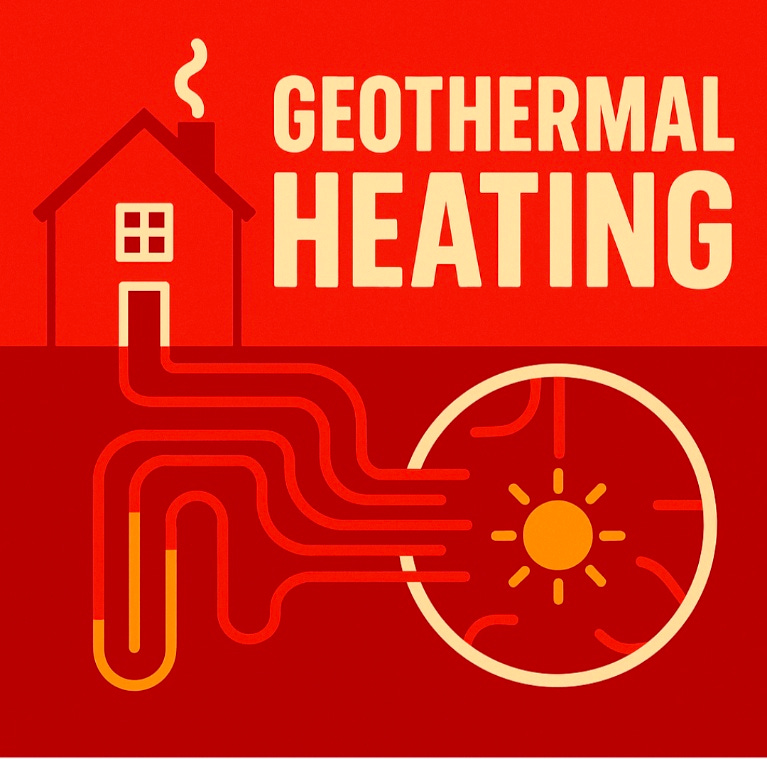
WHAT “NETWORKED GEOTHERMAL” ACTUALLY MEANS
Forget the Utah hype videos. Maryland isn’t drilling miles into superheated rock. We’re doing something more grounded:
- Drill a series of moderate‑depth boreholes in the right‑of‑way
- Install a closed-loop thermal network
- Connect each home to the loop via a ground-source heat pump
- Use the earth’s stable temperature to heat and cool buildings efficiently
It’s not exotic. It’s not speculative. It’s not a moonshot.
It’s infrastructure.
And it’s infrastructure Maryland is uniquely positioned to build.
WHY MARYLAND—NOT PENNSYLVANIA, WEST VIRGINIA, OR VIRGINIA—IS THE PLACE THIS WORKS
1. Pennsylvania is locked into gas economics
Pennsylvania’s political economy is built on the Marcellus Shale. Every gas main they retire is a direct challenge to a dominant industry. Their PUC is structurally aligned with fossil extraction.
Maryland is a gas importer. Every therm we don’t burn is money that stays in‑state.
2. West Virginia is structurally committed to fossil fuels
Even if the engineering case is strong, the political appetite for turning gas utilities into thermal utilities is minimal.
Maryland already crossed that bridge with the Climate Solutions Now Act and the WARMTH Act. We’ve put decarbonization into law, not aspiration.
3. Virginia’s monopoly structure slows innovation
Dominion’s vertically integrated model favors large, centralized projects. Neighborhood‑scale geothermal networks don’t fit that mold.
Maryland’s fragmented utility landscape—BGE, Washington Gas, Delmarva, Columbia Gas—creates space for multiple pilots, multiple models, and faster learning.
4. Maryland’s housing density is perfect for geothermal networks
Rowhouses in Baltimore. Garden apartments in Montgomery. Tight suburban blocks in Prince George’s.
These are ideal for shared thermal loops.
5. Maryland already has the workforce and the regulatory scaffolding
- A decade of geothermal heat pump installations
- MEA grant programs
- PSC dockets on non‑pipe alternatives
- Federal IRA dollars ready to match state action
We’re not starting from scratch. We’re starting from momentum.
THE STRATEGIC OPPORTUNITY: TURN GAS UTILITIES INTO THERMAL UTILITIES
This is the part the “smart people at the table” haven’t fully internalized yet.
The WARMTH Act is not about drilling holes. It’s about changing the business model of gas utilities.
Right now, utilities earn returns on:
- gas mains
- meters
- service lines
In a geothermal future, they earn returns on:
- borefields
- thermal loops
- in‑home heat pumps
It’s the same regulatory logic—just a different asset base.
If Maryland gets this right, we become the first state on the East Coast to demonstrate a financially viable, regulatorily sound, ratepayer‑fair pathway for gas utilities to transition without blowing up bills or climate targets.
That’s the play.
WHAT MARYLAND SHOULD DO RIGHT NOW
1. Treat the pilots as a national model, not a box to check
Direct MEA, PSC staff, Housing, and Labor to coordinate on:
- avoided gas infrastructure costs
- bill impacts
- workforce pipelines
- grid hosting capacity
If Maryland proves geothermal networks are cheaper than replacing old gas mains, other states will follow our lead.
2. Map the right neighborhoods
Overlay:
- gas main age
- leak data
- energy burden
- grid capacity
- climate vulnerability
Pick pilots where the economics and equity align.
3. Build a Maryland‑based geothermal industry
Use:
- state procurement
- federal matching funds
- workforce development programs
…to ensure Maryland firms become the contractors other states hire when they start their own geothermal transitions.
4. Prepare the PSC for the regulatory shift
Thermal utilities are a new category. Maryland can write the rules first.
That’s influence. That’s leadership. That’s legacy.
THE CLOSING ARGUMENT
Maryland is not Utah. We’re not sitting on a supervolcano. We’re not promising 30,000 years of energy.
What we are sitting on is something more practical and more powerful:
A chance to turn our gas streets into geothermal streets.
A chance to turn our gas utilities into thermal utilities.
A chance to turn our climate mandates into real pipes and pumps in real neighborhoods.
And thanks to Del. Lorig Charkoudian and Sen. Brian Feldman, the law is already on the books.
The only question now is whether Maryland chooses to lead—or waits for Massachusetts, New York, or New Jersey to do it first.