

The Military Voter Maryland Never Counts
A Hidden Identity Bloc in a State That Thinks It Knows Its Electorate
Maryland Democrats spend endless cycles modeling the same familiar variables:
race, ethnicity, geography, institutional endorsements, labor, education, federal‑workforce density, and the PG–Montgomery–Baltimore triad that defines statewide math.
But there is one identity bloc that Maryland Democrats almost never quantify — not because it’s small, but because it’s invisible in the voter file:
> Military‑adjacent Marylanders: veterans, active duty, Guard/Reserve, retirees, spouses, dependents, and multi‑generational military families.
This is not a boutique demographic.
It is a 300,000–400,000‑person identity group hiding in plain sight.
And in a future Democratic primary — including a governor’s race four years from now — it is one of the few blocs capable of shifting margins in counties that already dominate statewide outcomes.
Why Maryland Never Models Military Identity
Maryland’s voter registration system does not track veteran status.
It does not track military service.
It does not track Guard/Reserve affiliation.
It does not track dependents or military households.
So campaigns — and political media — default to the variables they can see.
The result is a blind spot:
Maryland treats military identity as if it barely exists.
But the state’s own data contradicts that assumption.
The Real Numbers: A Military State Without a Military Narrative
Veterans
Maryland has ≈360,000 veterans, according to the U.S. Department of Veterans Affairs.
Active Duty + Guard + Reserve + Dependents
Maryland’s official count is ≈100,000 — but this is only direct dependents, not extended families or multi‑generational households.
Retirees + Adult Children + Federal Workforce With Military Backgrounds
This group is not counted in any official dataset, but Maryland’s federal‑workforce density makes it unusually large.
When you combine all categories, the credible, data‑grounded estimate i≈300,000–400,000 military‑adjacent Marylanders.
That is larger than the entire population of Baltimore City.
It is larger than Montgomery’s Democratic primary turnout.
It is larger than the combined Democratic registration of the 15–17 smallest counties.
This is not a niche identity.
It is a structural force.
Why This Matters in a Democratic Primary
1. Military identity is culturally mainstream in Maryland
Maryland is a federal‑workforce state.
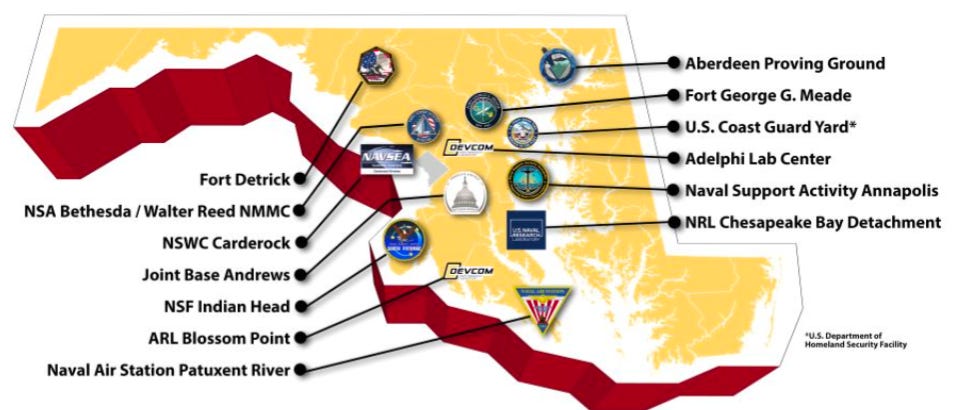
Service is not fringe — it is woven into PG, Anne Arundel, Charles, Baltimore County, and the I‑95 corridor.
A candidate with credible service credentials is not “a veteran candidate.”
They are a public‑duty candidate in a state that respects federal service.
2. Military‑adjacent voters turn out at higher rates
Veterans and Guard/Reserve households vote with:
- higher consistency
- higher civic participation
- higher reliability
In a Democratic primary where turnout is low, reliability is power.
3. Maryland’s military‑connected electorate is more Democratic than the national profile
Nationally, veterans lean Republican.
Maryland is different.
Because Maryland’s veteran population is:
- heavily Black
- heavily suburban
- heavily PG + AA + Charles
- heavily federal‑workforce
…the military‑adjacent electorate is structurally Democratic.
4. Military identity is one of the few cross‑cutting variables
It intersects with:
- race
- geography
- federal employment
- public‑sector culture
- civic institutions
It is one of the rare identity markers that can move voters across demographic lines.
The Jacob Day Example
Maryland Democrats rarely see a contender with:
- active Maryland National Guard service
- deployments in Europe and Africa
- a respected command role
- a pending promotion to lieutenant colonel
This is not “weekend warrior” service.
It is operational service with real-world deployments.
In a future statewide Democratic primary, a candidate with that profile introduces a variable Maryland Democrats almost never model:
> Military‑adjacent voters finally have a candidate whose identity matches their own.
This is not an endorsement.
It is a structural observation.
Maryland has not had many Democratic contenders with real military credentials.
When one appears, the 300,000–400,000 military‑adjacent Marylanders suddenly become visible.
The Maryland Wire Takeaway
Maryland’s political class models race, geography, and institutional power with precision.
But it consistently ignores one of the largest identity blocs in the state:
> Military‑adjacent Marylanders — a 300k–400k group with high turnout, strong civic identity, and deep roots in Democratic counties.
In a future governor’s race, this bloc will not decide the election alone.
But it will matter — and it will matter more than Maryland Democrats are used to seeing.
Military identity is not a novelty.
It is a structural force Maryland has simply never counted.