

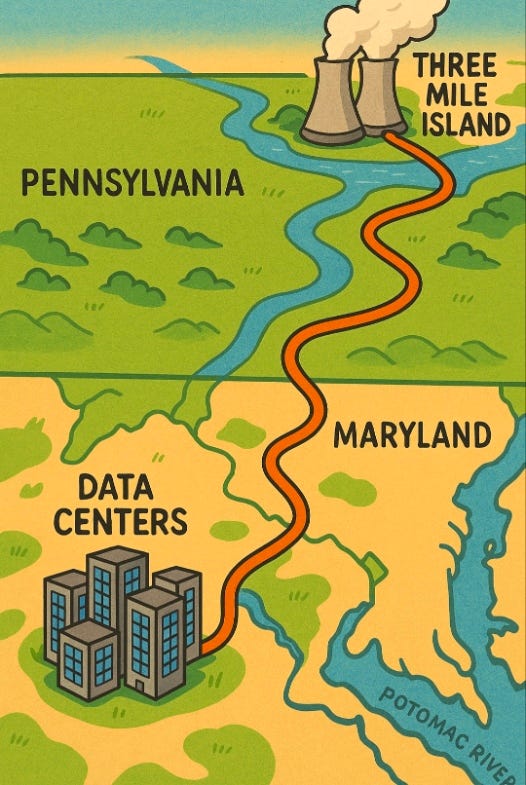
The Line in the Land: Maryland’s Northern Tier Pushes Back Against a Project No One Asked For
Marylanders in the Northern Tier have a word for what’s happening to them right now. They call it a siege. Not a metaphorical one, not a rhetorical flourish — a real, lived sense that someone far away has drawn a line across their map and decided their land, their farms, their heritage, and their quiet are expendable in service of a boom happening somewhere else.
That “somewhere else,” of course, is Virginia. Loudoun. Prince William. The Data Center Crescent. The place where the almighty dollar hums louder than the cicadas ever did, and where the appetite for electricity has grown so voracious that PJM and a handful of power companies now insist Maryland must carve a 70‑mile, 500‑kilovolt scar across its countryside to feed it.
Ask around in Baltimore County’s agricultural reserve, or in the rolling dairy country of Carroll, or in the foothills outside Frederick, and you’ll hear the same thing: “Why are we paying the price for Virginia’s choices?”
Not one farmer, not one landowner, not one local official seems to be in favor of this project — unless they happen to be a utility lawyer or a consultant billing by the hour.
The Project That United People Who Rarely Stand Together
Environmentalists and farmers don’t always end up on the same side of a fight. But this one? This one has them shoulder‑to‑shoulder.
- Farmers see a transmission corridor slicing through generational land, splitting fields, lowering property values, and inviting future industrial creep.
- Ecological voters see a massive, high‑voltage line bulldozing habitat, fragmenting forests, and enabling the very data‑center sprawl they’ve been warning about for a decade.
- Local governments see a process that feels predetermined, rushed, and dismissive of community input.
And all of them see the same thing: Maryland being treated as a pass‑through state for someone else’s profit.
A Fight Over Land, Power, and Who Gets to Decide
The Maryland Piedmont Reliability Project — the official name no one uses — is still in regulatory limbo. The Maryland Public Service Commission won’t rule on it until 2026. But the fight has already turned bitter.
Farmers describe surveyors showing up with court orders.
County officials describe being stonewalled.
Residents describe meetings so packed that fire marshals had to turn people away.
And the phrase that keeps coming up is: “We didn’t ask for this.”
Because they didn’t.
Maryland didn’t ask for Virginia’s data‑center explosion.
Maryland didn’t ask for PJM’s reliability warnings.
Maryland didn’t ask to be the extension cord for the Mid‑Atlantic’s most profitable industry.
Yet here they are — being told that a 500 kV line must run through their barns, their orchards, their wetlands, their backyards.
The Northern Tier Finds Its Voice
In the Northern Tier — that band of rural, conservative‑leaning, fiercely independent communities stretching from northern Baltimore County through Carroll and into Frederick — this issue has become the number‑one topic at town halls, county meetings, and civic gatherings.
People who haven’t agreed on anything in 20 years are suddenly finishing each other’s sentences.
You hear:
- “We’re not Virginia’s battery.”
- “We’re not a dumping ground.”
- “We’re not letting them take our land.”
And the most Maryland phrase of all:
“Not here. Not like this.”
This isn’t NIMBYism. It’s identity.
It’s stewardship.
It’s the belief that Maryland land is Maryland land — not a commodity to be traded away because someone in Ashburn wants to spin up another AI cluster.
The Outsiders Versus the Home Team
Every story needs its cast of characters, and Marylanders have sorted them neatly:
On one side:
- Power companies
- PJM
- Out‑of‑state lawyers
- Data‑center developers
- Corporate lobbyists
On the other side:
- Farmers
- Environmentalists
- County commissioners
- Local land trusts
- Residents who’ve lived on the same road for 150 years
The imbalance is obvious.
One side has money, lawyers, and federal judges.
The other has barns, boundary stones, and a deep, almost ancestral sense of place.
And that’s why the mood feels like a siege.
Because Marylanders feel like they’re defending their homeland from an invading economic force that doesn’t even bother to pretend it cares what they think.
What Happens Next
The PSC hearings will stretch into late 2026.
The court battles over survey access and eminent‑domain authority are already underway.
And the opposition is only growing — louder, more organized, more unified.
Marylanders have drawn their own line now.
Not on a map, but in the dirt.
In the soil they’ve tended for generations.
In the forests they’ve protected.
In the communities they’ve built.
And they’re saying, with the clarity of people who know exactly what they stand to lose:
“This is our land. You don’t get to take it for someone else’s profit.”