

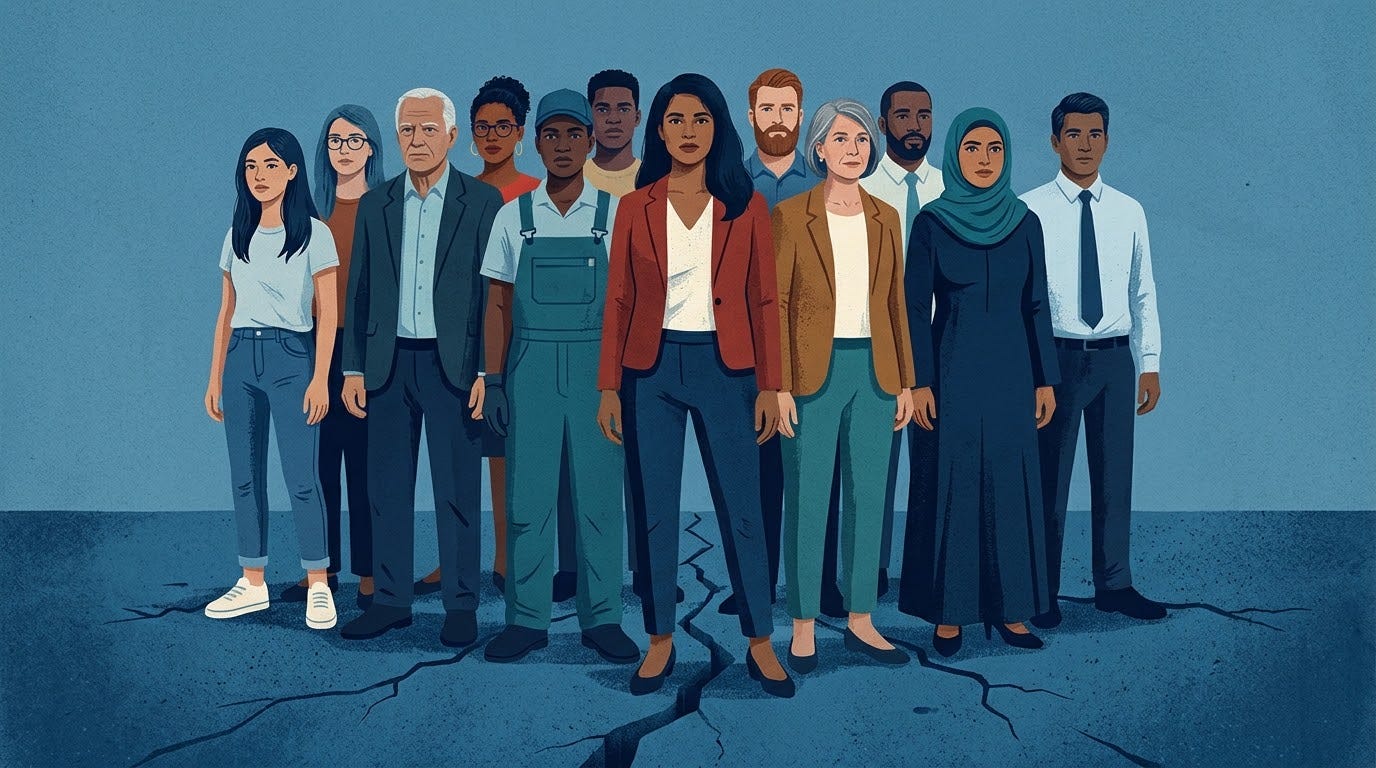
The Loyalty Tax: What the 2026 Jewish Vote Reveals About Coalition Friction—and 2028
Nov 15, 2026 · @Jack
POLITICAL ANALYSIS | PAID SUBSCRIBER EDITION
Nearly 7 in 10 Jewish voters backed Democrats in the midterms, yet post-election polling exposes quiet strains between Jewish voters and non-Jewish allies that could test the party when anti-Trump sentiment fades.
If you only glanced at the top-line numbers from the 2026 midterms, the story of the American Jewish vote looks straightforward. According to a post-election survey conducted by The Mellman Group for the Jewish Electorate Institute (JEI), Jewish voters backed Democratic congressional candidates by nearly a 3-to-1 margin—69% to 25%. In an election cycle defined by sweeping Democratic gains, American Jews remained one of the party’s most reliable constituencies.
Yet anyone who spent time inside Democratic spaces this fall—from local party clubs to online communities of Jewish women and their non-Jewish allies—knows the atmosphere was anything but simple.
Beneath that 69% headline sits a quieter, more complicated reality: a story about a loyal voting bloc carrying heavy reservations, non-Jewish allies feeling caught in the crossfire of bruising intra-party fights, and warning signs that neither party can afford to ignore heading into 2028.
The Myth of a Mass Exodus—and the Reality of the "Hold-Your-Nose" Vote
First, the numbers push back against a narrative that has gained traction in some Democratic circles: the idea that American Jews abandoned the party to embrace Trumpism.
They didn't. Among self-identified Jewish Democrats, party unity hit 91%, and 94% viewed President Trump very unfavorably. While overall Democratic support among Jewish voters in national exit polls dipped from 74% in 2024 to 68% in 2026—a noticeable drop in a year when Democrats gained ground with younger voters, Latinos, men, and white non-college voters—more than two-thirds of the community still pulled the lever for Democrats.
What changed wasn't their vote; it was the emotional cost of casting it.
By the Numbers: Inside the 2026 JEI Post-Election Poll
69% vs. 25%: Overall congressional vote split among Jewish voters (Democratic vs. Republican).
28%: Share of Jewish Democrats who voted for candidates whose positions on Israel concerned them because domestic issues outweighed those reservations.
36%: Share of Jewish Democrats who say their party has become too accepting of antisemitic rhetoric within its ranks.
25%: Share of Jewish Republicans who say the GOP has become too accepting of antisemitic rhetoric (with 34% expressing concern over white nationalists and the far right).
14%: Share of Jewish Democrats who cited support for Israel as one of their top voting factors—trailing democracy (54%), healthcare (53%), rising prices (52%), and corruption (46%).
In other words, nearly three in ten Jewish Democrats cast what strategists call a "reluctant coalition" vote. They stayed in the tent because they cared deeply about reproductive freedom, democratic norms, and the economy—and because a quarter of Jewish Republicans similarly reported discomfort with antisemitic rhetoric and far-right extremism inside the GOP.
The Other Side of the Table: When Coalition Fights Leave Bruises
Political friction rarely moves in only one direction. Just as Jewish voters have watched parts of the Democratic coalition with growing unease, non-Jewish Democratic regulars and allies have been navigating their own quiet frustration.
During the heat of the 2026 campaign, bitter disputes over primary endorsements, campus protests, and swing-state strategy—particularly in battlegrounds like Michigan—frequently boiled over into sweeping generalizations. For lifelong non-Jewish Democrats across the country who have stood shoulder-to-shoulder with their Jewish neighbors for decades, being painted with a broad brush as unreliable or indifferent stung.
"When intense, localized political battles turn personal, they leave hard feelings on both sides. Allies who want to show up in good faith end up walking on eggshells, while Jewish Democrats who stayed loyal to the ticket feel their concerns are treated as an inconvenience."
At the same time, watching a small but vocal segment of conservative-leaning Jewish commentators loudly embrace Trumpism created a distorted impression among some party regulars that the broader Jewish electorate was drifting away—an assumption that unfairly overlooks the nearly 70% who showed up and delivered for Democratic candidates.
Why 2028 Won't Forgive Unresolved Tension
For Democrats, the danger in the 2026 numbers isn't what happened this November—it's what happens when the political weather changes.
In 2026, overwhelming opposition to President Trump and urgent domestic concerns served as the glue that held a strained coalition together. Those forces convinced 28% of conflicted Jewish Democrats to set aside their reservations and vote blue anyway.
By 2028, that dynamic shifts. With an open presidential primary on the horizon and no incumbent Trump midterm referendum to unify the base, voters who felt politically homeless in 2026 will have less incentive to swallow their doubts. A few percentage points of stay-at-home attrition—or further slippage among moderate Jewish voters in swing states like Pennsylvania, Michigan, Nevada, and Georgia—can easily decide a close Senate race or electoral college map.
Moving Beyond Litmus Tests
The takeaway from the Mellman Group's findings isn't that the Democratic coalition is broken. It is that coalitions require mutual respect to stay healthy.
Jewish voters are not a single-issue monolith—only 14% of Jewish Democrats ranked support for Israel among their top voting issues, far behind democracy and healthcare. Nor are non-Jewish Democrats a monolith indifferent to Jewish safety and belonging.
Both sides have earned the benefit of the doubt: Jewish voters earned it by remaining one of the Democratic Party's most steadfast pillars even under immense strain, and non-Jewish allies earned it by standing firm for shared democratic values. Recognizing that both truths can exist at the same time is the only way to keep hard feelings from turning into permanent fractures before 2028.
Methodology Note: Data cited from the Jewish Electorate Institute (JEI) national post-election survey conducted by The Mellman Group following the November 2026 midterm elections.
This OpEd paints with a very broad brush.
Perhaps 70% of the Jews in Maryland voted the straight Democratic ticket but, a *majority* of Jews in Oakland County, Michigan split their tickets.
[https://jewishmajority.org/poll-complete-mi-2026/](https://jewishmajority.org/poll-complete-mi-2026/]
This study corroborates approximations based on data specific to communities with substantial Jewish demographics like West Bloomfield and Huntington Woods:
"50% of all surveyed Michigan Jewish voters backed El-Sayed, compared with 43% who supported Rogers, 4% who left the Senate race blank and 3% who voted for another candidate."
"69% of Jewish voters supported Democrat Jocelyn Benson for governor, a 19-point advantage over El-Sayed."
In Oakland County, home to the largest Jewish demographic in the state, Rogers won a majority of the Jewish vote, comfortably outpacing El-Sayed 52-39%.
Granted, the Jewish demographic is too small to greatly influence electoral results statewide in the midst of a "wave" election. However, Jewish principles, leadership, and patronage were foundational to the modern Democratic coalition and Democrats should no longer take for granted that Jewish voters will blindly support every nominee.