

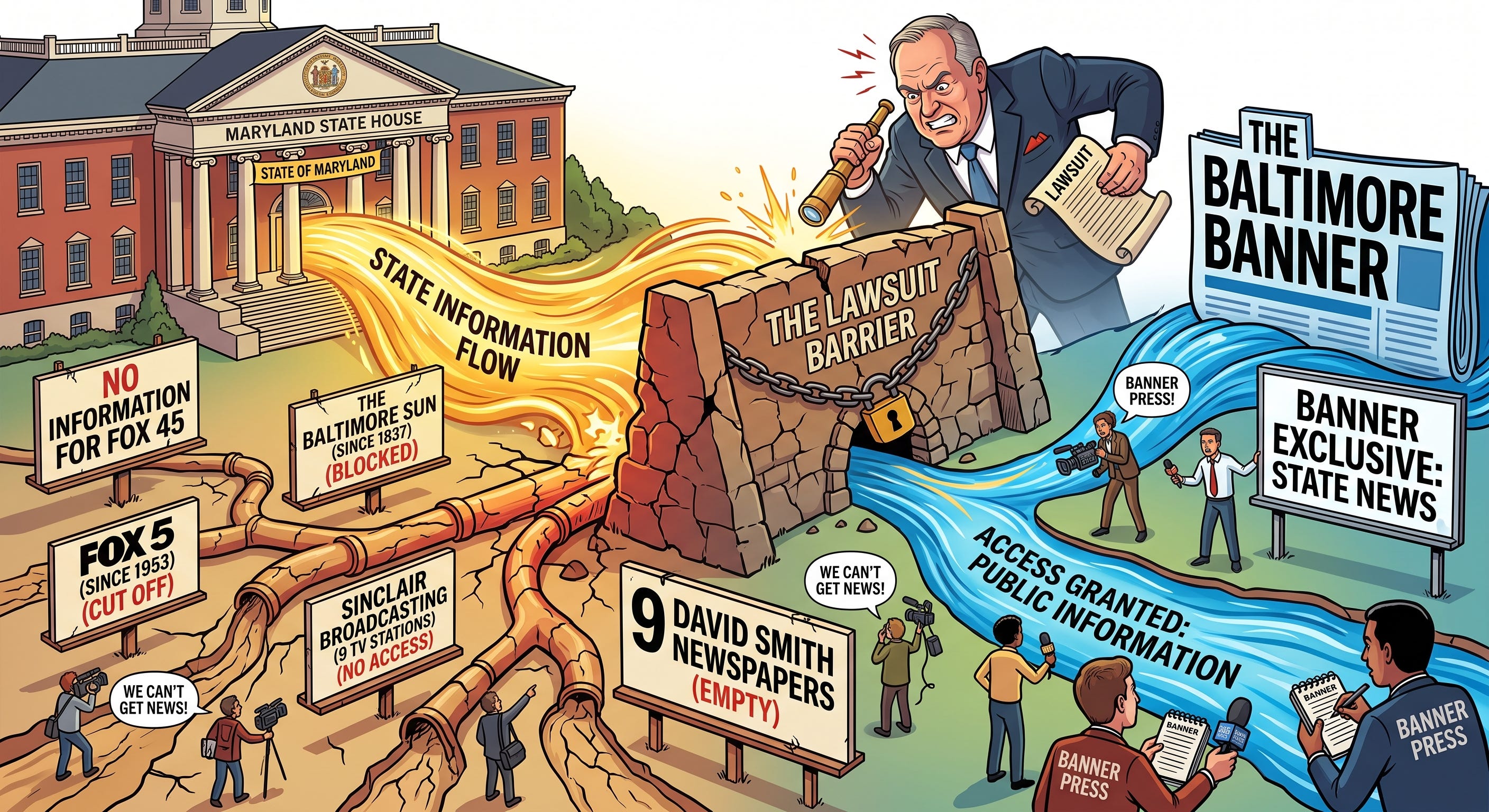
The Lawsuit Trap: When David Smith Sued Wes Moore, He Forfeited the Right to Easy Answers
By Barry O'Connell
The Maryland Wire
When you decide to drag someone into court, the ground rules immediately change. Anyone who has operated in the real world—or handled high-stakes legal squabbles—knows this simple truth: the second you serve a man with a lawsuit, you do not get to pick up the phone the next morning and expect him to do you any favors.
Yet, apparently, David D. Smith and his sprawling media ecosystem are shocked—shocked—to discover that state government doesn't work like a drive-thru window for people actively suing the chief executive.
Word trickled out this week that several Maryland state executive agencies have put the brakes on giving routine, off-the-cuff answers to reporters working for news outlets tied to Smith. Instead of handing out quick quotes, state communications officers are routing inquiries from these specific outlets straight to legal counsel for formal review.
Cue the predictable chorus of outrage from the usual corners, claiming the administration is stonewalling the press.
Give me a break.
Look, my readers know I don’t spend my days writing love letters to Annapolis or flattering Governor Wes Moore. His staff made that explicitly clear when they sent me a letter letting me know his team doesn't read my column. Fair enough. I’m not in the business of holding court for the administration, and I don't expect them to send me Christmas cards.
But fair is fair, and reality is reality. What we are watching unfold isn't a constitutional crisis—it’s a basic lesson in civil litigation that David Smith is learning the hard way.
When you file a personal defamation suit against the Governor of Maryland, you cross a line from standard press-government friction into adverse legal proceedings. You don't get to wage war in a courtroom with one hand while expecting state workers to hand you rapid-fire comments with the other.
In any properly run organization—public or private—the moment a party sues the CEO, every agency head and communications liaison gets a standard directive: Keep your mouth shut, route everything through legal, and protect the state.
It’s called risk management. It’s responsible governance. The Governor’s legal team isn't being tyrannical; they’re being competent. They are ensuring that state employees don't inadvertently compromise ongoing civil discovery or walk into trap questions designed for courtroom leverage.
And let's look at who is doing the complaining here.
We aren't talking about an isolated local daily just trying to cover county road paving. We are talking about an expansive, politically motivated media operation. Smith controls a vast array of properties: The Baltimore Sun along with its suite of nine regional broadsheets and weeklies—a group whose editorial shift and questionable direction have raised eyebrows across the state—backed by a powerhouse TV flagship in WBFF (Fox45), local radio outlets, and a national broadcast network.
For months, this network hasn't just been covering the Governor; they’ve been weaponizing airtime and ink, hunting for blood, and trying to ruin the man politically. When Moore publicly pushed back against Smith's network, Smith didn't just fight back in print—he went to the courthouse.
Well, welcome to the legal discovery zone.
David Smith built a media empire, but he seems utterly baffled by basic rules of engagement. When you sue the guy who runs the executive branch, you lock the door to casual access. You forced the state into a courtroom context, and now you have to deal with courtroom protocols.
Now, the reporters across those nine newspapers and broadcast stations are finding out what happens when the owner’s legal vendettas collide with daily beat reporting: you get referred to the lawyers.
If these newsrooms are finding it hard to get state agency comments, they shouldn't be knocking on the Governor's door asking why he won't play ball. They ought to walk up to the corner office at Sinclair, look David Smith in the eye, and ask him why he thought he could sue the state's chief executive and still get red-carpet service.
Relations between the press and the government are adversarial to start. News is what any government doesn't want reported. Adding a lawsuit be either party just increases the friction. BTW, although once it was the third-most read paper in D.C., the Sun is no longer respected.
History lesson for Smith:
U.S. District Judge William D. Quarles Jr. dismissed The Baltimore Sun's lawsuit against Maryland Governor Robert L. Ehrlich Jr. on February 14, 2005. Judge Quarles ruled that the First Amendment does not grant journalists a special, unrestrained right to gather government information beyond what is available to ordinary private citizens.
Background of the Ban:
The Order: Issued on November 18, 2004, by the Ehrlich administration's press office.
The Targets: The Baltimore Sun State House bureau chief David Nitkin and columnist Michael Olesker.
The Restriction: Prohibited executive department and agency employees from speaking to or returning calls from the two journalists.The Reason: The administration claimed the reporters produced unfair and non-objective coverage.Legal Outcome and Appeal:
District Court: Judge Quarles denied the request for injunctive and declaratory relief, stating the governor had the authority to control internal agency communications.
Fourth Circuit: A three-judge panel of the 4th U.S. Circuit Court of Appeals later upheld the lower court's dismissal in February 2006, concluding the directive did not violate constitutional rights.
Resolution: The Baltimore Sun chose not to pursue a further appeal, ending the legal challenge.