

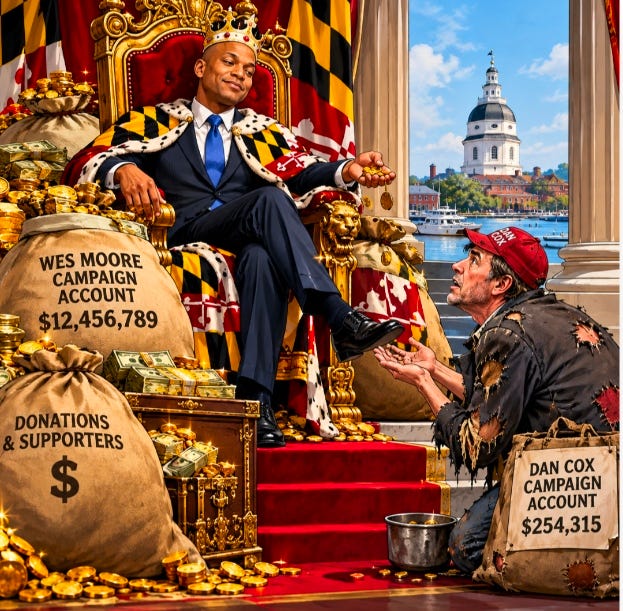
In politics, money doesn't guarantee a win, but a complete lack of it almost guarantees a quiet burial. When you look at the balance sheets in the race for Annapolis, Dan Cox isn't just fighting an uphill battle against an incumbent Democrat in a blue state; he is running on fumes while Wes Moore commands a financial fortress.
Here is the breakdown of where the campaign finances stand, separating the hard data on file from what logic tells us is happening behind closed doors.
What We Know as Fact
The Cash Chasm: Official campaign finance disclosures show Governor Wes Moore holding an overwhelming, multi-million-dollar cash advantage over Dan Cox. While Moore continues to pull in steady, high-dollar contributions across multiple quarters, Cox’s filing totals show minimal intake and a razor-thin bank balance relative to a statewide race.
Zero RGA & National Ad Footprint: Independent expenditure tracking confirms that major national party arms—most notably the Republican Governors Association (RGA)—have poured virtually zero ad money or independent expenditure capital into Maryland airwaves to support Cox.
Lack of Marquee National Platform: During major national party gatherings, including the Republican National Convention, Cox was given no prime-time speaking slot, no featured national campaign surrogate blitzes, and no publicly announced, co-headlined financial photo-ops alongside top-tier national party figures.
Asymmetrical Airwaves: The Moore campaign and its aligned political action committees maintain a consistent media presence across radio, television, and digital platforms, whereas Cox's presence remains largely restricted to grassroots social media, local club appearances, and organic outreach.
What We Surmise and Infer
Strategic Triage by the National GOP: National Republican strategists operate on a simple formula: ROI (Return on Investment). The complete absence of RGA independent expenditures implies that the national apparatus has written Maryland off as a non-viable battlefield, choosing instead to triage their capital toward tight, purple-state gubernatorial contests.
The "Stay Home" Message: The total lack of national platform visibility suggests party leadership signaled early on that high-profile appearances from Cox would not be featured at national conventions or major donor retreats. In national political parlance, if you aren't being paraded on stage to help drive national fundraising, you've effectively been told to stay out of the frame.
The Cold Shoulder from State Donors: Traditional Republican donor networks within Maryland—the business groups, real estate developers, and moderate PACs that previously backed Larry Hogan—have largely sat on their hands or cut checks to Moore. This confirms local institutional money views Cox as an unviable candidate rather than a solid investment.
The Reality of the Race: Running for governor in a state as media-expensive as Maryland requires millions just to establish baseline name recognition and message control across the Baltimore and Washington media markets. Cox has been left to sink or swim entirely on his own grassroots steam, while the national and state party institutions look the other way.
They are right. Cox can't win. Why doesn't he have money? Maybe not enough of the people of Maryland support his positions.