

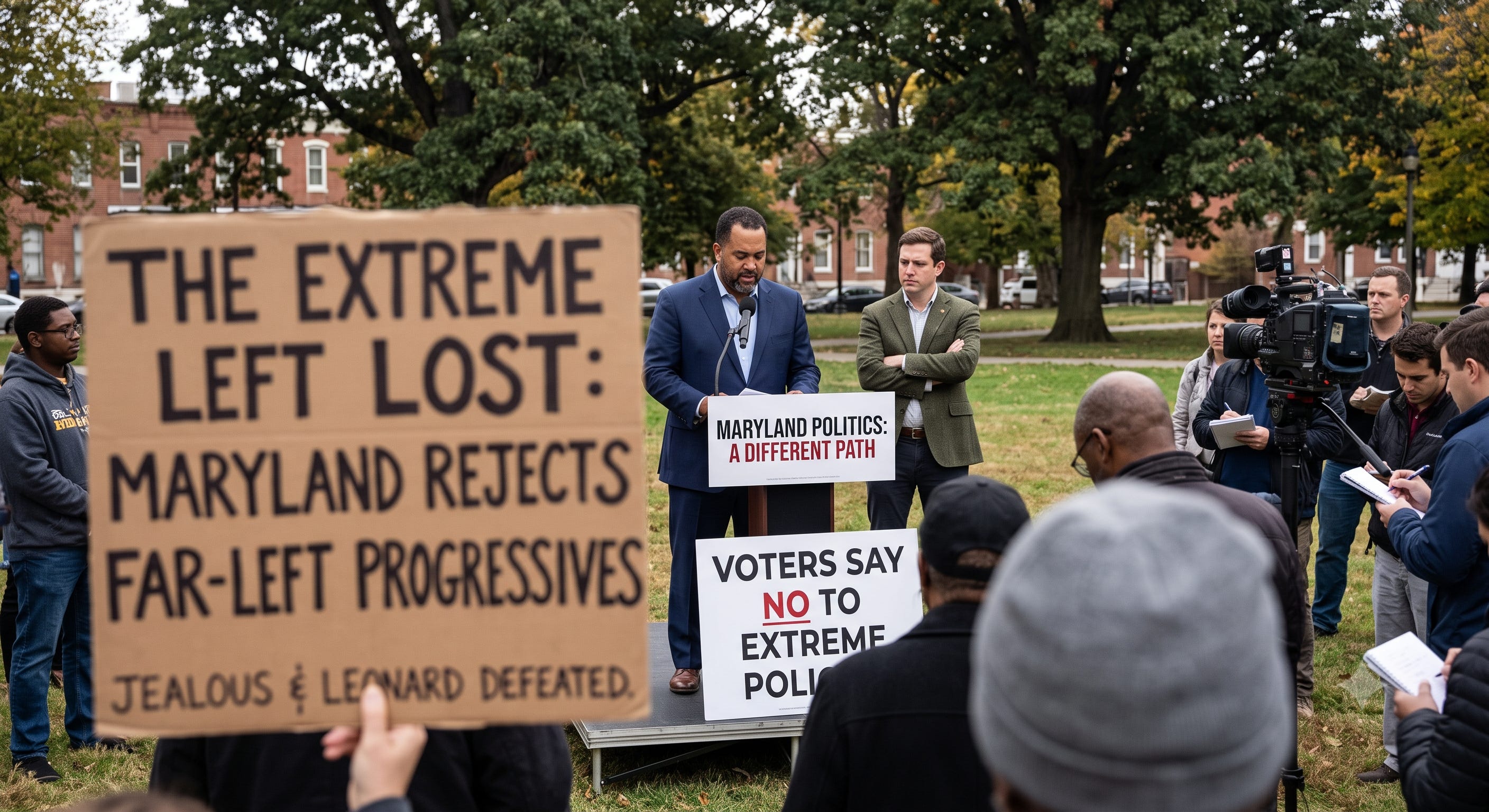
The Far-Left Trap: How Ideological Extremism Costs Elections in Maryland
I will be the first to admit that I am not everyone’s cup of tea. Over a long career asking tough questions and writing political commentary, I’ve made plenty of friends, but I’ve also earned my share of detractors. At times, I can be opinionated, blunt, and perhaps even a bit irritating. I don’t lose sleep over it. What I do find endlessly entertaining, however, is when political figures take personal grudges to comical lengths—like Robbie Leonard, who still regularly calls up people I am interviewing to warn them that I am a "bad guy" and urge them not to talk to me.
Robbie actually tried to formally cancel me. What sort of a dumb stunt is that? Sometimes I swear he acts like a 5th grade mean girl on the playground.
It is a bizarrely humorous little feud, but it points to a much larger issue in our local political landscape: the tendency of the hard-left flank to prioritize personal hostility, ideological purity, and extreme agendas over practical governance.
My own political journey often surprises people. In the mid-1980s, I worked for Ronald Reagan, met the man, and spent time helping our brave Freedom Fighters in Nicaragua. Back then, in the state of Pennsylvania, I was considered one of the most radically conservative rabble-rousers in the Republican Party. Today, without my core principles changing all that much, I find myself advocating for a practical, center-left, representative Democratic Party. The political goalposts have shifted so dramatically that yesterday’s Reagan conservative ends up looking like today’s pragmatic centrist.
From where I stand, the mathematics of Maryland elections remain clear: Maryland voters are pragmatic. When candidates try to drag the state into far-left experimentation, voters pull the emergency brake. We don't have to guess about this; the electoral record proves it.
Case Study 1: Ben Jealous and the 2018 Landslide
When Ben Jealous won the Democratic gubernatorial nomination in 2018, the national progressive movement celebrated. Endorsed by Bernie Sanders and national activist groups, Jealous ran on a hard-left national platform: state-funded single-payer healthcare, free college tuition, and a radical overhaul of the criminal justice system.
The result in November was a catastrophe for Maryland Democrats:
Suburban Alienation: Suburban voters in key swing jurisdictions like Howard, Anne Arundel, and Baltimore counties looked at the massive tax increases required for single-payer state healthcare and ran the other way.
A Centrist Alternative: Moderate Republican Larry Hogan didn't have to work hard to frame Jealous as fiscally reckless. Moderate Democrats quietly crossed party lines in droves.
The Final Score: In a state where registered Democrats outnumber Republicans two-to-one, Jealous lost in a massive 55% to 43% landslide.
Jealous proved that running an activist platform suited for a primary base alienates the broad center required to win statewide office.
Case Study 2: Robbie Leonard’s Two-Time Electoral Ceiling
If Ben Jealous is the statewide example, Robbie Leonard is the local textbook case in Baltimore County.
The 2018 State Senate Debacle (District 42)
District 42 was a winnable suburban seat for Democrats in a year where a massive national "blue wave" was sweeping Democrats into office nationwide. But Leonard ran as an unyielding progressive activist. Republican Chris West was able to paint him as far too extreme for a moderate suburban district. While other Maryland Democrats rode the blue wave to victory, Leonard lost the seat to West.
The 2022 Primary for State's Attorney
Undeterred, Leonard ran in the 2022 Democratic primary against 16-year incumbent State's Attorney Scott Shellenberger. Campaigning on a "progressive prosecutor" platform focused on scaling back prosecutions for lower-level offenses, Leonard aligned himself with activist groups demanding sweeping decarceration.
Even inside a Democratic primary, voters worried about rising violent crime rejected the far-left option, handing Shellenberger another victory.
The Practical Center Is Where Elections Are Won
Candidates like Ben Jealous and Robbie Leonard run on platforms that sound great in academic seminars and activist chapter meetings, but fall apart when exposed to real-world voters. Average Marylanders—whether they reside in suburban neighborhoods or urban communities—want reliable services, safe streets, good schools, and sensible taxes.
When the far left insists on pushing policies that alienate everyday citizens, they don't just lose elections—they hand seats to the opposition or force primary voters to cling to the status quo. Fighting for a pragmatic, centrist Democratic Party isn't about abandoning principles; it’s about recognizing that to govern effectively, you first have to listen to the people you seek to represent.

Is Maryland Progressive? and What about CD5

Maryland Democrats didn’t whisper their preferences in 2026 — they shouted them.