

🧭 The Exodus to Independence: Maryland’s Voter Drift and the Moral Crisis Beneath It
By Barry O’Connell
September 17, 2025
In the great state of Maryland, something quiet but seismic has been unfolding beneath the surface of our politics. Since 2000, both major parties have been bleeding voters—not to apathy, but to independence. The numbers tell a story of erosion. The reasons behind it tell a story of conscience.
📊 From Partisan Loyalty to Unaffiliated Conscience
Let’s start with the data. In 2000, Maryland’s voter rolls looked like this[^1]:
- Democrats: ~58%
- Republicans: ~30%
- Unaffiliated/Independents: ~10%
Fast forward to 2025[^2]:
- Democrats: ~51%
- Republicans: ~23%
- Unaffiliated/Independents: 22%+
That’s a doubling of independents in just 25 years. And among new registrants this year, more than a third are choosing no party at all[^3]. Maryland’s closed primary system may slow the shift, but it can’t stop the sentiment: voters are walking away from the binary.
🔥 Why They’re Leaving: A Personal Reflection
I understand why people are leaving the Republican Party. The party that once stood for fiscal restraint, limited government, and cautious foreign policy has abandoned those principles. The Goldwater-to-Specter spectrum has collapsed into a culture war echo chamber. “Tax and spend” has become “borrow and spend,” and the moral clarity that once animated conservative Christianity has been traded for grievance politics and populist theatrics.
But I also understand the discomfort of being a born-again Christian in today’s Democratic Party. Among its most visible activists, there’s a hostility toward faith that feels existential. Jesus Christ is my Lord and Savior. I believe the Bible. And yet, that belief is often treated as dangerous—an affront to the secular moral order that defines progressive activism. Rights are declared without metaphysical grounding. Identity is elevated above conscience. And those of us who anchor our ethics in something older than the news cycle are seen as suspect.
This isn’t a screed. It’s a lament.
🧠 Historical Parallels: When the Center Cannot Hold
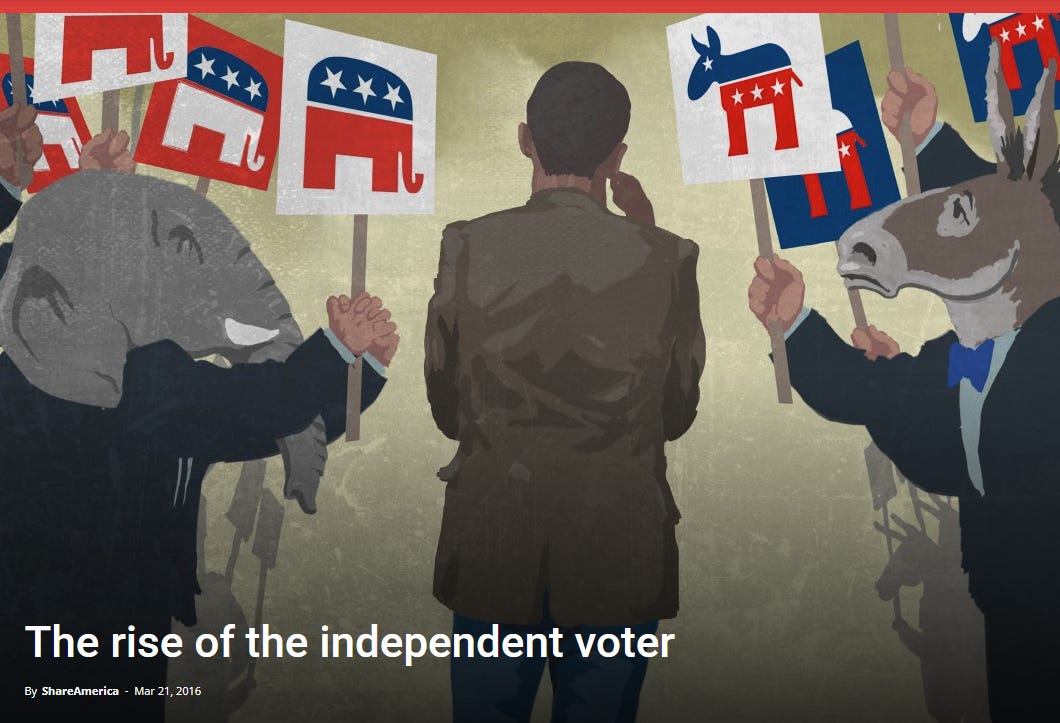
We’ve seen this before. In the 1850s, the Whig Party collapsed under the weight of moral contradiction—unable to reconcile its factions on slavery and federal power[^4]. In the 1960s, the Democratic coalition fractured over civil rights and Vietnam[^5]. And in the 1980s, the rise of the Moral Majority began reshaping the GOP into a party of cultural absolutism[^6].
Today’s fracture is different. It’s not just ideological—it’s ontological. Voters are leaving because they no longer recognize themselves in the parties they once trusted. They’re not looking for purity. They’re looking for a place where faith, reason, and civic duty can coexist.
🕊️ The Rise of the Independents: A Flight to Moral Agency
Nationally, 43% of adults now identify as independent[^7]. In Maryland, unaffiliated voters are the fastest-growing segment[^8]. These aren’t disengaged citizens. They’re disillusioned ones. They want:
- Moral clarity without tribalism
- Policy pragmatism without purity tests
- Representation without ideological hostage-taking
They’re tired of being told that conscience is dangerous. That faith is oppressive. That fiscal restraint is outdated. They’re looking for something older, deeper, and more honest.
🛠️ No Easy Solutions, But a Clear Diagnosis
I don’t have a silver bullet. But I do have a diagnosis:
- Closed primaries reward extremism and exclude conscience-driven voters[^9].
- Gerrymandering makes compromise irrelevant[^10].
- Activist gatekeeping alienates moderates and faith communities.
- Social media punishes nuance and rewards outrage[^11].
If we want to rebuild trust, we need to start with moral humility. We need to make room for people who believe in God, in restraint, in accountability. We need to stop treating disagreement as heresy and start treating it as democracy.

Barry O’Connell is a strategic editorialist, reputational architect, and conscience for Maryland politics. He writes about governance, moral clarity, and the architecture of influence.
📚 Footnotes & Sources
^1]: Maryland State Board of Elections, Voter Registration Statistics (2000): [https://elections.maryland.gov/voterregistration/stats.html
^2]: Maryland State Board of Elections, Voter Registration Statistics (2025): [https://elections.maryland.gov/voterregistration/stats.html
^3]: Independent Voter Project, Maryland Voter Trends: [https://independentvoterproject.org/voter-stats/md
[^4]: Daniel Walker Howe, What Hath God Wrought: The Transformation of America, 1815–1848
[^5]: Rick Perlstein, Nixonland: The Rise of a President and the Fracturing of America
[^6]: Kevin M. Kruse, One Nation Under God: How Corporate America Invented Christian America
^7]: Pew Research Center, Political Typology and Party Affiliation (2024): [https://www.pewresearch.org/politics/2024/party-affiliation-trends
^8]: Maryland State Board of Elections, Unaffiliated Voter Growth: [https://elections.maryland.gov/voterregistration/stats.html
^9]: Boyd Rutherford’s lawsuit on Maryland’s closed primaries: [https://www.marylandmatters.org/2024/11/15/rutherford-lawsuit-open-primaries
^10]: Brennan Center for Justice, Gerrymandering Explained: [https://www.brennancenter.org/issues/gerrymandering
^11]: MIT Technology Review, “How Social Media Polarizes Us”: [https://www.technologyreview.com/2023/06/15/social-media-polarization