

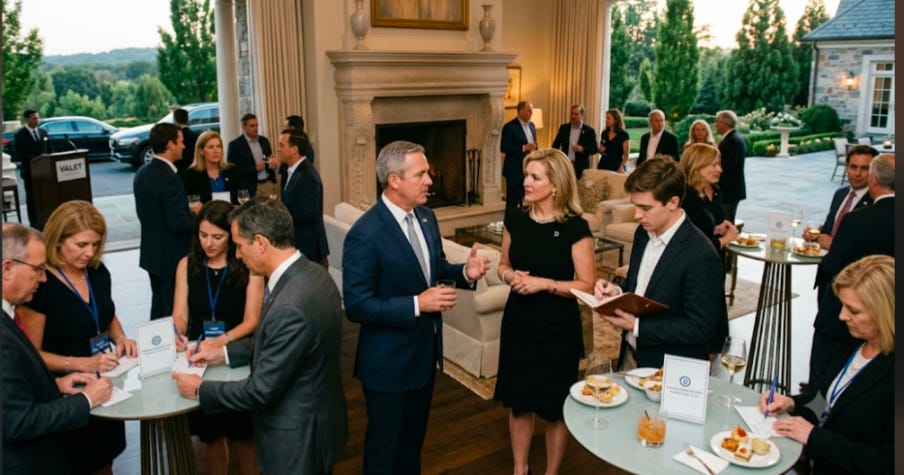
The Democratic Professional Class: The People Who Think for Us
There’s a group inside the Democratic Party that most voters never meet, never see, and never vote for. They don’t run for office. They don’t knock on doors. They don’t stand in union halls or VFW posts or church basements. But they make the decisions. They decide who stays in a race, who gets pushed out, who gets protected, and who gets sacrificed.
I call them the Democratic Professional Class.
They are the donors, the consultants, the strategists, the media figures, the think‑tankers, the people who live in the political biosphere stretching from Boston to DC to New York to San Francisco to Los Angeles. They are not villains. They are not malicious. They are not scheming against ordinary Democrats. They simply live in a world so insulated, so socially homogeneous, that they cannot imagine anyone disagreeing with them.
In their world, they are the Democratic Party.
And the rest of us — the rank‑and‑file voters — are abstractions.
The bubble they live in
The Democratic Professional Class lives in a world where:
- everyone they know went to the same kinds of schools
- everyone they know works in the same kinds of offices
- everyone they know consumes the same media
- everyone they know shares the same cultural assumptions
So when they speak, they don’t think they’re speaking for us.
They think they’re speaking as us.
They don’t think they’re overriding voters.
They think they’re representing voters.
They don’t think they’re silencing dissent.
They think dissent doesn’t exist.
This is not ill will.
This is insulation.
How this plays out when Democrats get scared
When a Democrat stumbles — even slightly — the Democratic Professional Class reacts with panic. They worry about moral optics, donor expectations, media narratives, and elite embarrassment. They worry about how things look inside their own world, not how things feel in ours.
That’s how we ended up with:
- the forced beheading of Al Franken, a decision many Democrats now openly regret
- the panic over Joe Biden after one debate, while President Trump was giving press conferences that sounded like St. Paul Park improv theater
- the collapse of Graham Platner’s campaign, decided not by the people of Maine but by people who don’t live within 500 miles of Maine
These weren’t decisions made by voters.
They were decisions made by the Democratic Professional Class.
And the voters — the people who actually live in the states, who actually cast the ballots — were spectators.
A cultural blind spot the size of a continent
The Democratic Professional Class doesn’t understand certain kinds of Americans because they don’t know any.
They don’t understand young men who:
- leave high school
- join the service
- serve in combat
- come home
- join the National Guard
- go to college
- and then go back into combat again
In their world, young men don’t do that.
In their world, service happens in offices wearing suits, not on battlefields wearing combat gear.
One strategist recently told me that he would feel more comfortable with Graham Plattner if he had a record of public service. I asked him what about 4 years in the military plus 4 years in the National guard. Isn’t that public service. He rejected my premise outright. They don’t mean that sort of service. They mean working in a non-profit or serving soup to homeless.
They don’t understand people who get tattoos because they want them.
They don’t understand people who serve because they feel called.
They don’t understand people whose patriotism is physical, not performative.
In their world, the only socially acceptable tattoo is the one George Shultz got at Princeton — a tiger on his backside — because at least Princeton tigers are tasteful.
This is not hatred.
This is cultural dissonance
Why they keep making decisions we regret
The Democratic Professional Class believes they are protecting the party’s brand.
They believe they are safeguarding moral credibility.
They believe they are preventing embarrassment.
They believe they are doing the responsible thing.
But they are doing it from inside a bubble.
So they push out candidates who might have survived.
They panic over moments that voters would have forgiven.
They sacrifice people who didn’t need to be sacrificed.
They make decisions that feel “smart” in their world but disastrous in ours.
And then, years later, we look back and say:
“Why did we do that?”
The answer is simple:
We didn’t.
They did.
The Democratic Professional Class did.
The cost of letting a small group think for millions
When a small, insulated group believes it speaks for everyone, it stops listening.
It stops asking questions.
It stops considering alternatives.
It stops imagining that ordinary Democrats might have different instincts, different values, or different priorities.
And that’s how we end up with a party that:
- forces out Al Franken
- panics over Joe Biden
- sidelines Graham Platner
- and repeatedly underestimates the voters it claims to represent
Not because of malice.
Not because of conspiracy.
But because of insulation.
The Democratic Professional Class doesn’t hate us.
They simply don’t see us.