

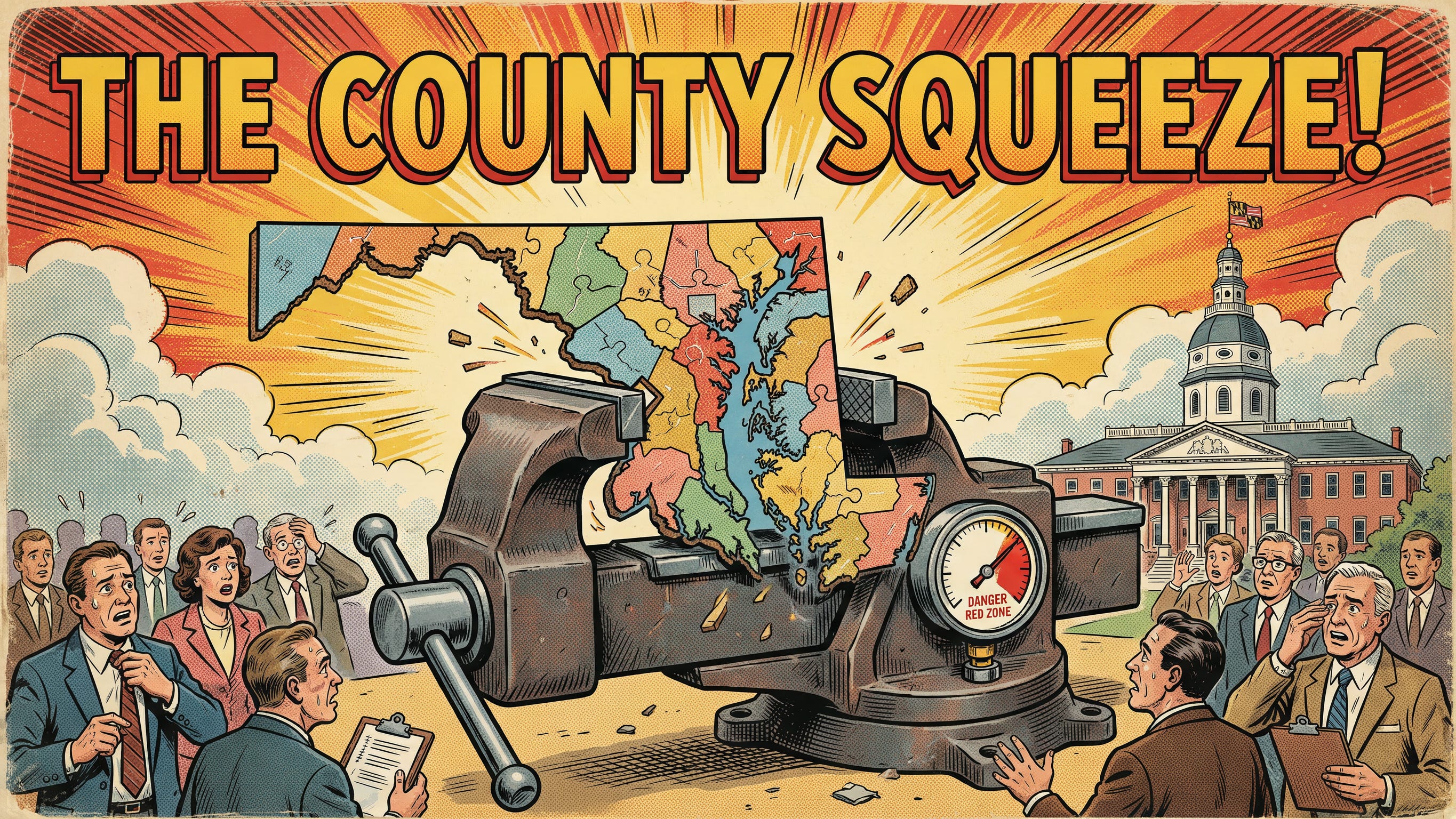
The County Squeeze: How Annapolis’s School Funding Freeze Hits Home—And Who Is Being Paid to Fight It
Budget Secretary Jake Weissmann’s warning to flat-fund K–12 aid in FY 2028 doesn’t erase the bills. It pushes the political pain straight onto newly elected county executives, local school boards, and a small army of Annapolis lobbyists.
(Editor’s Note: Yesterday morning, we examined why Budget Secretary Jake Weissmann’s Sunday letter instructing Maryland’s 24 school systems to budget for flat state funding in FY 2028 was a calculated opening bid ahead of the 2027 legislative session. Today, over your Thanksgiving coffee, we look at what happens when that squeeze hits the ground—and name the local leaders and State House lobbyists who will spend the next five months fighting over who pays the tab.)
When Annapolis freezes its share of public school funding, the costs of negotiated teacher raises, special education mandates, and Blueprint for Maryland’s Future staffing requirements don’t magically vanish. Under Maryland’s Maintenance of Effort (MOE) law and the Blueprint’s local wealth-sharing formulas, a flat state check instantly becomes a local fiscal crisis.
Even worse for local politicians, Weissmann’s letter lands just days before a wave of newly elected county executives take office in early December—handing brand-new administrations an immediate, multi-million-dollar budget headache before they’ve even hung pictures on their office walls.
Here is how the squeeze breaks down across Maryland’s regions—and the exact roster of associations and hired-gun lobbyists preparing to descend on Lawyer’s Mall in January.
— PAYWALL —
