

Pikesville Plaza, Patoka’s Political Peril, and the Inspector General Who Stayed Silent
By Barry O’Connell
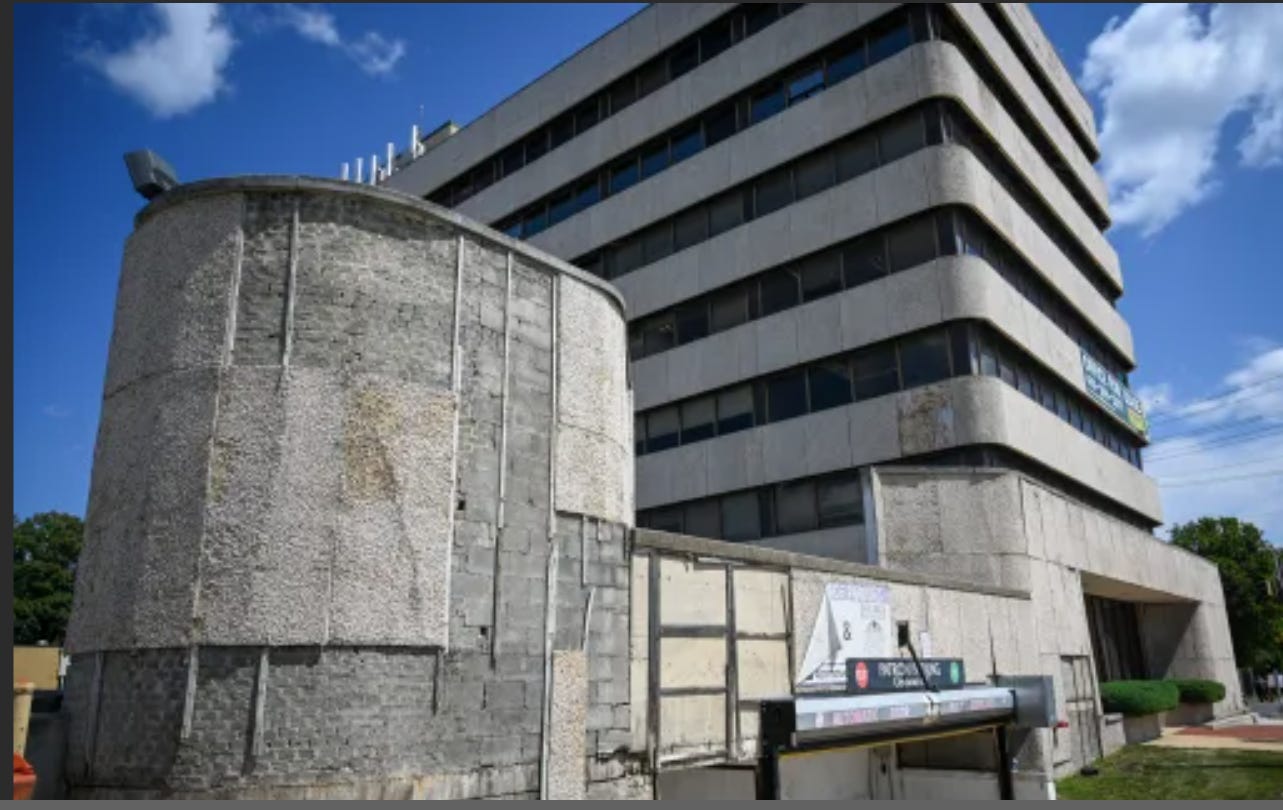
In the heart of Pikesville, Maryland, a seven-story office building known as Pikesville Plaza was once pitched as a commercial anchor for the Reisterstown corridor. Today, it stands condemned—literally. Structural failures, unpermitted renovations, and a sudden evacuation have turned the building into a symbol of dysfunction. But behind the crumbling façade lies a deeper story—one that could implicate Councilman Izzy Patoka, the county’s embattled power broker, in a web of political favors and quiet deals.
💥 The Collapse Nobody Saw Coming
In July 2021, Baltimore County officials ordered the immediate evacuation of Pikesville Plaza after engineers flagged critical failures in the building’s parking garage and expansion joints. Tenants were given hours to vacate. The building’s owner, Michael J. Snider, had allegedly conducted renovations without permits, including HVAC work and structural modifications.
But the real question isn’t just how the building failed—it’s who let it happen.

🕶️ The Patoka Connection
Multiple sources in Pikesville’s civic and business circles have quietly pointed to Councilman Izzy Patoka as a behind-the-scenes player in the Plaza’s troubled history. While Patoka publicly expressed concern about the building’s condition, insiders suggest he may have had informal ties to the renovation process, and possibly worked to shield the owner from scrutiny.
A high-level source inside Baltimore County government, who requested anonymity to protect her job, claims Patoka was instrumental in securing the continued tenure of Inspector General Kelly Madigan, but not out of civic virtue.
> “Izzy made a deal,” the source said. “He fought to keep Madigan in office so she wouldn’t investigate the Plaza mess. She owes him now.”
This claim, while unverified, aligns with Patoka’s unusually aggressive support for Madigan during the recent IG nomination battle. When County Executive Kathy Klausmeier attempted to replace Madigan with an independent federal auditor Khadija Walker, Patoka led the charge to block the appointment.

🧾 The Inspector General’s Silence
Madigan, Baltimore County’s first Inspector General, has built a reputation for exposing waste and abuse. Her office has produced over 30 public reports, including investigations into misuse of county vehicles and campaign-related activity.
Yet no investigation into Pikesville Plaza has ever been publicly released. Given the scale of the building’s failure—and its impact on tenants, taxpayers, and public safety—the silence is deafening.
Was this part of the deal?
💰 Political Envelopes and Quiet Quid Pro Quos
Rumors swirl that Patoka’s involvement goes beyond zoning and oversight. Some allege that campaign envelopes, a stuffed with cash, have changed hands, though no formal charges or investigations have been announced. The implication is clear: Patoka may have used his influence to protect allies, secure favors, and keep the Plaza scandal buried.
To be clear, no one is accusing Patoka of criminal wrongdoing (yet). But the optics are troubling. A condemned building. A councilman fighting to keep an inspector general. A source alleging a backroom deal. And a community left wondering who’s really like looking out for them.
🧩 What Happens Next?
If the Plaza scandal gains traction, Patoka could face ethics inquiries, political backlash, or worse. The building’s structural failure is a matter of public record. The question is whether its political fallout will be, too.
Baltimore County deserves answers. And if Kelly Madigan truly owes her job to Izzy Patoka, then the watchdog may need watching.
📚 Footnotes
1. Baltimore County Council rejects nominee, Madigan stays as Inspector General
2. As Baltimore County's IG fights for her job, she pushes for independence
3. Baltimore County's Inspector General search sparks controversy
4. Baltimore County Councilman Izzy Patoka defends Madigan
5. Baltimore County watch dog highlights misuse of government vehicles
6. Baltimore Brew: Nearly every document involving the Madigan case is redacted I am not okay barely getting
Would you like help crafting a follow-up piece that explores the ethics of watchdog independence or the role of rumor in political accountability?
The Last Two Jews in Kabul
There were once two Jews left in Afghanistan. Not two families, not two congregations—just two men. The last remnants of a community that had once stretched across the Silk Road, through Herat and Balkh, into the mountains and bazaars of Kabul. Everyone else had fled: to Israel, to New York, to Montreal, maybe even Baltimore. But these two stayed. Whether out of stubbornness, devotion, or sheer inertia, they remained in the shell of a synagogue in a city ruled by the Taliban.
And like many stories of survival, it didn’t unfold with quiet dignity. It unraveled with bickering.
One accused the other of neglecting the Torah scrolls. The other retaliated by accusing him of theft. In a gesture of righteous preservation—or petty sabotage—one man took the scrolls from the other’s wing of the synagogue and moved them to his own. The scrolls, ancient and fragile, became the center of a feud that would have been comic if it weren’t so tragic.
Unable to resolve their dispute, they did what any citizen might do: they appealed to the authorities. But in Taliban-run Kabul, that meant reporting each other to a regime that barely tolerated their existence. The Taliban, stunned to discover there were still Jews in Afghanistan, responded with characteristic subtlety: they threw both men in prison and tortured them.
But even the Taliban had limits. After weeks of listening to the two men argue, about scrolls, rituals, and who had the right to call himself the caretaker of Kabul’s Jewish soul—they released them. Not out of mercy, but exhaustion. The last two Jews in Afghanistan had outlasted the patience of the Taliban.
✡️ A Parable of Peoplehood
There’s something deeply revealing in this story. It’s not just about survival under tyranny. It’s about the intensity of Jewish identity, the fierce loyalty to tradition, and yes, the tendency toward internal argument that has defined Jewish history from the Talmud to Twitter.
I’m not supporting Izzy Patoka in Baltimore County. And for that, I’ve received a flood of messages—many from Jews across the country—telling me why I’m wrong. Passionate, articulate, sometimes furious. It’s not personal. It’s tribal. It’s cultural. It’s the same impulse that drove two men in Kabul to fight over scrolls in a city that had forgotten them.
And I say this with admiration: the Jewish people are extraordinary. Their intellectual rigor, their moral clarity, their historical resilience—these are gifts to the world. But they are also a people who argue. Who debate. Who split hairs over halacha and politics and the placement of scrolls in a crumbling synagogue.
The story of Kabul isn’t just about two men. It’s about the indestructible spirit of a people who will fight for meaning even when the world has stopped watching. It’s about the beauty and the burden of being part of a tradition that refuses to go quietly.
This has the air of a smear directed against Madigan. There’s absolutely nothing against her but Patoka’s support for her (shared by most of the Council and the general public) is used to vaguely taint her. The alleged source “high within the County Offices” doesn’t lessen the smell one bit.