

The Biggest Caper in Maryland?
How Brooke Lierman Turned the Comptroller’s Office Into a Statewide Political Brand While Taxpayers Waited for the Basics
By someone besides me who asked me to let her write this.
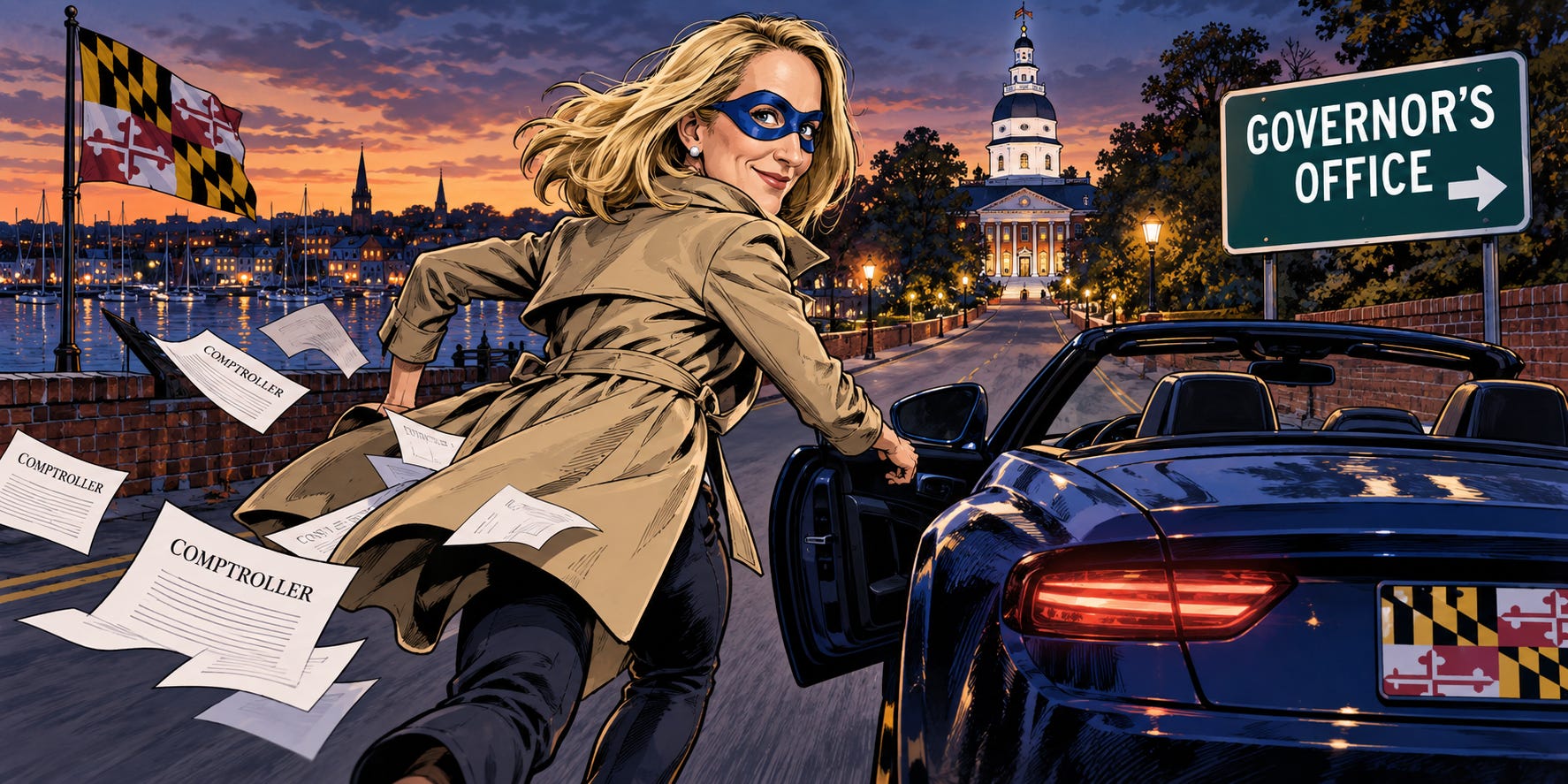
Marylanders waited for refunds while their comptroller accumulated publicity, political money and statewide visibility. Was the Comptroller’s Office the destination, or merely the vehicle?
There is a particular kind of political caper that does not require ski masks, getaway cars or somebody leaving Annapolis with a sack marked “taxpayer money.”
It happens in plain sight.
The politician obtains public office, gives the institution a makeover, places her name and image everywhere, travels the state under the banner of public service and emerges several years later with the organization, visibility and fundraising network necessary to seek an even larger office.
Nothing is necessarily stolen in the traditional sense. The prize is political capital, and the public provides the platform.
That is the question surrounding Maryland Comptroller Brooke Lierman. Did she enter the Comptroller’s Office principally to administer Maryland’s taxes, or did she recognize that the office could become a publicly supported launching pad for a future campaign for governor?
No public record presently proves that Lierman has decided to run for governor. Nor is there proof that she illegally diverted government money into a political campaign. What the record does show is a highly personalized statewide political operation growing alongside tax delays, customer service complaints, technology problems and costly legal setbacks.
The Comptroller’s Office was certainly modernized.
It was also Brookeified.
First, Even the Walls Changed Color
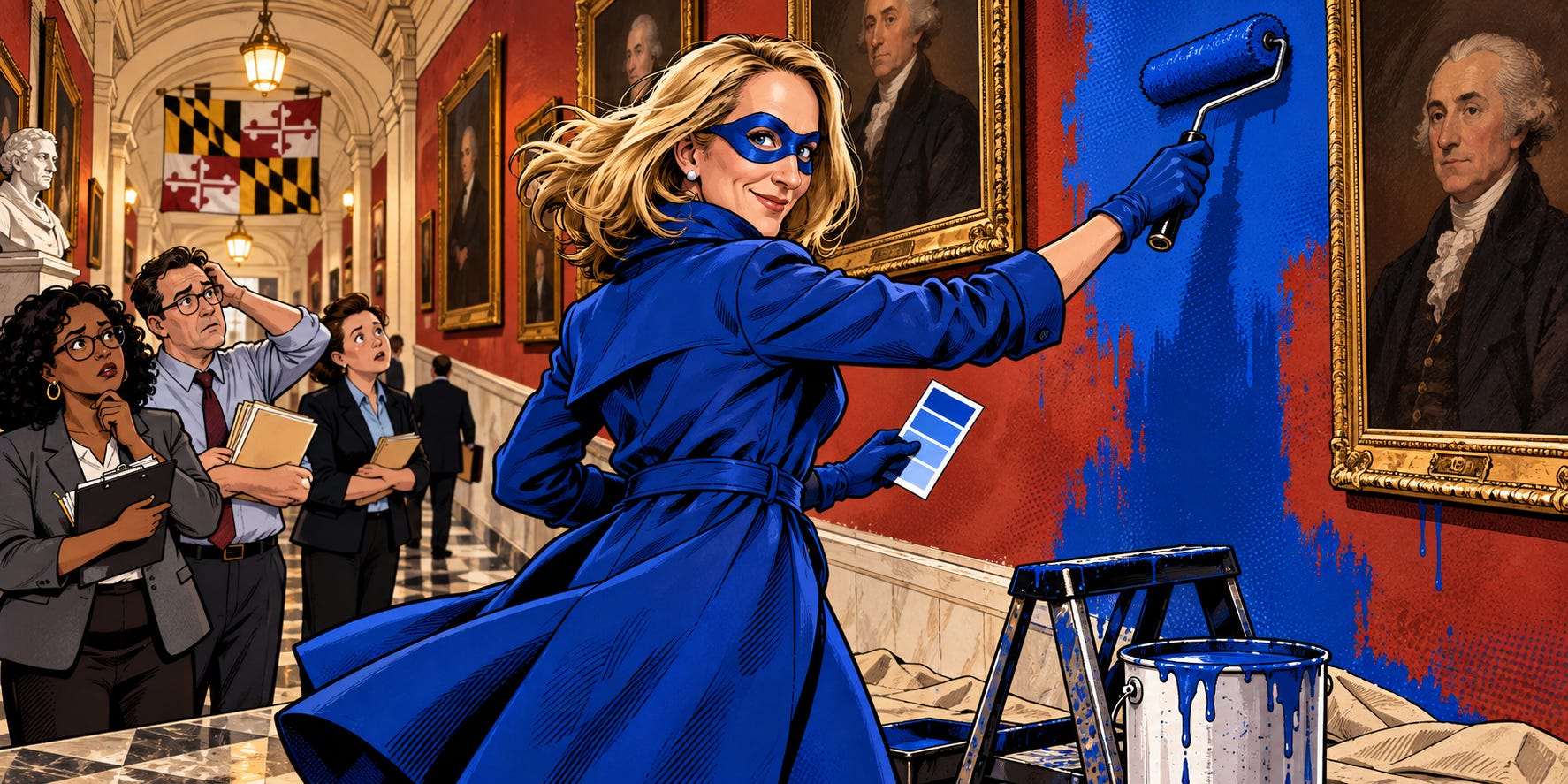
The political transformation may have begun with something as ordinary as a can of paint.
Employees familiar with the Louis L. Goldstein Treasury Building say that during Peter Franchot’s administration, the hallway displaying portraits of former state financial officers was painted a traditional rust red. After Brooke Lierman took office, the hallway was repainted blue.
Blue is one of the colors prominently featured in Lierman’s campaign branding.
No, Brooke Lierman did not invent blue. Democrats have been using it since cable news decided every political thought needed a color code. Painting a government hallway blue is not, by itself, illegal, unethical or proof of a secret gubernatorial plot.
But context matters.
This was not a private campaign office. It was a hallway inside a taxpayer owned building named for Louis Goldstein, Maryland’s legendary comptroller. The hallway commemorates the history of Maryland’s financial leadership. It was changed from its longstanding rust red to a color associated with the newest officeholder’s political brand.
Apparently, peaceful transitions of power now come with a trip to Sherwin Williams.
The public deserves to know:
Who ordered the repainting?
Who selected that particular shade of blue?
Did the shade match a color identified in Lierman’s campaign branding materials?
Did any campaign consultant or political communications professional participate in the decision?
Was the repainting part of routine maintenance or a broader rebranding project?
How much did the work cost?
Were other signs, photographs and public areas redesigned at the same time?
A coat of paint cannot establish political intent. It can, however, serve as a striking symbol.
Brooke Lierman did not merely move into the Comptroller’s Office. The office began to look increasingly like Brooke Lierman.
Then Marylanders Had to Wait for Their Own Money
While the walls received attention, Maryland’s tax-processing operation encountered a much less flattering makeover.
In early 2024, Maryland began accepting individual income tax returns while delaying the processing of refunds as the state introduced Maryland Tax Connect. The new portal reportedly launched approximately two weeks into the tax season. WBAL-TV reported on the delayed refunds and questioned the timing of the portal’s launch.
The old tax-processing technology unquestionably required replacement. The systems were decades old, and modernization was necessary. But “the old system was old” does not answer the central management question:
Why was a critical technology transition allowed to interfere with the timely processing of Marylanders’ refunds?
The state was ready to accept returns before it was ready to process the resulting refunds.
That arrangement was convenient for the state. Maryland could receive taxpayer information while taxpayers waited for Maryland to return their money. Government has always enjoyed a payment policy best summarized as, “Your deadline is mandatory. Ours is aspirational.”
For many families, a refund is not bonus money. It pays rent, repairs a vehicle, catches up a utility bill or replaces groceries purchased on a credit card. A delay imposed by the government therefore has consequences far beyond an inconvenient portal message.
A Signature Modernization Project With a Long Runway
Tax Connect did not arrive through one clean and uneventful launch.
The Comptroller’s Office implemented it through multiple phases. The office’s own website states that all Maryland tax-processing systems were not transitioned to Tax Connect until September 1, 2026. Comptroller of Maryland
A phased implementation is not inherently improper. Large government systems are complicated. But a project touching tax accounts, business filings, payments and individual income tax returns should be judged by measurable results, not celebratory press releases.
Marylanders deserve complete answers:
How many returns were delayed during each phase?
What caused each delay?
How many accounts were incorrectly coded or associated with incorrect information?
How many taxpayers received erroneous notices?
How many payments were incorrectly applied?
How many people were unable to reach the office for assistance?
What was the average call waiting time?
How many callers abandoned their calls?
What defects remained unresolved when each phase went live?
Did the contractor satisfy its performance requirements?
Did the state recover money from any vendor responsible for defects or delays?
Were taxpayers reimbursed when a state-created problem caused them financial harm?
The office has described recent processing seasons as fast and successful. Those claims should be measured against complete operational data, including the people whose returns were not processed quickly.
Government should not be permitted to grade its own homework, award itself an A and then refuse to show the class how many pages were missing.
Customer Service Is Also Part of Modernization
Technology problems become customer service problems the moment a taxpayer cannot reach a human being.
Public complaints have described delayed refunds, inaccessible information and difficulty reaching the Comptroller’s Office. When an agency replaces decades-old technology during tax season, additional customer support should be operational before the transition begins.
A modern portal is helpful.
A modern portal that produces a problem and then directs the taxpayer to a telephone line nobody answers is simply an old government headache wearing newer software.
This matters politically because Lierman made modernization one of the defining promises of her administration. She cannot claim personal ownership of every ribbon cutting, dashboard and successful processing statistic while treating disruptions as inherited complications produced by somebody else.
If it carries her name when it succeeds, it belongs to her administration when it fails.
The Digital Advertising Tax Disaster
The technological problems were not the office’s only tax-related embarrassment.
Maryland’s digital advertising tax was enacted before Lierman became comptroller, so she cannot fairly be blamed for creating it. She did, however, become the official charged with administering and defending the collection of the tax.
In August 2025, the United States Court of Appeals for the Fourth Circuit ruled that a provision restricting how companies could identify the tax on customer invoices violated the First Amendment. The court concluded that Maryland could not suppress criticism by preventing businesses from telling customers that a price increase resulted from the tax. Reuters
In August 2026, the Maryland Tax Court went further. It struck down the tax and ordered refunds to companies including Apple, Google and Peacock TV. The court found that the tax violated the federal Internet Tax Freedom Act as well as constitutional protections involving speech, interstate commerce and due process. Associated Press
The tax had been expected to generate approximately $250 million annually for education.
Instead, Maryland now faces questions about refunds to some of the richest corporations on Earth.
Only state government could devise a plan intended to collect money from Big Tech for public schools and end up potentially returning the money after spending years administering and defending the tax.
The unanswered questions include:
How much has Maryland collected?
How much may have to be refunded?
Could the state owe interest?
What did administration and litigation cost?
What warnings did the Comptroller’s Office receive?
Did Lierman recommend legislative changes to address those warnings?
What contingency plans existed for an adverse judgment?
How will the loss affect education funding and future revenue estimates?
Lierman did not write the original law, but leadership is not merely standing near successful policies and several feet away from unsuccessful ones.
The Office Became a Statewide Publicity Platform
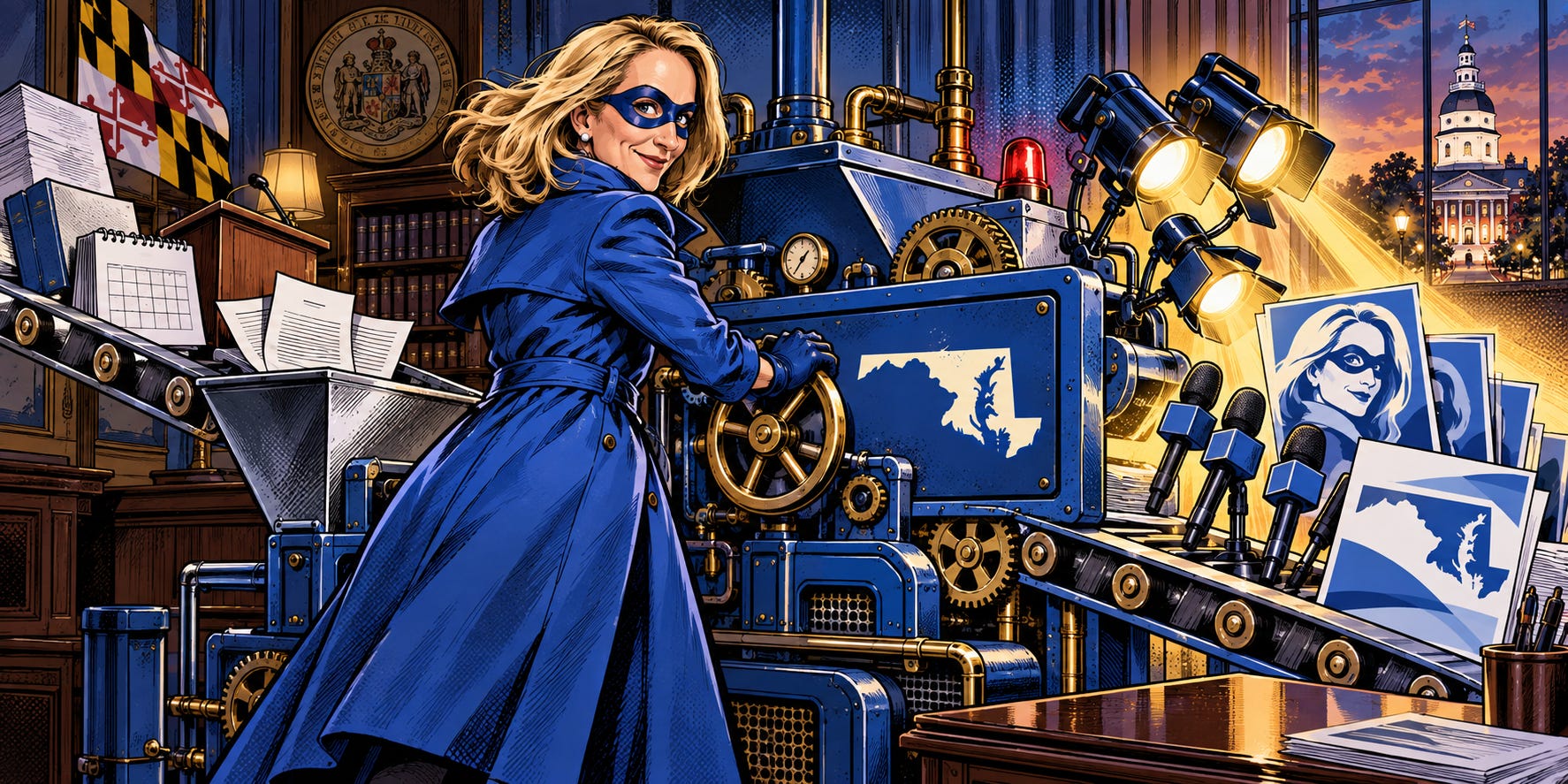
The official Comptroller website heavily features Lierman’s photographs, appearances, initiatives, newsletters, economic presentations, social-media materials and opportunities for public engagement. Some personal visibility is unavoidable for an elected official, but the cumulative presentation feels less like a tax agency and more like the early architecture of a statewide political brand. Comptroller of Maryland
The campaign website makes the overlap particularly noteworthy. It invites people to participate as Lierman travels the state or in connection with her work as comptroller. Brooke Lierman campaign website
That does not prove public employees performed campaign work. It does show how seamlessly the campaign treats her government activity as a political asset.
The Comptroller’s Office provides nearly everything an ambitious Maryland politician needs:
A statewide title
Regular press coverage
Taxpayer-funded communications personnel
Official events in every region
Access to business owners and local officials
Economic reports that create reasons for public appearances
Membership on the Board of Public Works
A platform for questioning the governor
A permanent reason to discuss every Marylander’s money
The office may be responsible for taxes, but politically it is an all-inclusive statewide tour package.
The Money Looks Larger Than a Routine Comptroller Campaign
Lierman also built a substantial political treasury.
Campaign-finance information attributed to the Maryland State Board of Elections showed that as of January 2026, Lierman had raised approximately $2.95 million and retained roughly $2.19 million. She was running for reelection as comptroller, but the size of the operation also gave her the resources and donor relationships necessary for a future statewide race.
Raising money is legal. Preparing for future elections is legal. Ambition is not corruption.
Still, an enormous political account combined with statewide travel, constant public branding and an office redesigned around the elected official naturally creates a question:
Was Lierman building a campaign merely large enough to remain comptroller, or one flexible enough to become something else?
The Moore Fault Line: Partner in Public, Competitor in Waiting?
The public record does not show open warfare between Lierman and Governor Wes Moore. It shows broad cooperation combined with carefully selected moments of independence.
That is politically smarter.
The clearest example came in August 2025, when Lierman raised concerns about a proposed $300 million information-technology contract. She questioned competition, transparency and whether the structure disadvantaged Maryland agencies and Maryland businesses. The Board of Public Works approved the contract despite her concerns. News From the States
Her questions may have represented exactly the type of fiscal oversight a comptroller should perform. They also positioned her publicly as the transparency watchdog while the Moore administration defended a very large contract.
Both interpretations can be true.
The Board of Revenue Estimates provides another platform. As a member, Lierman participates in announcing revenue projections that directly affect Moore’s budgets. In March 2025, Maryland’s projected revenue was reduced by approximately $280 million across fiscal years 2025 and 2026, deepening the fiscal crisis confronting the governor. Lierman became one of the officials publicly explaining the state’s deteriorating financial outlook. The Washington Post
That creates a politically useful division of labor:
Moore proposes, spends and accepts responsibility for the budget.
Lierman counts, warns and asks questions.
If Maryland’s finances improve, she can claim responsible stewardship. If they deteriorate, she can say that she warned everyone.
That is not proven sabotage. It is excellent political positioning.
The Record Also Shows Cooperation With Moore
Any fair article must acknowledge that Lierman has frequently supported Moore’s administration.
Board of Public Works transcripts regularly show Lierman moving to approve administration agendas while Treasurer Dereck Davis seconds the motion. Moore also gave Lierman the floor during the October 22, 2025 meeting to announce a new procurement-transparency dashboard. October 22, 2025 Board of Public Works transcript
In February 2026, Moore, Lierman and Davis jointly demanded federal reimbursement for tariffs they described as illegal. Governor’s Office
The documented relationship is not one of constant hostility. It resembles a governing partnership in which Lierman generally cooperates while maintaining enough independence to create her own political identity.
She does not have to destroy Moore to prepare for a future after Moore.
She only has to remain close enough to share popular successes and far enough away to avoid owning every failure.
The Davis Fault Line: Who Owns Maryland’s Financial Identity?
Evidence of a personal feud between Lierman and Treasurer Dereck Davis is even thinner. Public Board of Public Works proceedings frequently show them cooperating, agreeing and approving the same agenda items.
The more credible tension is institutional.
Davis is Maryland’s State Treasurer. He is the principal custodian of the state’s cash, investments, securities and collateral. He manages critical banking, debt and investment responsibilities and serves independently on the Board of Public Works.
The Comptroller collects taxes, maintains accounting records, processes state payments and countersigns checks drawn by the Treasurer.
The jobs overlap, but they are not interchangeable.
Lierman’s public branding repeatedly places her at the center of Maryland’s financial identity. Her office produces economic reports, transparency initiatives, business programs, tax campaigns and statewide presentations while describing the comptroller as Maryland’s chief financial officer.
That framing can leave the public wondering whether the Treasurer is the person who manages Maryland’s money or simply the gentleman sitting beside Lierman at Board of Public Works meetings.
The institutional questions are significant:
Who speaks for Maryland after a bond-rating decision?
Who receives credit for responsible financial management?
Who leads public discussions about state debt?
Who represents Maryland’s financial position to investors?
Who receives visibility when major financial programs are transferred?
Does the Comptroller’s public messaging accurately distinguish her responsibilities from those of the Treasurer?
Has Lierman’s office entered policy or communications territory traditionally associated with the Treasurer?
The conflict does not require a public argument.
Davis can continue holding Maryland’s money while Lierman works to own the public story about it.
Maryland’s Lost Moody’s Triple-A Rating
In May 2025, Moody’s lowered Maryland’s general obligation rating from Aaa to Aa1, ending a rating the state had maintained with Moody’s since 1973. Moody’s cited economic and financial underperformance, vulnerability to federal changes and elevated fixed costs. Associated Press
The downgrade was not caused solely by Lierman, Moore or Davis. Maryland’s dependence on federal employment and spending was a major factor, as were broader budget pressures.
But the political response demonstrates the competition over financial identity.
Moore had to defend his administration.
Davis had to address the implications for borrowing and debt management.
Lierman could use the moment to reinforce her image as the official explaining fiscal danger.
In a future gubernatorial campaign, that distinction could become a ready-made message: the comptroller who saw the problems clearly while everyone else was managing them.
Was the Comptroller’s Office Ever the Destination?
There is no public confession announcing a future Lierman campaign for governor. Politicians rarely mail those in advance.
Intent must be inferred carefully from conduct:
She left the legislature for statewide constitutional office.
She built a multimillion-dollar political organization.
She expanded her visibility throughout Maryland.
Her government work became central to her campaign presentation.
Her official communications emphasized her personal leadership.
The historic headquarters reportedly changed from rust red to one of her campaign colors.
She developed an independent fiscal identity alongside the governor.
She expanded the Comptroller’s public profile into territory overlapping the Treasurer’s financial role.
None of this proves illegality.
Together, however, it supports a legitimate question about whether the office was being administered primarily as an institution or cultivated as an asset.
Sabotage, Oversight or Something More Sophisticated?
The available evidence does not prove that Lierman intentionally sabotaged Moore or Davis.
Her objections to state contracts can be legitimate oversight. Her revenue warnings can be part of her statutory responsibilities. Her public engagement can educate taxpayers. Her blue hallway can be ordinary decorating. Her campaign money can be intended solely for reelection.
But politics rarely arrives with one document labeled “The Plan.”
The more plausible concern is not crude sabotage. It is strategic differentiation.
Lierman can support Moore on most matters while selecting certain contracts, revenue forecasts and transparency issues on which to appear more cautious than his administration. She can cooperate with Davis while expanding her office’s public profile until Marylanders begin associating nearly every state financial function with her.
She does not need to attack either man directly.
She merely needs to benefit from their vulnerabilities.
The Questions Maryland Should Ask
Before Maryland accepts the official story of modernization and progress, the Comptroller’s Office should disclose:
Tax Connect defect reports and implementation warnings
Refund-processing times for every filing season under Lierman
The number of delayed, suspended or incorrectly coded returns
Call-center staffing, waiting times and abandoned-call rates
Contractor performance reports and corrective-action plans
Communications between official employees and campaign vendors
Official travel schedules and associated public expenses
Contracts for branding, photography, communications and social media
Records concerning the repainting of the Goldstein building
The paint manufacturer, product, shade and color code
Communications containing the words “blue,” “brand,” “branding,” “Brooke,” “campaign color,” “hallway” or “Goldstein”
Records describing how the Comptroller’s functions are distinguished from those of the Treasurer
Communications concerning future statewide office, gubernatorial plans or 2030
If the repainting was routine, the records will show that.
If official work and campaign strategy remained completely separate, the records will show that too.
Transparency should not be difficult for an administration that built an entire brand around transparency.
The Caper
The central allegation is not that Brooke Lierman walked into the Goldstein building and carried Maryland’s treasury away.
It is that she may have recognized something more valuable than the money stored or managed inside it: a taxpayer-supported statewide platform capable of producing years of publicity, relationships, photographs, events, policy credentials and political leverage.
Meanwhile, Marylanders experienced delayed refunds, technology frustrations and difficulty obtaining answers. A major tax suffered constitutional defeat. The state lost one of its triple-A credit ratings. Yet the public image remained polished, energetic and relentlessly forward-facing.
Even the walls had joined the campaign color palette.
The blue hallway does not prove the caper.
It may simply be where Maryland should begin looking.